Category Archives: Agriculture

The Agrihub, Online Agri Marketing Platform Launched

Hyderabad :

The Agrihub, the first agriculture-specific online discovery platform, was launched here on Monday. The platform, launched at the Agri Horti Tech International Exhibition, provides authentic product information on the best brands in conventional and hi-tech agriculture and connects companies or brands, distributors and retailers to cater to the needs of farmers in India.

Sidharth Kumar, co-founder of TheAgrihub, said: “One of the leading causes of inefficiency in farming is the lack of proper knowledge and access to correct resources. We, as urban customer, have option to select things we need from five various platforms but farmers, who feed the world, do not have a single website from where they can get authentic information. With this platform, TheAgrihub has a vision to expose its users to the best of global technologies enabling the growth of farmer as well as agriculture as a whole.”

“The objective of TheAgrihub is to bring agricultural products sourcing for B2B and B2C on fingertips, help them track innovations or products and also find suppliers next door to facilitate educated decisions on purchase. ‘If you are in the field of agriculture, you have to be on TheAgrihub platform’ is what our team wishes to promote.”

The platform has already signed up with over 3,600 hi-tech agricultural farmers and many prominent brands. Seeds and plants of fruits, flowers and vegetables, irrigation products, fertilisers and plant protection products, farm tools and equipment, polyhouse are some of the products listed on the platform.

source: http://www.newindianexpress.com / The New Indian Express / Home> States> Telangana / by Express News Service / April 26th, 2016
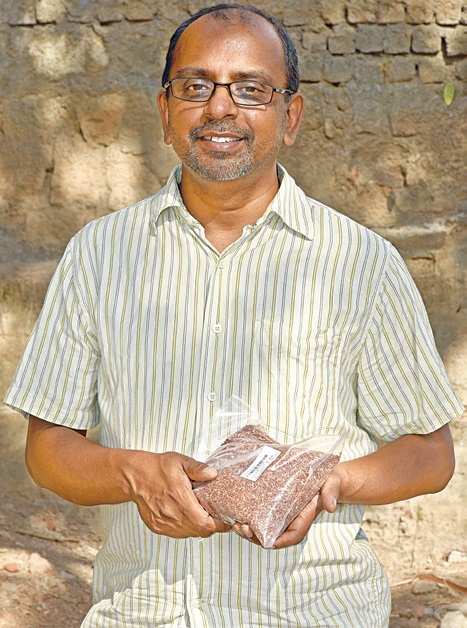
Hopped up on Seeds, Crops and Hope

GoodSeeds01TELAN27apr2016

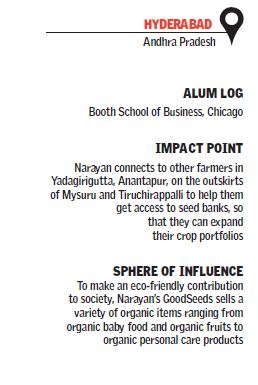
When Narayan Murthy came to India from the United States, he didn’t know that he would end up retracing his roots, in a journey that would last forever.

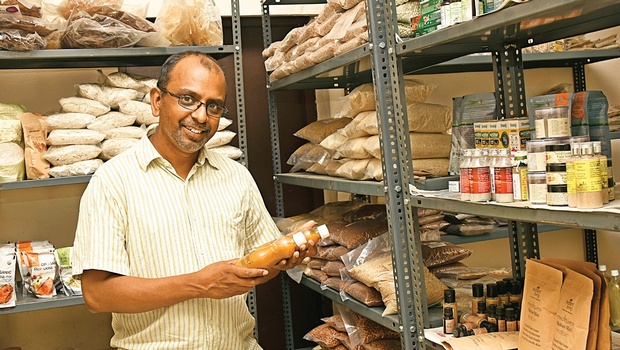
A management consultant by profession, he is the founder of GoodSeeds, an organisation that sells organic food and home products. And it doesn’t end there.

Narayan works closely with farmers across the region to help them find a platform where they can find buyers and connect with other farmers for better reach and productivity.

Says Narayan, “I left India in 1992 and went to the US for higher studies and a job. I completed an MBA from Booth School of Business, Chicago, after which I started working as a management consultant. I was earning quite a decent package and monetarily I was very sound. But there was a voice in my head which kept on telling me that this is not what I wanted to do. But I didn’t know what it was that I was looking for.” That’s when he decided to come back to India and spend a few years here, “I came back and after a year or so, I realised that it was my roots that I had been missing.”

Narayan Murthy, founder of GoodSeeds, which sells organic food and home products

Originally from Chennai, Hyderabad is now his home. But how did he land up here? He answers with a chuckle, “I got a job here in Microsoft as a strategic planner in 2008. Now this city is my home.”

It so happened that one day his friend complained about how good organic food is not available in Hyderabad. Since Narayan was already wondering what to do with himself, the idea appealed to him. Thus was born GoodSeeds in the year 2012. “The name came about because it was about sowing good ideas about what we eat, drink, who we live with and where we live,” adds Narayan. Sort of an eco-friendly contribution to society.

While the company sells a variety of organic items ranging from organic baby food and organic fruits to organic personal care products, farmers often come to them to gain market connections, “Many farmers get in touch with me. I connect them to the market and customers who choose to buy organic products. This way they are able to connect to other farmers as well. We also help them get access to seed banks, so that they can expand their crop portfolios,” informs Narayan.

GoodSeeds03TELAN27apr2016

He goes with farmers to different areas like Yadagirigutta, Anantapur, outskirts of Mysuru and Tiruchirappalli (Tamil Nadu) for advise and to network. As a result of his efforts, farmers are coming closer and becoming part of co-operatives. Narayan adds further, “It’s beneficial that small farmers become part of small co-operatives. For example at Timbaktu, Anantapur there’s a small co-operative of 40 farmers. A farmer can’t do everything alone. If he tries everything and it goes wrong then unfortunately it will be him who will starve. These days people give their lands to farmers on lease to grow crops. In return, the farmers are paid on a monthly basis. So, even if there’s a drought, farmers will get their money and manage to keep their respect intact, as well.”

They also encourage things like the Sunday organic bazaar held at Saptaparni, Lamakaan, Our Sacred Space and Goethe Zentrum, where farmers sell everything from organic fruit to staples like rice. It’s probably not as fancy as the farmers’ markets in the US, but hey, with people like him around — it may become a reality sooner than you think!

source: http://www.newindianexpress.com / The New Indian Express / Home> Education> Edex / by Saima Afreen / April 25th, 2016

Dual delight intrigues botanists

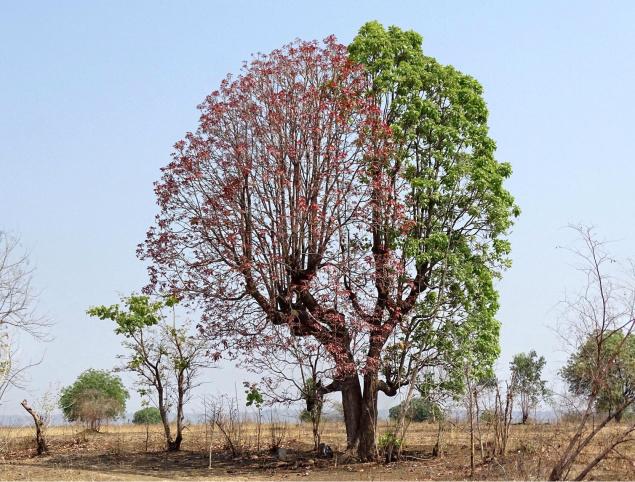
Bi-coloured wonder:A mahua tree with dual coloured foliage.–Photo: S. Harpal Singh

The mahua or ippa tree can be seen on the Utnoor-Asifabad road in Adilabad

Many miss this natural wonder while zooming past on the Utnoor-Asifabad road in Adilabad, but those who do spot the colourful tree, stop to marvel at its beauty. A majestic mahua or ippa tree, located about 500 metres from Heerapur village in Utnoor mandal, towards Jainoor, is a visual delight and scientific curiosity — half the tree has red-brown leaves while the other half has green leaves.

The tree retains this dual foliage from the end of March for about a month, soon after it sheds its flowers.

Adilabad has an estimated five lakh mahua trees, mostly in the tribal belt. The mahua flowers have medicinal value and form a major non-timber forest produce for the forest dwelling Gond and Kolam tribal communities.

The tree bears two differently coloured leaves at the same time apparently because it has a dual leaf development stage. “This could be because of two different seeds joining at the time of germination but retaining individual characteristics of growth on maturity,” said a forest department official of the rare phenomenon.

The tree is about 40 years old, according to villagers. “It was a young tree when I was a child,” recalled Atram Shankar, a 40-year-old Gond farmer from Hasnapur village, about 2 km from the bi-coloured beauty.

The Forest department has taken note of the tree with the rare foliage and Forest Range Officer of Utnoor, P. Ramesh Rao and others have visited the place to document the occurrence.

source: http://www.thehindu.com / The Hindu / Home> National> Telangana / by S. Harpal Singh / Adilabad – April 18th, 2016

Popularising the farm pond concept

In an effort to popularise farm pond concept, Komatireddy Pratheek Foundation dug up a farm pond at farmer Kola Bikshamaiah’s field at Kakulakondaram village of Nalgonda mandal here on Sunday.

Pratheek Foundation had started closely working with Deshpande Foundation, which has been actively working on rain water harvesting in Nizamabad and Maharastra.

CEO of Pratheek Foundation M.V. Gona Reddy said that they simply want to replicate the work of Deshpande Foundation in the district for the benefit of the farming community.

The chairman of the foundation and Nalgonda MLA Komatireddy Venkat Reddy said they were planning to initiate several skill enhancement programmes for the youth in the district to improve their employability. “They would also concentrate on maternal health, student leadership, micro-entrepreneurship and livelihood opportunities,” he said.

Several skill enhancement programmes planned to improve employability.

source: http://www.thehindu.com / The Hindu / Home> National> Telangana / by Staff Reporter / Nalgonda – April 18th, 2016

Seed is better preserved this way

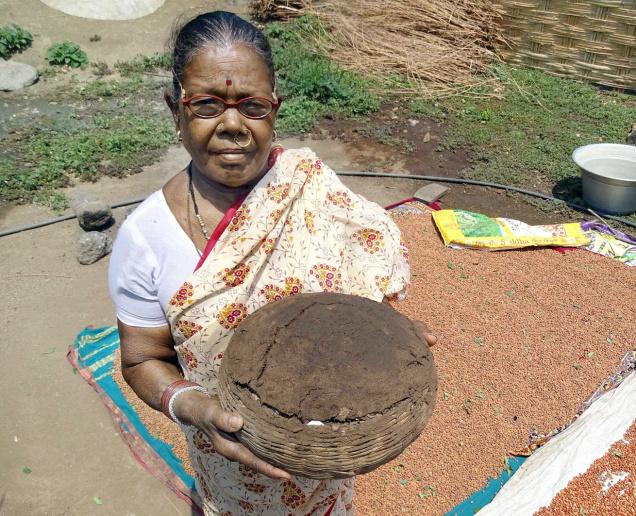
WAY FORWARD:tram Laxmibai displaying the airtight basket with seeds-Photo: S. Harpal Singh

Effective procedure of Adivasis to preserve seed for cultivating millets needs to be popularised

One of the important aspects of biodiversity conservation is seed preservation but, this area is perhaps the least bothered about in the gamut. While the non-tribal farming communities have jettisoned seed preservation technique completely after taking to foodgrain hybrids, the Adivasis in Adilabad district find no use for it despite the instance of cultivating desi or indigenous varieties.

As there is a sort of revival of the tradition of cultivating local varieties of millets by the aboriginal tribe farmers in the interior and far flung areas in the tribal belt, the need to revive the seed preservation technique has become imperative. Preserving seed could also help farmers in reducing their investment, according to agriculture experts.

“We are cultivating local variety millets in a limited extent which does not require us to preserve seeds beyond a few months. The little quantity of seeds which we get in one season is used up in the ensuing season,” explained Atram Madhav Rao, a Gond Adivasi farmer from Seetagondi village in Sirpur (U) mandal.

“I have some quantity of sama (little millet) and bhadi (barnyard millet) from 12 years back,” revealed Laxmibai, Madhav Rao’s mother. “Using this technique I can preserve seeds for longer even,” she added.

The technique which Laxmibai talked about is simple yet effective going by its potential to preserve seed. The seed which are needed to be preserved are stored in an airtight bamboo basket. The basket, its size varying with the quantum of seeds to be stored, is first lined with a thick layer of neem leaves from the inside. A thick layer of ordinary ash is covered over it and the seeds are placed over it.

After closing the lid of the basket, it is smeared with clay mixed cow dung to make it air tight.

“This mixture ensures that the seed remain without decaying or losing their potency to germinate over a long period,” Laxmibai stated.

The Integrated Tribal Development Agency (ITDA), Utnoor, will now take up awareness programmes aimed at reintroduction of the simple seed preservation technique among the Adivasis where it is promoting cultivation of desi varieties of millets.

“We need to do so, so that farmers who are cultivating the local varieties get self-sufficient in terms of seeds at the earliest,” observed ITDA Project Officer R.V. Karnan.

The ITDA is promoting cultivation of indigenous millets under the Vanabandhu Kalyan Yojana. It has procured seed from Adivasi farmers and distributed in areas where the tradition had been lost.

source: http://www.thehindu.com / The Hindu / Home> News> National> Telangana / by S. Harpal Singh / Adilabad – April 15th, 2016

Kadaknath breed of rooster to foray into Khammam

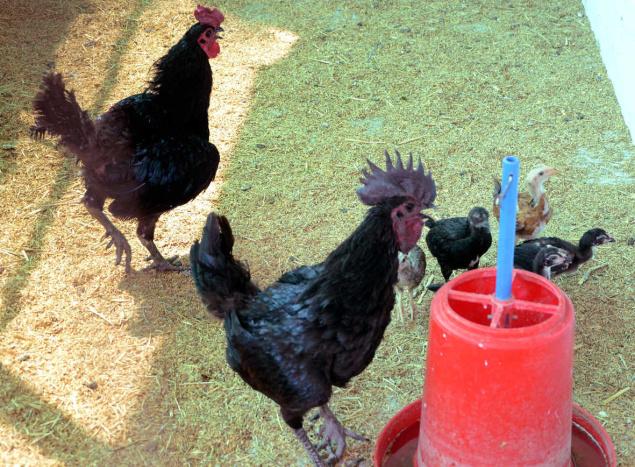
Seeking popularity:The Kadaknath breed of roosters at the demonstration unit of the Krishi Vigyan Kendra in Wyra of Khammam district.– PHOTO: G.N. RAO

Known for its unique black colour and black meat, the rooster suits the taste and preference of health-conscious people

The unique jet black coloured rooster christened ‘Kadaknath’ – the indigenous fowl breed of tribal heartland in Madhya Pradesh – is all set to foray into the predominantly tribal-populated Khammam district if the ambitious plans of the Wyra-based Krishi Vigyan Kendra (KVK) to popularise the low-fat and protein-rich native breed of chicken among local farmers are any indication.

The KVK has a small number of Kadaknath roosters known for their unique black colour and black meat that suits the taste and preference of health conscious people. Kadaknath breed of fowls stands out from other popular native variety of roosters at the demonstration farm of KVK by virtue of their unique jet black colour

The Kadaknath breed rooster acclaimed wide popularity in various parts of the country as a viable means of boosting income levels of rural households through backyard poultry farming.

Several farmers from various mandals in Khammam division evinced keen interest in the breed during a demonstration organised by the KVK scientists in Wyra recently.

Gauging farmers’ interest in the indigenous breed of rooster, KVK officials have drawn up plans to hold more demonstrations to highlight the benefits of rearing Kadaknath breed of fowls in terms of income and nutritional value among low-income families, particularly in tribal pockets of the district.

The breed is most suitable for backyard poultry rearing considering the low investment involved and good returns assured by it, says Hemanth Kumar, programme coordinator, KVK, Wyra.

Some farmers are rearing Kadaknath breed fowls in Sattupalli in Khammam district and a few other places elsewhere in the State, besides Tadepalligudem in West Godavari district of Andhra Pradesh.

Efforts are under way to popularise and promote backyard rearing of indigenous breed of roosters such as Kadaknath, Giriraja and Vanaraja to supplement the income of rural households and cater to the demand for eggs and meat

The protein-rich Kadaknath black meat contains low fat compared to other breeds of chicken, particularly the broiler variety.

This makes the Kadaknath breed most suitable for backward rearing to supplement income and serve nutritional needs of tribal people, he remarks, adding that farmers were being given tips on taking up backyard country chicken farming.

Inadequate availability

Inadequate availability of Kadaknath chicks and lack of proper financial support are posing major hurdles in undertaking backyard poultry farming using the most sought-after Kadaknath roosters, deplores Suresh, a tribal farmer of Venkatapuram.

The government agencies concerned should provide Kadaknath chicks free of cost and extend subsidies to exclusively promote the farm enterprise in remote tribal pockets of the district, he suggests, asserting that such a move would help check drought-induced migration in Agency areas.

source: http://www.thehindu.com / The Hindu / Home> National> Telangana / by P. Sridhar / Khammam – April 14th, 2016

Ryot Takes Organic Way, Uses Cow Urine to Increase Productivity

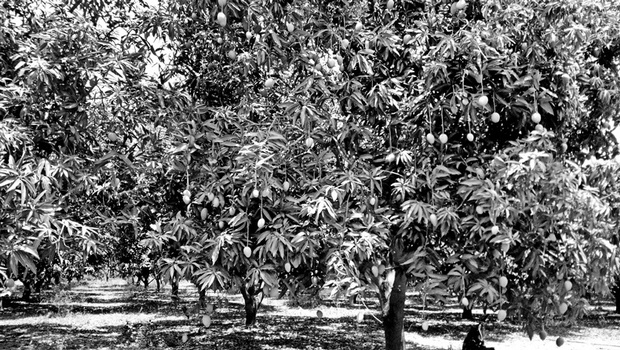
The mango orchard of Guda Narsimha Reddy in Karimnagar.  I EXPRESS PHOTO
The mango orchard of Guda Narsimha Reddy in Karimnagar. I EXPRESS PHOTO

Karimnagar :

At a time when the farming community is in dire straits over the drought conditions, here is a progressive farmer who is reaping dividends by making the most of organic farming methods.

Meet the forty-four year Guda Narsimha Reddy of Katukur village in Bheemdeverapalli mandal, whose success mantra in getting a good yield in his mango crop is simple – use cow urine, dung and organic fertilisers.

CowTELAN09apr2016

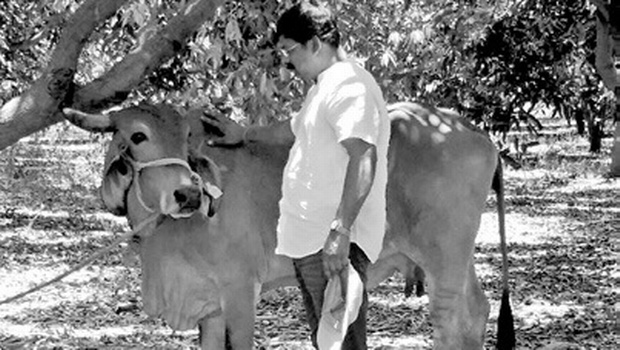
Narsimha Reddy rears Gir cows brought from Gujarat in his orchard. He collects the cow urine in a storage tank and through drip irrigation and supplies the same to the mango trees as a substitute for water. For the specific purpose of storing cow urine, he constructed a 450-liter sump at his cow shed in the mango orchard. And he uses the cow dung too for farming. He burns the dried dung cakes under the mango trees once a month to kill pests.

Setting aside traditional farming, he adopted new methods like drip irrigation, organic cultivation and pruning the trees after plucking mangoes. Since last five years, he is cultivating mango crop in 10 acres and has raised about 500 mango trees. With his systematic water management and usage of organic fertilisers, he has become an inspiration to other farmers.

Surprisingly, other farmers in the village are also having mango orchards but they are not exceeding three tonnes per acre of produce, in view of the prevailing dry spell. However, Reddy has overcome such hurdles and succeeded in raising a robust crop of Banganapalli variety and exports it to Delhi and Nagpur every year.

Speaking to Express, Narsimha Reddy said presently his crop yield is 10 tonnes per acre, and he plans to increase it to 15 tonnes. This year, he claims to have spent just Rs.1 lakh for crop cultivation, and earned returns over Rs.18 lakh.

Katukur village is an upland area with no water sources, except for borewells that have to be dug hundreds of feet. Though he had finished graduation, since childhood, he had a passion for cultivation.

source: http://www.newindianexpress.com / The New Indian Express / Home> States> Telangana / by Naveen Kumar Tallam / April 08th, 2016

This progressive farmer’s effort pays off

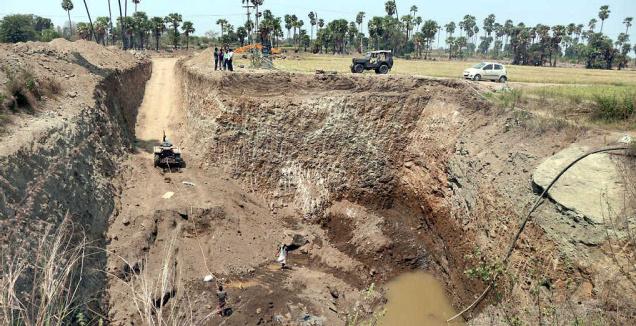
Timely returns:The water harvesting pit in the farm of S Jayapal Reddy of Kesamudram in Warangal district.–Photo: M. Murali

Farm pond dug up in Jayapal Reddy’s field three years ago begins to yield water

To spend Rs. 10 lakh to dig a farm pond is not possible to every farmer. But S Jayapal Reddy, who with a fond hope of harvesting water, went on and dug up a huge open pit.

“I have about 50 acres land here but as there was no water I embarked upon the task of getting a water harvest pit dug up in my land about three years ago. The pit is 30 feet deep and 100 feet wide.

This effort started yielding some water which is enough to irrigate about 10 acres,” he explained. He draws water with three motors for about five hours daily to wet his paddy fields. He strongly argues in favour of massive plantation and digging up water harvesting structures everywhere to conserve every drop of water.

According to him, the huge trench in his fields also helps recharge bore wells and open wells around his fields belonging to other farmers.

There were no proper rains for the past three years. As a result , he groundwater table also went down and with no irrigation water in these parts of the mandal, the farmers were finding it difficult to continue farming operations with meagre water in extreme weather conditions.

Going by the advice of scientists, many decided to opt for farm ponds, recharge pits and trenches in fields to hold little water when it rained.

“We hope to get good rains this year. But not much is being done to hold as much as possible.

Motivating others

Here we are motivating farmers to opt for farm ponds and rain water harvesting pits wherever possible,” Mr Jayapal Reddy explained.

source: http://www.thehindu.com / The Hindu / Home> National> Telangana / by Gollapudi Srinivasa Rao / Kesamudram (Warangal Dt) – April 26th, 2016

Icrisat Unveils Green Phablet for Farmers

Hyderabad :

To improve productivity and profitability of small farmers in the state, the state government and the International Crops Research Institute for the Semi-Arid Tropics (Icrisat) have joined hands to implement Information and Communication Technology (ICT)-based knowledge sharing platforms and other agricultural innovation initiatives.

The collaboration was launched during the Digital Telangana Week.

As part of this, a Phablet was launched through which small farmers can have tips on the kind of agricultural inputs they require for their fields.

Based on specific soil health of the lands of a farmer, the scientists at the Icrisat and the government will send timely messages to the farmers through the phablet.

The phablet is a smart device bigger than a phone but smaller than a tablet.

Icrisat launched the Green Phablet which comes for around `18,600. Icrisat will maintain servers to safe keep the information.

A tripartite Memorandum of Understanding (MoU) was signed between two state government departments — department of Information Technology, Electronics & Communications and department of Agriculture and Cooperation — and Icrisat here on Tuesday.

The partnership will explore areas of collaboration in digital agriculture along with agriculture value chain and explore the possibilities of Icrisat playing an active role in the T-Hub, the incubator being launched by the state government.

The partnership will help launch innovative digital platforms that aim to revitalize information dissemination in rural areas, expert systems for providing real time advisories and better access to market information by smallholder farmers.

‘’Icrisat has been at the forefront of using the latest technology to benefit smallholder farmers of Asia and Sub-Saharan Africa. The digital agriculture initiative will allow information to be precisely targeted to individual farmers. This will help farmers to access agricultural related information and keep themselves up-to-date with market related information, which gives them an opportunity to sell their produce at fair prices, thus putting them on the path to prosperity,’’ Dr David Bergvinson, Icrisat Director General said explaining the proposed activities under the digital agriculture initiative.

The MoU was signed by C Parthasarathi, agriculture secretary, Jayesh Ranjan, IT secretary and Icrisat Director General Dr David Bergvinson in the presence of agriculture minister Pocharam Srinivasa Reddy and IT minister K T Rama Rao.

Speaking on the occasion, Rama Rao said ‘’Access to timely information and knowledge can help millions of farmers in Telangana to improve their yields, incomes and resilience since they can now make informed choices about good farming practices.’’

Rama Rao, however, felt that there is a need to bring down the cost of Phablet to `10,000 to make it affordable for farmers.

Pocharam Srinivasa Reddy felt that it is very appropriate to launch the digital agriculture activities at a time when use of digital gadgets is on the rise in rural areas.

source: http://www.newindianexpress.com / The New Indian Express / Home> States> Telangana / by Express News Service / July 08th, 2015

Traditional knowledge on biodiversity in Telangana being gathered

Hyderabad :

In the fledgling Telangana State, the aged are being approached to find out from them traditional knowledge pertaining to medical plants and the richness of the bio-diversity in the areas.

The Telangana State Biodiversity Board (TSBB) which was formed after the bifurcation of united AP, has sent well-equipped teams with technical knowledge to fan out into bio-diversity rich areas to gather complete information about forest areas, government land, lakes, and rivers. Specifically, photographs are to be taken of plants and animals.

Dr Shilpi Sharma, a regional biodiversity coordinator said considering the importance Ayurveda has gained, the aged are being specifically approached to find out from them about the medicinal value of plants in the area they live.

Talking to them about traditional knowledge and their experiences, the teams will document everything with photographs and statements.

The idea behind gathering all the information is to record the rich biodiversity in the areas, and check if still exists. The information will also help in taking measures to preserve the bio-diversity in the specific areas.

The TSBB constituted Biodiversity Management Committees (BMCs) to prepare what are called “People’s Biodiversity Registers” (PBRs) in 50 areas at the gram panchayat level in Adilabad, Karimnagar, Khammam, Mahbubnagar, Medak, Nalgonda, Nizamabad, Ranga Reddy and Warangal. Scientific institutions, NGOs and community-based organisations are also involved as Technical Support Groups (TSGs) with the BMCs to gather what will be a mine of information.

According to official sources a lot of information has been gathered at various places, even pertaining not only to the plant life but also insect life and microorganisms in the areas.

Interesting information also is coming out from people who are said to be parting with the traditional knowledge that they have acquired. Drying of fish today is mainly done by customized solar dryers but traditional knowledge provided an insight into how to do it in a better way without the use of solar dryers. The findings and knowledge will be well documented.

The National Biodiversity Board (NBB) has asked the biodiversity boards of all the states in the country and it has been going in for some years. Prior to united AP bifurcation in June last year, work pertaining to preparing “People’s Biodiversity Registers” had been taken up in all the districts.

However, with Telangana becoming a separate state, a fresh programme was begun a couple of months ago. Some preliminary information in the form of the PBRs is expected to be submitted in the next six months or so.

source: http://www.timesofindia.indiatimes.com / The Times of India / Home> City> Hyderabad / by Ch. Sushil Rao, TNN / June 18th, 2015