Category Archives: Business & Economy

Hyderabad buoyant on software exports

SoftwareTELAN10jul2015

Despite the bifurcation of the state, the software exports from the city are likely to touch Rs 64,000 crore during the current financial year 2014-15.

Hyderabad is the second largest software exporting city in the country after Bengaluru, and is forecast to grow by 13 per cent over last year.

Addressing the media on the sidelines of the announcement of the 23rd edition of the annual summit and awards of the Hyderabad Software Enterprises Association (HYSEA) here on Friday, Telangana IT, Electronics and Communications Secretary Harpreet Singh said that during 2013-14, the software exports from Hyderabad stood at Rs 57,000 crore.

“This year, we will be touching Rs 63,000 crore-Rs 64,000 crore in total IT exports, if 13 per cent growth rates happens,” he added. It is estimated that about 3.2 lakh people are working in the IT sector. “We expect another 20,000 employees to be added, taking the figure to 3.4 lakh during this fiscal,” the official said.

The HYSEA is holding its annual summit on March 11 and March 12 here. Elaborating on the initiatives taken by the Telangana government to promote the sector, Singh said, “We are setting up T-Hub, the country’s biggest technology incubation centre, which will facilitate start-ups to grow. This start-up system will see good number of IT companies originating from Hyderabad,” the official said.

Promoting skill

“We are trying to promote skill development to enhance the employability of students who are graduating from the engineering colleges here. We are looking at making graduates industry-ready,” he said adding “we are working with Jawaharlal Nehru Technological University (JNTU) to produce a curriculum in sync with the industry.”

Referring to the proposed Information Technology and Investment Region (ITIR) project in Hyderabad, Singh said, “ITIR is in the planning stage. We are planning to have better infrastructure than Cyberabad. We are in the process of getting a consultant.”

source: http://www.deccanherald.com / Deccan Herald / Home> Business / DHNS – Hyderabad / February 13th, 2015
Lessons in a Container

Stack them, put them alongside or line them up in a row – Safeducate’s mobile school concept uses re-cycled freight containers to erect schools overnight in the rural belts of the country. Divya Jain, CEO of Safeducate (the education and learning arm of logistics firm Safexpress), says, “It’s like Lego blocks. You can add space or remove, depending on the need of the area.” Showing us pictures of the said containers, she tells us that a school could vary from a single classroom to six containers. To begin with, their first container school set up on their own piece of land, commissioned two weeks ago in Ambala, will have 189 logistics students, who are all over 18 years old.

In the box

“Learning logistics is difficult in a closed environment. But with these movable classrooms we can take the students as close to their working environment as possible,” says Jain, adding that this idea came to them two and a half years ago. “Since then, we’ve done extensive research on cooling methods, insulations and checked the containers for life, rusting, etc. They have been checked though seasons to see how they withstand the elements,” Jain adds about the background work that has gone into ensuring that these ISI certified containers are safe for their students. “This is just our first draft and we are looking at making them even more self-reliant with solar panels,” she says, pointing out that this will especially be handy when setting up in rural places that have minimal access to electricity. Other points that work in favour of these 40-foot containers is that they can be turned into classrooms, labs, libraries or even toilets or bedrooms and require an investment of as low as `8 lakhs.

While these container schools will initially be set up in around 20 places like Bihar, Agra, Hyderabad and Chennai (in two months, we’re told), Jain is confident that it is the answer to setting up schools in rural areas. Given that they are already converted into offices and hotels outside the country, it might not be long before we come up with many more uses for them. “We see these being used as schools for children and even as hospitals – especially on highways, where emergency services are poor,” Jain concludes.

source: http://www.newindianexpress.com / The New Indian Express / Home> Cities> Hyderabad / by Express Features / July 09th, 2015

Rockwell Industries’ factory in Medchal gets Platinum rating

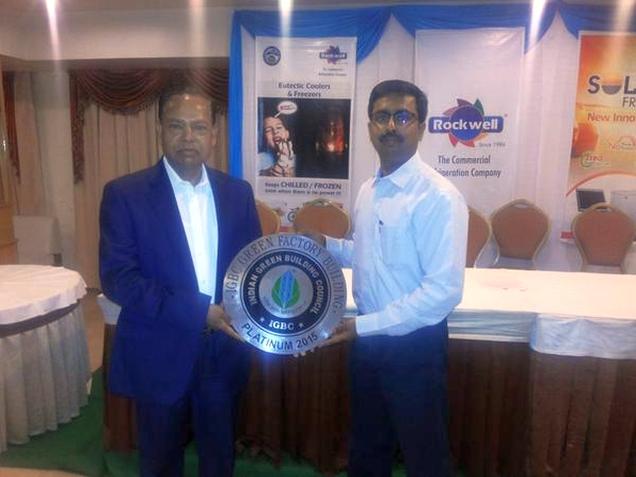
Rockwell Industries MD Ashok K.Gupta & M.Anand, Principal Counseller, IGBC Accredited Professional, displaying the Platinum rating shield in Hyderabad on Wednesday. Photo: N. Ravi Kumar / The Hindu

This is the first factory in all of Telangana and Andhra Pradesh to achieve the Platinum rating, declared M. Anand, Principal Counsellor and IGBC-accredited professional.

Cold chain equipment manufacturer Rockwell Industries’ new facility in Medchal, near Hyderabad, has achieved platinum rating standards of IGBC (Indian Green Building Council) for factory buildings.

The parameters for which it got the highest rating certification range from energy and water consumption, green energy generation, providing green landscape to using re-used materials.

This is the first factory in all of Telangana and Andhra Pradesh to achieve the Platinum rating, declared M. Anand, Principal Counsellor and IGBC-accredited professional at the CII-Sohrabji Godrej Green Business Centre, who was associated with the project.

Senior executives of Rockwell, led by Managing Director Ashok K. Gupta, at a press meet here on Wednesday, said that the facility was the first in its category across the country to receive the Platinum rating. “The new facility of Rockwell proves that factory buildings in Indian sub-continent can be made green by carefully working during design and construction stages,” explained Mr.Gupta.

Set up at a cost of Rs.28 crore, the company has incurred an incremental eight per cent cost towards the green parameters. In less than two years, it could recover the cost, said Mr.Anand. Manufacturing operations at the 45,000 sq ft facility began about a year ago.

Counting the green initiatives, he said that Rockwell had set up a 100-kilowatt roof-top (on-site) solar PV and a 1.5 mw windmill (off-site renewable energy generation) in Madhya Pradesh.

Towards reducing energy consumption and costs measures such as reflective roof coating, minimising lighting energy consumption by maximising use of daylight, provision of efficient LED and CFL fixtures have been made. Ultra low flow flush fixtures and 100 per cent rain water harvesting are some other features of the new facility.

A release from Rockwell said that the company received the green rating certificate on Monday from Telangana IT and Panchayati Raj Minister K.T.Rama Rao during the launch of Swachh Digital Telangana programme.

source: http://www.thehindu.com / The Hindu / Home> News> Cities> Hyderabad / by N. Ravi Kumar / Hyderabad – July 08th, 2015

On the threshold

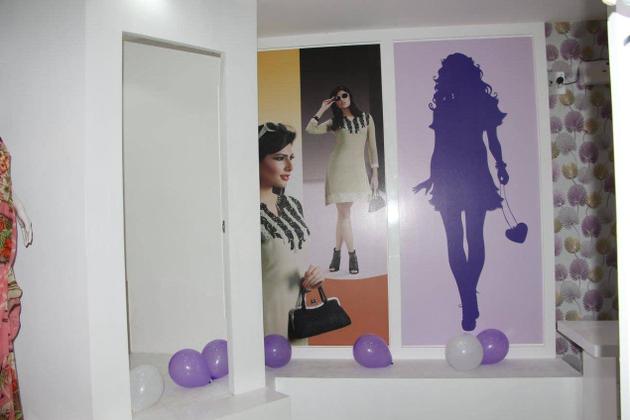
Shop with fun: The Bethel Store. Photo: Special Arrangement

In a first of its kind in the country, St. Francis College sets up a retail store to be managed by students of Retail Management & IT course

For better learning experiences and prospects, students won’t settle for anything less than the best. The Department of B.Voc (Retail Management & IT) of St. Francis College for Women, Begumpet is attempting to provide just that, as it takes opportunity into a completely new, uncharted and exciting array.

Bethel Retail Store is a first of its kind in the country — a store for and by the students — aiming to to provide students with a hands-on experience of managing a retail store.

“The idea of the store stemmed from the need to provide students a way to implement classroom learning; industry assignments, projects, live research and internships are limited due to time and resource constraints. The course is a skill-based and focused on practical learning. So, it’s like a lab for the students to explore and be trained in,” shares Subi Verghese, Head of Department of B.Voc (RM & IT).

The store will showcase merchandise from various retailers for products ranging from textile, footwear, jewellery, books, cosmetics, handbags and designer wear. The present focus is on collaborating with small entrepreneurs, but could tie up with bigger brands in future. The format of the store will chang every month.

In running and managing the store, students will handle everything from promoting and marketing it to unpacking the products, setting up the display counters and shelves, selling to a customer, billing and handling cash operations of the store. Department faculty explains that they have set aside an hour in their timetable for skilling and students would handle the store in shifts.

“Industry retail experts will also train the students. The store isn’t expected to be a commercial establishment, but a platform to learn. A lot of initiative has been taken by the students themselves during the initial stages in terms of contacting people and implementing the idea. They’re thrilled about it,” adds Subi.

Mahati, a student shares her excitement: “At first we were sceptical of the idea and how we would go about it. But as it built up we realised it was an amazing opportunity. I’m expecting to learn more about aspects like how to visually market products.”

“This is something beyond what we’ve expected and we’re all eagerly waiting to start working at the store!” adds Usha, another student.

The store will be operational from mid-August, during the college hours. With the tagline “The Threshold of learning”, the store aspires to be that and more.

source: http://www.thehindu.com / The Hindu / Home> Features> MetroPlus / by Sadiyah Y. Lasania / July 02nd, 2015

Celkon opens phones manufacturing unit in Hyderabad

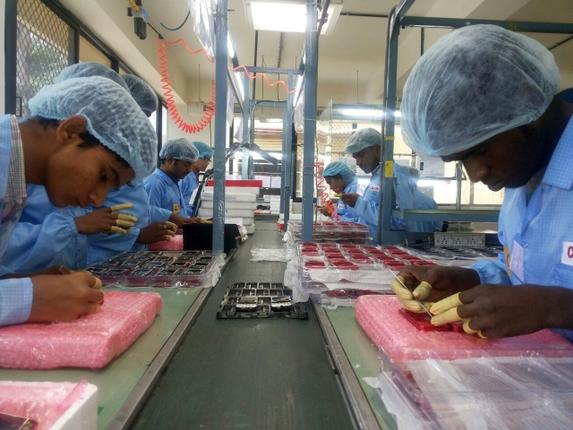
Phones manufacturing unit opened at Medchal in Hyderabad on Friday. Photo: N. Ravi Kumar / The Hindu

Celkon’s unit is in Medchal and equipped with four assembly lines and has a capacity of two lakh units a month.

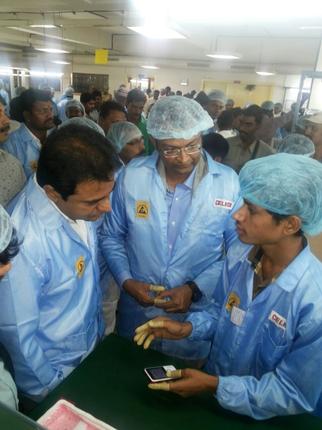
A number of mobile phone manufacturers are considering setting up units in Telangana, the State’s IT Minister K.T. Rama Rao said on Friday. Inaugurating a facility of smartphone maker Celkon, which has been outsourcing from China, the Minister declared: “This is just the beginning. Chief Minister K. Chandrasekhar Rao is keen on a having a mobile manufacturing hub in Telangana.

“Micromax has decided to set up a plant near Hyderabad on 50 acres,” the Minister said, adding he would be visiting South Korea and Japan soon to hardsell the State to electronic hardware manufacturers. Noting that both the Centre and the Telangana Government were on the same page with their ‘make locally’ approach, Mr. Rama Rao said that there were plans to develop hardware cluster in Maheswaram, Medchal and Ghatkesar, all near Hyderabad.

Celkon’s unit is in Medchal and equipped with four assembly lines and has a capacity of two lakh units a month. It is to be expanded to 12 lines and a total of five lakh units capacity per month. Reiterating the focus of the Government on facilitating industrial growth to create jobs for youths, Mr. Rama Rao said that mobile phone units can provide large number of low-end employment opportunities to those from ITIs and diploma holders.

Telangana IT Minister K.T. Rama Rao listening to the manufacturing process of Celkon phones at its unit in Medchal in Hyderabad on Friday after formally opening it. / Photo: N. Ravi Kumar / The Hindu

The State, he added, was keen on creating an eco-system that eventually will help host an analog Fab manufacturing unit. Celkon Chairman and Managing Director Y. Guru expressed satisfaction at becoming the first mobile phone manufacturer in south India. “This comes at a time when India is poised to become the largest consumer base for mobile phones and we are set to bring in a new phase of growth at Celkon,” he said.

Executive Director Murali Retineni said that by next quarter the investment on the new facility will be around Rs.225 crore. Lion’s share of Celkon monthly sales of 6-7 lakh units will be made in India.

source: http://www.thehindu.com / The Hindu / Home> News> Cities> Hyderabad / by N. Ravi Kumar / Hyderabad – June 26th, 2015

Eve from Adam’s maker will be a ‘mother-drone’ robot

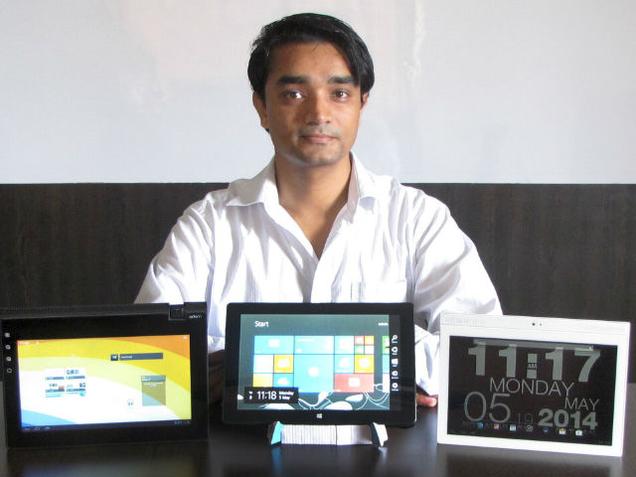
Rohan Shravan, Notion Ink founder. / Special Arrangement / The Hindu

Eve can be used for everything from asteroid mining to scanning the depth of the oceans for exotic creatures.

Rohan Shravan, whose company Notion Ink is making Eve, a personal computing robot that understands the needs of its users and can fly like a drone, says this will be the first time artificial intelligence will itself be an operating system, rather than just being part of it, as was the case with Siri or Google Now.

Siri is a personal assistant that works on Apple’s mobile operating system iOS and Google Now works on Google’s Android platform.

Spending on robots worldwide is expected to more than quadruple from just over $15 billion four years ago to about $67 billion by 2025 — a 10.4 per cent compound annual growth rate since 2010, says a study by the Boston Consulting Group. The personal segment, which includes robots used for entertainment, cleaning, education, security, and household applications, is projected to grow the fastest, at a compound annual rate of 15.8 per cent, rising from $1 billion to $9 billion during that period.

Eve will be able to communicate with other smart devices, record every second of what it sees, and store humungous amounts of data. Mr. Shravan says Eve can be used for everything from asteroid mining to scanning the depth of the oceans for exotic creatures.

He bootstrapped Notion Ink with personal savings of about Rs. 6 lakh and used the facilities of B.V. Raju Institute of Technology (BVRIT) in Hyderabad, where his firm got incubated. Most of his initial employees were final year students, who, he says, were later poached by multinational companies. When he told venture capitalists that his product Adam would be a challenger to Samsung and Apple, they laughed at him, he says.

“They told me that ‘you are not going to survive even for six months’,” says Mr. Shravan, who quit his job at Schlumberger, the world’s biggest oil-services company, to launch Notion Ink in 2009.

For a while, their scepticism seemed well founded. Notion Ink ran into huge problems. Google came up with its own operating system, Honeycomb, but restricted access to players such as Motorola. Notion Ink’s other partner Nvidia Corp, a maker of chips for computer graphics cards, which used Honeycomb, also discontinued support. This had a drastic impact on Notion Ink, whose tablet was based on Google’s Android platform.

Mr. Shravan then tied up with U.S. chip-maker Texas Instruments for hardware support. In 2012, Texas Instruments announced it was winding down operations in smartphone- and tablet-oriented chips. Notion Ink had to start all over again.

Then, last year, things started looking up for his firm. Two of the world’s largest tech companies, Microsoft and Intel, formed a partnership with the firm to provide their chips and software, respectively, to Notion Ink’s touch-enabled computing devices.

Mr. Shravan now sells the devices directly to 30 large enterprises, competing alongside Dell and Toshiba.

Notion Ink is now re-entering Apple’s home turf, by selling its Cain tablet in the U.S. market.

Former Infosys Director and Chairman of Manipal Global Education Services T.V. Mohandas Pai says, “People in India need to learn how to market their products.” Also, he says, “India produces good engineers, but it is important for them to make hardware products intuitive and attractive in terms of design.”

source: http://www.thehindu.com / The Hindu / Home> S&T> Technology / by Peerzada Abrar / Bengaluru – June 21st, 2015

KCR hardsells Brand with 15-day formula

Hyderabad :

Unveiling what is being billed as the ‘game-changing’ industrial policy, Telangana became the first state in the country to bestow on investors the right to get clearance of their projects within a set time frame.

The new industrial policy unveiled by chief minister K Chandrasekhar Rao at a gala event here on Friday makes the state liable for penal action if it fails to respond to investment proposals within the time frame.

Under Telangana Industrial Project Approval and Self-Certification System (TS-iPASS), all the mega projects (over Rs 200 crore) will get clearance in 15 days, while the other projects will be approved in a month. The chief minister, addressing a gathering of nearly 2,000 industry representatives, including several CEOs and company heads, promised corruption-free and hassle-free business environment.

“If you apply online to set up your industry, we will give all approvals and make allotments within 15 days. The chasing cell will see to it that the clearances are given within the set time frame. If the deadline is missed, then the officer concerned would be asked to pay a fine of Rs.1,500 for each day’s delay,” KCR said at the mega event held at Hyderabad International Convention Centre (HICC) in Madhapur.

The chief minister’s announcements got a big thumbs up from industry captains. Describing the policy as “fantastic”, Pawan K Ruia, chairman of Ruia Group, said “such a policy is unprecedented. We have only seen deadlines fixed for investors to start their projects. We had never seen a deadline fixed for the other side. The penalty clause alone makes the policy game-changer.”

Apart from TS-iPASS, the policy framework announced on the occasion includes T- IDEA (Telangana Industrial Development and Entrepreneur Advancement) to help micro, small, and medium enterprises, and T-PRIDE (Telangana Program for Rapid Incubation of Dalit Entrepreneurs).

Chandrasekhar Rao also launched the TSICC (Telangana State Industrial Infrastructure Corporation) website where industrialists can apply online for single window clearance. The industrial policy framework, which was approved by the Telangana assembly in November 2014, also promises minimum inspections and maximum facilitation.

The government has identified 14 core areas for a focused approach for industrial development. The sectors include life sciences, pharmaceuticals, information technology, aerospace, automobiles, textiles, minerals and transportation and logistics.

The policy prescribes norms for giving permissions to mega (with investments of Rs. 200 crore and above), large (Rs 10 crore-Rs 200 crore) and small and medium sized projects and each industrial park will provide a ‘plug and play’ environment. In addition, the government was also planning to develop industrial townships near such parks for easier commute to work.

Stating that the government was pulling out all stops to make it easy for investors to come to Telangana, Chandrasekhar Rao said anyone seeking to invest in the state would be attended to at every stage by a special team of protocol officers.

“On receiving your application, we will invite you to Telangana. A protocol officer will escort you straight from the Shamshabad Airport to my chambers. You will meet me and the industry secretary for a small discussion. You will be invited again within 12-15 days and the protocol officer will receive you. I will hand you over a cover containing all allotments and clearances,” Chandrasekhar Rao said.

The chief minister also unveiled the Telangana solar power policy which promises single window clearances to solar power projects.

Chief secretary Rajiv Sharma, who made opening remarks, said with a land bank of about 1.40 lakh acres in the state, the government will provide a hassle-free environment for the investors allowing them to focus on their core activities.

source: http://www.timesofindia.indiatimes.com / The Times of India / Home> City> Hyderabad / TNN / June 13th, 2015

Foodie awards

hym-food award
hym-food award

There were so many enthusiastic participants at the Telangana Food Fest, that the judges confessed it was a tough job to pick the best. Nevertheless a few have scored better than others and walked away with the awards.

The awards were presented to participating hotels in different categories.

In the five-star hotel category, Marriott won the first prize followed by ITC Kakatiya (second prize) and The Park (third prize). The best in four-star category included Hotel Aalankrita (first), Hotel Daspalla (second) and Hotel Golkonda (third) while three-star category winners were Best Western Ashoka (first), Central Court (second) and Hotel Katriya (third).

The winners in the Food Courts category were Aahar bistro (first), Hotel Vivera (second) and Sridevi Swagruha (third) and those adjudged for Best Ambience were Hotel Marriott (first), Aalankrita (second) and Aahar bistro (third).

The Best Food Service category selections went to ITC Kakatiya (first), Aalankrita (second) and Aahar bistro (third) while the best chefs chosen were M.V. Naidu (Marriott), Lakshit (ITC Kakatiya) and Thimma Reddy (The Park).

In the Restaurant category, Dakshina Mantapa (Taj Tristar) was selected as first, Pickles (Basera) as second, and Haritha, Pragnapur, as third.

source: http://www.thehindu.com / The Hindu / Home> Features> MetroPlus / June 11th, 2015

Road less taken

Refusing to be shackled, these young entrepreneurs from small towns are making it big in Hyderabad.

According to American entrepreneur and author Scott Belsky, ‘It is not about ideas. It’s about making ideas happen.’ Entrepreneurs in the city certainly seem to agree when it comes to realising their start-up dreams. Despite humble beginnings in life, these entrepreneurs are determined to make a difference with their entrepreneurial pursuits. Refusing to be shackled, these small town entrepreneurs decided to push their boundaries to set up successful start-ups and are now set make it big in their own right.

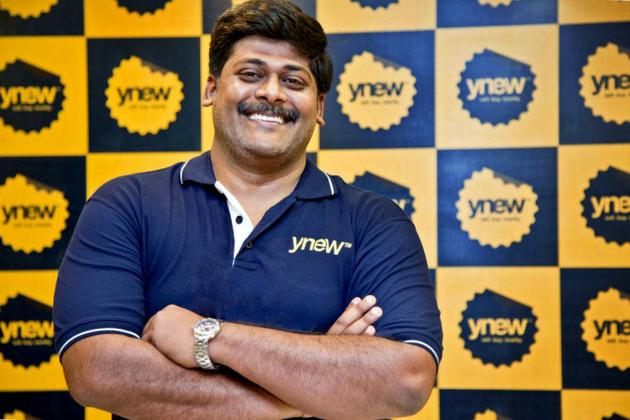
Ram Nutakki
Ram Nutakki

Take for instance, Ram Nutakki, founder of Ynew, a re-commerce portal that encourages people to buy used and refurbished gadgets like laptops and cellphones. “When we started 2.5 years ago, we had a different vision. However, along the way that changed and we now have Ynew. Before I decided to become an entrepreneur I was running my own business consultancy, which I did straight out of college. So I’ve been through my share of changes and along the way I have realised that for an entrepreneur, adaptability is one of the most important qualities,” he says.

Hailing from an agricultural family in a small town in Guntur district, Andhra Pradesh, Ram was all set to become a doctor until circumstances forced him to drop out of MBBS mid-course. He then went on to pursue a degree in B.Pharmacy, which also he had to discontinue. He finally completed his graduation in BBM and then went on to do his MBA in Hyderabad. “I’m a first-generation entrepreneur and expectedly my family was not too convinced about it. But my stint as a business consultant gave them some confidence in my vision. At the end of the day struggle is part of the business, but I believe in adapting to the circumstances and being emotionally resilient.”

Jay Guru Panda,
Jay Guru Panda,

For Jay Guru Panda, who co-founded Wazzat Labs, a visual search engine for fashion e-commerce portals, launching his own start-up is a break away from his upbringing in Damanjodi in Koraput district of Odisha. “I moved to Hyderabad to study at IIIT-H and by the end of it I knew that I wanted to set up my own company. Wazzat allows people to use the image of an outfit they like, to scan various e-commerce sites and find similar styles and patterns. We’ve tied up with various retailers, one of them being Target in US.

WazzatTELAN27may2015

Wazzat Labs was set up soon after I graduated and we participated in and won the Google Launch Pad event earlier this year; and also received seed funding. Right now we are looking to raise a larger sum in the third quarter of 2015,” he says, adding, “Fortunately, my parents trust me with my choices and I didn’t have to work too hard to convince them when I decided to set up my own company. These days, there is a lot more acceptance of start-ups.”

Sunil Mohan Ranta
Sunil Mohan Ranta

Sunil Mohan Ranta, who hails from a small town in Himachal Pradesh with a total population of 600, too decided early on to not settle for a regular desk job. Which is why, he launched his company Crypsis even as he was pursuing his Masters’ degree. “At Crypsis we work with technology start-ups throughout their product life cycle, starting from conception to the launch and beyond. We have a lot of US clients today and are a 30-member strong team. Fortunately, we are at a stage where we don’t need to raise any funding for the company,” says Sunil, adding that convincing his family initially was no mean feat. “Though initially, my family was sceptical about me setting up my own company, today they are at ease with my decision. At the end of the day I wouldn’t trade my entrepreneurial pursuit for anything else.”

source: http://www.thehindu.com / The Hindu / Home> Features> MetroPlus> Society / by Ranjani Rajendra / May 22nd, 2015

On a successful streak

City students are giving their entrepreneurial dreams wings as they set up their own companies

A new crop of Hyderabadi youngsters are looking to do a lot more than be just students. From setting up their own photography studios to launching learning solutions companies or tracking apps, these students can’t wait to get started with their entrepreneurial pursuits, even as they juggle college and full time classes.

Raveena and Puranjani of Project Sonder / Special Arrangement

Small beginnings
Take for instance, Puranjani Kabra and Raveena Kandregula, two second year students from St. Francis Degree College. With a common passion for photography and filmmaking, the duo set up Project Sonder and have shot some weddings and even a fashion show for Gaurang Shah at Taj Falaknuma apart from a music video on a song by The Script. Puranjani talks about what prompted them to take the entrepreneurial plunge: “I have been into photography for a while now, doing self-driven projects and experimenting. With Raveena I got interested in filmmaking as well and I thought that instead of doing internships, we could combine what we both have and start earning by doing what we love best. My father’s willingness to invest in us provided the final push for us to begin.”

Raveena chips in, saying, “I love feeling busy. It is a challenge to maintain college attendance, stay up late hours and still be able to do shoots. But it is definitely a challenge we love. Project Sonder’s vision is to capture, through photographs and videos, every emotion and the story behind every life, as if it is the centre of the universe – rare, vivid, and complex in its own way. We are excited about this and do not want to limit ourselves in any way. We will complete our graduation in a year and if everything goes as planned we would love to continue.”

The larger picture
Aneeq Dholakia on the other hand, decided a regular 9 to 6 job was not for him. The fourth year student at IIIT-Hyderabad knew he wanted the freedom to do things on his own terms and decided to launch his start-up Spaceman & Mammoth along with his partner Kaushik Nooguri, who is also pursuing a course in CS. “Most of my batch mates have landed plum jobs through placements and I realise I may not make as much as they will even in the next couple of years; then again they all plan to take a break now before they join their jobs, but I cannot afford to do that since we are working on establishing our start-up. These are sacrifices I’m willing to make. After experiencing what it is like to do your own thing I am willing to spend 24 hours doing something I love,” he says, adding, that their company is all about introducing experiential learning programmes. “We have a three-day boot camp coming along called Reboot for undergraduate students to reflect on their current scenario and discover new, exciting and unique opportunities. The idea for this came along when we attended an event by AIESEC where we conducted a session called Spaceman vs. Mammoth. That is where the idea to reinvent the whole learning process came from,” he explains.

Time Management
The going doesn’t get any easier for these student-turned-entrepreneurs. It involves a lot of juggling and time management to be able to handle both academics and their work. Ravneet Singh Kathuria, a student of IIIT-H, who along with five other friends launched Brthe, a tracking app, says, “I think getting our families to see our vision is the hardest thing to do. It helps that we receive so much support from our mentors at CIE. I’ve always wanted to be an entrepreneur and as of now most of our days and nights are spent working on Brthe. Sometimes one person from our group manages to get us proxy attendance and we catch up on missed lectures later. It’s all about time management and I’m willing to do it to be able to realise my entrepreneurial dreams,” he says.

But it is not just about setting up their own companies. The idea is to take forward their vision and receive funding to establish them. Jeevan Chowdary, who launched Shoppers Express — a company that helps you get cash backs on online purchases — , says that his company recently received funding and will soon be employing four full time employees as well. “Our whole business philosophy is to create a cohesive experience for users to engage in e-commerce. Across our company’s touch points, we strive to give; give as we get. And that in my best opinion is what good businesses do. Entrepreneurship is something like connecting the dots. What I realised is that if anyone wants to launch a start-up, he shouldn’t search for the ideas and try to implement them. The best way to go forward to identify problems he/she faces and implement an efficient solution. Provide that same service to the world to bring out the entrepreneur in you,” says the IIIT-H student, who is looking forward to completing his one year of entrepreneurship along with Rohit, his technical head.

source: http://www.thehindu.com / The Hindu / Home> Features> MetroPlus / by Ranjani Rajendra / Hyderabad – May 06th, 2015