Category Archives: Business & Economy

K’nagar a Model City

Karimnagar :

An autonomous committee has been set up with the Mission of Karimnagar City Renovation (KCR) to develop Karimnagar as a model city.

The 12-member committee, set up three days back, is headed by Karimnagar MP B Vinod Kumar and has MLA, Karimnagar Municipal Corporation (KMC commissioner, mayor and deputy mayor and seven prominent residents of the town as its members.

A brainchild of Karimnagar MLA Gangula Kamalakar, the committee has already collected `5 lakh as donations from the public.It will work parallel to the KMC. Revealing this to newsmen here on Sunday, Kamalakar said that to ensure transparency, the committee had opened a bank account in the name of the KMC commissioner and donors could directly deposit their mite into it.

He pointed out that the city of Dayton in the United State had been similarly developed with public funds.

Meanwhile, the committee launched its first activity on Sunday — that of making Karimnagar green by planting 120 saplings in the KMC’s 4th Division/Ward. Division/Ward. The committee proposed to plant 1 lakh saplings over a period of time.

source: http://www.newindianexpress.com / The New Indian Express / Home> States> Telangana / by Express News Service / July 07th, 2014

Software exports from ‘T’ put at Rs. 57,000 cr.

The software exports from Telangana during 2013-14 are estimated at Rs. 57,000 crore, Secretary of Information Technology Department Harpreet Singh has stated.

In a statement on Friday, the IT Secretary quoting the figures compiled by the Software Technology Park of India (STPI) and Development Commissioner SEZ, said IT and ITES had grown by over 14 per cent compared to 2012-13. The software exports for 2012-13 were 49,831 crore, he stated.

The official stated that the direct employment generated by software exports was 3,23,691 for 2013-14 and the revenue estimate did not include the domestic software sales and electronic hardware industry.

source: http://www.thehindu.com / The Hindu / Home> News> Cities> Hyderabad / by Special Correspondent / Hyderabad – July 05th, 2014

Telangana filmmakers press for split of AP film chamber

Hyderabad :

Filmmakers from Telangana on Friday demanded the bifurcation of the AP Film Chamber of Commerce (APFCC) and strongly opposed the move to change its name to Telugu Film Chamber of Commerce.

At a meeting held some time ago, the executive committee had decided to change the name of the body, which would deal with the industry in both the states. Friday’s general body meeting was called to ratify the decision, but saw major opposition from the Telangana members, who attended in huge numbers. They contended that the APFCC should represent only the 13 AP districts while the new Telangana Film Chamber of Commerce (TFCC) should represent the interest of the industry in the new state.

“The demand is very clear. Telangana filmmakers should have a separate body since a new state has been formed. There is no compromise on that,” M Vijayendar Reddy, an exhibitor and president of TFCC, told TOI.

After the initial volley of arguments, APFCC president NV Prasad brought the meeting to order and said a committee comprising five representatives each from the two states would be formed to discuss the issue. The decision made by this committee would be discussed at the next general body meeting.

Meanwhile, Friday’s meeting also saw a few students, reportedly from Osmania University raising ?Jai Telangana’ slogans pressing for the bifurcation of the film chamber outside the meeting venue at Filmnagar.

source: http://www.timesofindia.indiatimes.com / The Times of India / Home> City> Hyderabad / TNN / July 05th, 2014

More doctors for Telangana hospitals

DoctorsTELAN05jul2014

Counselling being conducted for giving postings to 124 in-service doctors. Ninety-eight of the in-service doctors opted for Telangana Vaidya Vidhana Parishad hospitals.

In one of the first appointments taken up by the government after the formation of Telangana, the medical authorities on Friday conducted counselling for giving postings to 124 in-service doctors who recently completed their postgraduate courses in different specialisations.

The counselling at the auditorium of Directorate of Medical Education was confined to clinical duties in gynaecology, paediatrics, general medicine, anaesthesia, ophthalmology, dermatology and pharmacology. Ninety-eight of the in-service doctors opted for Telangana Vaidya Vidhana Parishad hospitals and twenty others for Directorate of Public Health institutions in the State, including primary health centres. There were six absentees.

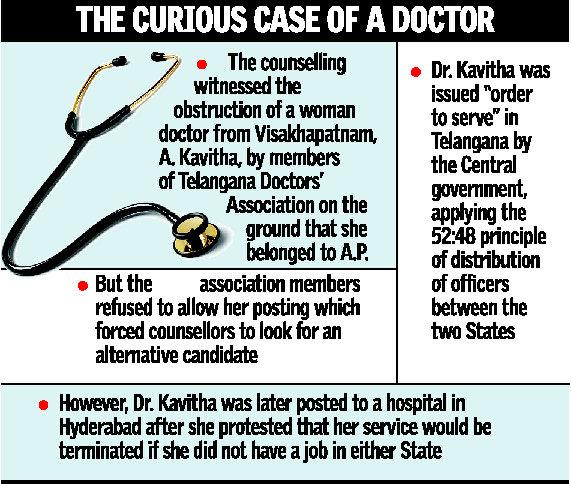
On Saturday, counselling will be held for non-clinical posts. The doctors will be re-designated as Civil Assistant Surgeons (Specialist) after they resume duty. The counselling on Friday witnessed the obstruction of a woman doctor from Visakhapatnam, A. Kavitha, by members of Telangana Doctors’ Association on the ground that she belonged to Andhra Pradesh. Dr. Kavitha was issued “order to serve” in Telangana by the Central government, applying the 52:48 principle of distribution of officers between the two States.

But the association members refused to allow her posting which forced counsellors to look for an alternative candidate. However, Dr. Kavitha was later posted to a hospital in Hyderabad after she protested that her service would be terminated if she did not have a job in either State.

The shutdown of power added to the confusion. The Director of Public Health, Champa Naik, was present.

source: http://www.thehindu.com / The Hindu / Home> News> National> Telangana / by Special Correspondent / Hyderabad – July 04th, 2014

Hyderabad to host global meet of IIT alumni

Nearly 3,000 IIT alumni from across the globe are expected for the event, which will be held in December

All roads will lead to Hyderabad in December when the cream of India’s intellectual exports will converge in the city for the 12th edition of the IIT Global Conference, an annual meet of alumni from the prestigious engineering institution.

Nearly 3,000 IIT alumni from across the globe are expected for the event, which is being organised with the agenda to contribute to the country’s development.

It will be held from December 19 to 21, and is being hosted by the PanIIT Hyderabad Alumni Association and IIT Hyderabad.

A curtain raiser of the event was held on Sunday at the Indian School of Business (ISB), in which some prominent IIT alumni participated.

Chief executive officer (CEO) of tablet-maker Datawind, Suneet Singh Tuli gave a detailed presentation on the low-cost Aakash, as part of his keynote address.

Unlike companies like Apple and Samsung that target the well-heeled 5 per cent, Mr. Tuli said he was interested in going after the remaining 95 per cent, which constituted a vast untapped market of people ignorant about internet and tablets.

Tech-induced change

He spoke of how technology could result in a decrease in illiteracy, and of its advantages in improving education and commerce.

ISB Dean Ajit Rangnekar called upon the IIT alumni to try and contribute more to the country’s development.

www.thehindu.com / The Hindu / Home> News> Cities> Hyderabad / by Staff Reporter / Hyderabad – June 30th, 2014

Story of growth: Business woman emerges out of sick firm

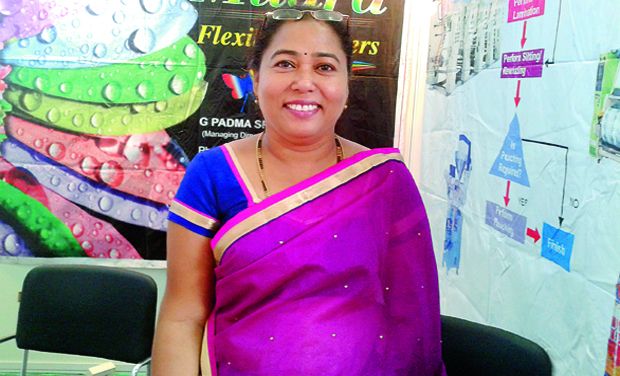
Padmasree Gunnala (Photo: DC)

Hyderabad:

For the success of a business, a good management is as important as the product itself. Several people have made fortune just by reviving companies that have fallen sick due to inefficient management. Padmasree Gunn-ala belongs to this creed.

Padmasree, a young home maker who was a lawyer by education, found reviving a sick company more interesting and challenging. “In 2005, I was planning to start a business as I was always interested in entrepreneurship. My friend suggested me to start a unit in ancillary sector. He had an experience in that sector. So we partnered to buy a sick company and revived it to be known as Mudra Flexible Printers and Laminators,” she told this newspaper.

Mudra operates in the roto-packaging industry, which manufactures food-grade packaging products. Its specialty lies in catering to all kinds of flexible packaging material in multi-colour printing and laminations.

The partners, however, later found that acquiring a sick company will have its own share of hiccups. And Padmasree was very quick to realise that getting a bank loan for a sick company was very difficult.

“So we pooled in about `6 lakh for working capital as no bank was forthcoming to help us. The same was the case with customers. It took pretty long time for us to convince customers to give us orders as they were unsure about our business continuity,” she recalled.

A well-trained karata, Padmasree had to endure testing time when her factory was gutted in a fire accident. “I don’t whether I can call it a turning point or not; but the fire accident that gutted my factory has strengthen my resolve to succeed and it showed my customers’ faith in me.”

Mudra, which started off with 18 clients, claims a fairly strong customer base of 700 companies, comprising varied spectrum starting from MSMEs to MNCs. The customers spread across sectors like food and FMCG, pharmaceuticals, agro industries, bio-technology, cement, automobiles, distilleries and many more – both in India and abroad.

Though successful in business, Padmasree rues about the fact that her work-life balance was skewed towards business and as a result, she could not focus on the upbringing of her son, who is now pursuing engineering course. “I feel woman entrepreneurs must focus on this aspect also.”

Padmasree was among the chosen few to be a part of the Golman Sachs 10,000 Women’s program-me along with Indian School of Business (ISB).

Ask her about her success mantra and she is quick to respond saying, “hard work.” She explains that there is no other alternative for hard work, quality and customer satisfaction. Mudra saw the growth from being a small scale enterprise to a medium scale enterprise and now, Padmasree, only dreams of Mudra to flourish with a better annual turnover every year.

(In association with jobsdialog.com of TMI e2E Academy)

source: http://www.deccanchronicle.com / Deccan Chronicle / Home> Business> Latest / DC–jobsdialog.com / June 24th, 2014

Why academic, gender diversity is imperative in B-schools

BSchoolsTELAN28jun2014

Management institutes look to re-jig the student mix for a holistic perspective

Puja Das talks excitedly about her new role as President of the graduate student board of the Hyderabad-based Indian School of Business. Conversing in the sandstone-coloured wind-swept cavernous atrium of the B-school, her enthusiasm is infectious.

The 26-year-old IIT Bombay graduate, who worked a little over two years in oil exploration company Schlumberger before joining ISB, has her agenda full: add lustre to the ISB brand, reach out to alumni, host national-level competitions… she’s brimming with ideas.

For ISB’s Deputy Dean Savita Mahajan this year has been in some sense one of twin triumphs. The Class of 2015 of the post graduate programme in management has 231 women students constituting 30 per cent of the total class size – the highest number ever since the school’s inception 13 years ago. “From the start of ISB, we had this target of 30 per cent in mind; it’s been steadily going up and this year is a landmark for us,” she explains. And, for the first time, the student’s body has a woman President: Puja Das won after a hard fought election, which saw six women in a field of 14 competing in two rounds of polling.

But, the landmark the Dean refers to isn’t just mere symbolism or a target to be achieved. It’s something that B-schools around the country have been grappling with these past few years: how to increase both academic and gender diversity in business schools. As Dean Mahajan explains, “Diversity of any kind; in educational background, gender, culture, is very useful in the learning process. It brings different skill sets and perspectives in the analysis of a problem situation and its possible solution. Particularly in management education, where the case method is used to illustrate real life situations, usually there is no single ‘right’ answer. Diverse opinions can challenge the mainstream view, and throw up out-of-the-box solutions, thus enhancing the whole group’s learnings and insights.”

As Das herself says of her a little over two-month stint at ISB, “We get to learn a lot from our colleagues, because they come from such diverse backgrounds.”

Importance of diversity

How important then is academic and gender diversity at B schools? Very much, going by what IIM-A Director Ashish Nanda said in an earlier interview to Business Line. “When I came here and met the students in different sections, my question was: How many of you are engineers? But I couldn’t ask the other questions; more than 95 per cent of the students were engineers. In our kind of classrooms, where learning is by discussion, if a teacher is just coming to teach fact and data then academic diversity doesn’t matter so much. But, if you have a class where most of the learning happens in interaction, and the faculty member is a facilitator, then it is important that students come from different points of view and are surprised by what others say and build on those learnings.”

Diversity, says Nanda, comes from different points of view; it comes from intellectual curiosity; gender; different socio-economic and educational backgrounds. “The participants of a classroom at IIM-A would benefit more if this were to happen,” he adds. Nanda, himself a 1983 batch alumnus of IIM-A, recalls that the imbalance was not so acute during his days as a student. And, now as Director of the country’s top B school, Nanda worked along with the admissions committee to restore some balance by making some proactive changes to the recruitment and admissions process for the 2014-16 batch. Partly as a result of these changes and with a greater recruiting effort by IIM-A in non-traditional areas, non-engineers constitute 11 per cent of the students to whom offers have been made this year, compared to 5 per cent or less of the batches in the past three years.

Also, 28 per cent of the offers, a record high for IIM-A, have been made to women applicants, compared to women constituting 11 per cent to 22 per cent of batches in the past three years.

But, as B-school dons point out, more women in management education indicates a quiet social phenomenon at work as well. ISB’s Mahajan says the pool of women entering the corporate workforce has multiplied otherwise one wouldn’t see the numbers going up in B-schools. “The gender scenario in the corporate world itself is changing and lot more women feel confident that this is a career they can build,” she says. Schools such as ISB and Great Lakes Institute of Management require a minimum of two years work experience to enrol for a one-year programme. GLIM’s Executive Director S Sriram says that traditionally very few women pursued higher education and those of them who did, got into humanities and social sciences and career wise, most aspired to become teachers and jobs of similar nature. “Modern women are pursuing engineering and other professional education and naturally they aspire to become managers and leaders of organisations. This is the supply side explanation.”

On the demand side, he says, corporates are increasingly realising the need and importance to have women managers and leaders. They are not only good in people management and organisational building due to their better developed EQ but also bring in possibly better corporate governance and ethics, as women tend to have less tolerance for compromise. “Even research conducted after the 2008 crisis found that companies with more women on board suffered less,” explains Sriram.

Uday Salunkhe, Group Director, WeSchool, says it’s all a domino effect due to the better policies in place that support women and overall a society that respects women for the talent they show. “With every woman you train, you fade the gender bias prevalent in many regions and strata and strengthen their determination for a better life. Well balanced gender diversity in all facets of life helps developing a healthier attitude and better respect for all. ” he adds.

Schools such as ISB have also been proactive in roping in women into B-school by reaching out to them during their undergraduate courses. It also admits women on an average who are younger then similarly qualified men. “We realised if we don’t give them an opportunity then or say you’re too young and work a couple of years and come back, they say there is too much pressure to get married and they may not be able to do the course later. It’s a valid reason. So we are open to taking them younger,” says Mahajan. But, even that is changing, she adds. With married students’ accommodation and conducive campus facilities, more married women are signing up for a B-school education — this year she says there are 45 married women on campus.

Best case practices

IIM-A’s Nanda recalls that two decades ago, MIT in the US used to have a similar problem of fewer women joining. It’s considered one of the top schools in hard sciences, but it was not getting many women students “and the reason was there was a general wisdom that you don’t get many women interested in hard sciences as the environment is not supportive of them.”

The leadership of MIT said it had to aggressively go and recruit women from schools, encourage them to apply; bring them to MIT to spend a couple of days; offer scholarships. “Today, MIT has almost 50 per cent women. And, in fact, it is considered one of the most women-friendly institutions. But, it took a decade. So we have to reach out to students; encourage people in society who think it’s important and provide motivation and incentives to people from different backgrounds to apply,” explains Nanda.

Anaita Singh, a student of the 2015 batch at ISB, who earlier worked in a bank, a government project and for a political party in the Delhi state elections, says earlier there was a set agenda for women, that they could work only in particular sectors. “We have more support systems now. And, now we are in a position to create something for ourselves rather than be stereotyped.”

Not just IQ, but EQ and SQ as well

The Chennai-based Great Lakes Institute of Management has traditionally had a high proportion of women in its batches since it started ten years ago. Executive Director S Sriram points out that managers who aspire to be in managerial and leadership positions need to have a strong EQ (emotional quotient) and SQ (social) apart from IQ.

“Our traditional education, and particularly in the Indian context, does not provide structured inputs to develop EQ and SQ. More particularly in management education, these aspects are very important as an overwhelming majority of students come from an engineering background which emphasises the IQ component almost to the exclusion of the other two,” he explains. One of the effective ways to respond to this of equipping future managers and leaders with an SQ and EQ component is ensuring diversity in terms of gender and the academic background they come from. “Women,” he says, “traditionally possess a higher EQ component. So, by being in the same class, interacting with them, looking at and learning from their perspective of managerial and leadership situations enables one to not only appreciate the EQ component but also develop it further.” People who come from diverse undergrad backgrounds bring in their own perspective to managerial issues/challenges. For example, he points out, a humanities person will look at a productivity problem very differently compared to an engineer. This not only enriches class room learning but also enables one to develop diverse perspectives.

source: http://www.thehindubusinessline.com / Business Line / Home> Features> New Manager / by Vinay Kamath / June 24th, 2014
Global Edge Software Limited Inaugurates its Hyderabad Facility at Hi-Tech City

Global Edge Software Ltd., has inaugurated its Hyderabad facility at Mindspace, Raheja IT Park, Hi-Tech City, Hyderabad. The Expansion is in alignment with its growth module and strategy of the organization.

Global Edge Software Limited, a SEI CMM Level 5 certified ISO 27001 & 9001 driven company has been venturing into cutting edge Embedded Technology Solutions for Semiconductors, Automotive, Industrial Automation, Telecom & Wireless under one roof. They have been providing comprehensive services on Mobile Application, User Interface, Operating Systems and various mobile platforms. Expertise spans across 2G, 3G, 4G and LTE technologies.

After Bangalore, Hyderabad has been fast emerging innovative hub for product engineering. With a vision of being a leading technology company, transforming the embedded world with innovative solutions and services, the expansion plan was made to upgrade the service provision & satisfaction levels of their customers with extra facilities customized to suit their needs.

The new facility was inaugurated by Mr. Shashi Reddy, VP Engineering Qualcomm which saw people from the fraternity to be a part of it. Speaking on the occasion Mr. Shashi Reddy, VP Engineering Qualcomm said “Global Edge Software Ltd is a strategic partner & this facility set up should provide enhanced support on the engineering front for the various client projects based out of Hyderabad & a new footprint for the organisation”

Speaking on the occasion of the inauguration of the 50 seater new Facility at Hyderabad, Mr. M.P. Kumar, Chairman & CEO of Global Edge Software said; “As new trends, technologies and consumer expectations emerge and with shrinking product development cycles, the need to support older products, and constant pressure to optimize costs and differentiate products to meet consumer demands, companies must adapt quickly to changes. Being product engineering partners with expertise in the domain, agility and innovation help us surmount the challenges of delivering high-quality, timely products and services to our client. A new facility dedicated to this helps us focus on meeting our customer needs very effectively.” he added.

Source: Equity Bulls

source: http://www.equitybulls.com / Equity Bulls / Home> Industry News / June 23rd, 2014

16 Hyderabad firms on D&B’s top 500 list

Companies that have made it to the list include Amara raja batteries, Andhra bank, Aurobindo Pharma, Dr Reddy’s among others

Sixteen companies from Hyderabad have made way to the recently released ‘India’s Top 500 Companies’ report of Dun & Bradstreet (D&B), a provider of global business information and insight.

According to D&B, the ranking is done on the basis of various parametres such as total income, net profit and net worth. It includes both private sector and public sector companies that are listed on stock exchanges.

The companies that have been included in the report are Amara raja batteries, Andhra bank, Aurobindo Pharma, BS Limited, Coromandel International, Cyient, Dr Reddy’s, Gayatri Projects, HBL Power Systems, Heritage Foods, Madhucon Projects, NCC, NMDC, Prism Cement, Ramky Infrastructure and Steel Exchange India Limited.

“Despite subdued consumption demand and inflationary pressures that persisted during FY14, the top 500 Companies managed to show a modest 8 per cent growth in their top line earnings during first nine months of FY14 as compared to the same period previous year.

“On the profitability front, margins declined marginally from 7.5 per cent during 9M FY13 to 7 per cent during 9M FY14. On the back of policy initiatives expected from the new government, we expect revival in the domestic economy in FY15, albeit at a slower pace, as measures to boost business confidence will take time to fructify. For FY15, D&B expects the GDP to grow by 5.5 per cent,” D&B India president and chief executive officer, Kaushal Sampat, stated in a press release.

source: http://www.business-standard.com / Business Standard / Home> Companies> News / BS Reporter / Hyderabad – June 23rd, 2014

Race course set to gallop into history

Hyderabad :

A major landmark of the city is set to disappear soon with the Telangana Rashtra Samithi government firming up plans to turn the iconic Hyderabad Race Club into an education hub.

Leading into the elections, TRS supremo K Chandrasekhar Rao, promised a slew of sops to boost education, and one idea, which startled educationists, was turning the 100-year-old iconic race course into an education hub.

After he assumed power, the education department has been entrusted the task of preparing a blueprint for establishing 150 educational institutions in and around the sprawling Malakpet race course. These institutes will offer post-graduate courses in various subjects, specialize in research and development, it is learnt.

In fact, a similar proposal to create an educational hub by the then Congress chief minister YS Rajasekhara Reddy, was shelved in 2008 after vehement opposition from the race course authorities, backed by political parties.

Now the higher education department has pulled out the old blueprint and is re-working it with renewed zeal and giving it proper shape, at the behest of the state government.

The government’s plan is to build about 150 higher education institutes on 500 acres of land, which includes the race course and also the Chanchalguda jail.

When asked about the plan, G Jagadish Reddy, minister for higher education said that the manifesto will be implemented at any cost.

“We will implement the manifesto at any cost. The hub will come up and the modalities will be discussed soon,” the minister said.

As per the plan, the whole concept is at the formative stage and the government has plans to rope in several stakeholders and finalise the mega project. Education department officials said companies like Wipro and Infosys, among others will be roped in for the project.

Educationists are privately criticising the move saying Telangana already has plenty of quality educational institutions, including IIT-Hyderabad, National Institute of Technology in Warangal and Indian School of Business among others.

“Educational hub is a good concept, but establishing it by destroying an iconic landmark is definitely a bad idea. There is a plenty of open land where the government can set up such institutions, why here?” questioned a former vice-chancellor, who did not wish to be named.

Incidentally, the present race course in Malakpet was shifted from Secunderabad a century ago as the British government wanted it closer to the city and now thanks to Telangana chief minister K Chandrshekar Rao, it is all set to move out of the city again.

The race course and the Chanchalguda jail are part of a sprawling 2,000 acres of land, which the new government has been eyeing. In fact, the chief minister said clearly that his government would not allow such prime land to be wasted on racing and wanted the jail to be shifted out of the city, but has not specified where.

The 2008 plan envisaged a smaller project where only part of the race course would have been affected, officials in the know of things said.

source: http://www.timesofindia.indiatimes.com / The Times of India / Home> City> Hyderabad / by Nikhila Henry, TNN / June 20th, 2014