20
19
Hyderabad entrepreneur is new DICCI Working President
The Dalit Indian Chamber of Commerce and Industry (DICCI) elevated its south India president Narra Ravi Kumar, an entrepreneur from the city, as its National Working President.
His appointment was announced in a communication issued by DICCI Chairman Milind Kamble and the Governing Council, a release said.
Born to slum-dweller parents in Hyderabad – his father was a daily-wage mason and mother a daily-wage labourer – Mr. Ravi Kumar struggled to get education. He did his postgraduation in law and also acquired PG diploma in journalism as well as in public relations.
After his studies, he got into construction business. He is the managing director of several businesses—Apna Door Step Services Pvt Ltd, Smart Green Infra and Logistics Management India (P) Ltd and Aditya Communications.
As Working President, he will be second in command of the Pune-headquartered body of 8,500 Dalit entrepreneurs that has 26 State chapters and seven international chapters. “My challenges as National Working President of DICCI is to bring together all Dalit entrepreneurs under one umbrella and make the organisation a one-stop resource centre to promote entrepreneurship among Dalits as a solution to their socio-economic problems,” he said in the statement.
Mr. Ravi Kumar is the first Dalit entrepreneur to be awarded Padma Shri from south India, for his contribution to the growth of Indian industry. He played an active role in formulating a role model policy support for entrepreneurs in Telangana and Andhra Pradesh, which is now being adopted by various States, the release said.
source: http://www.thehindu.com / The Hindu / Home> News> Cities> Hyderabad / by Special Correspondent / Hyderabad – July 17th, 2018
T-Hub to mentor Canadian tech firm
Invites entries for Communitech’s programme for companies to access Indian market
The T-Hub has called for applications from Canadian start-ups and scale-ups for a Global Bridge programme of Communitech, a Canada-based public-private innovation hub, to help them build expertise in scaling their operations in India.
Through mentorship, T-Hub would enable Canadian entrepreneurs to offer high-quality solutions to Indian consumers and supercharge innovation, while bolstering trade relations and knowledge-transfer between the two countries. The T-Hub and Communitech had signed an MoU during Canadian Prime Minister Justin Trudeau’s visit to India earlier this year. “India unlocks huge opportunities for global entrepreneurs to scale their businesses,” T-Hub CEO Jay Krishnan said in a release on the programme. Canadian start-ups stood to benefit from the vast market, while India would receive technology solutions in critical areas such as sustainability and healthcare, he added. Being accepted into this programme offered by Communitech, the Canadian Digital Media Network and T-Hub would result in a much more successful entry into India for Canadian tech companies, said Lisa Cashmore, Communitech’s director of international strategy.
Selected companies – in the areas of clean technologies and sustainable infrastructure; health and biotechnology; and B2B enterprise solutions – would receive two-and-a-half months of virtual coaching and access to resources, followed by three weeks in market.
While in India, the company representatives get to participate in formal programming in Hyderabad and network and travel for sales meetings around the country. Companies would receive up to $4,000 CAD to help offset travel and accommodation costs to be reimbursed by the CDMN, the release said. Last date for application is August 15. Visit https://t-hub.co/globalbridge_ca_in for more details.
source: http://www.thehindu.com / The Hindu / Home> News> Cities> Hyderabad / by Special Correspondent / Hyderabad – July 17th, 2018
A near-professional U-15 football team in the making
To play league matches exclusively for Hyderabad Football Academy
The coming week, Hyderabad Football Academy (HFA) would become the only sports school in the city to have an under-15 football team that would exclusively play for it. Besides, the team would play for the academy in league matches at the national level approved by the All India Football Federation (AIFF). The U-15 tournaments hosted by the AIFF include Indian-league (I-league).
The team would be selected from a group of children who are already being trained at the academy. The HFA holds three regular training sessions for children in a week. The U-15 team would, however, be trained throughout the year.
According to HFA director Tejo Ananth Dasari, the team would start playing at the national level in 2019, after completing over six months of training in Hyderabad. “When they play in national tournaments, they get more exposure and their game improves. It also helps them improve their discipline and performance. Each of the States in the country, including Telangana, has about 40 U-15 teams, though a very few play at the national level. Each professional football club in India too has U-15 teams as they work as talent pool for the club,” said Mr. Dasari.
The HFA that feeds talent to Kerala Blasters also hopes to make its U-15 team rise to professional standards. “In Europe, U-15 players get to play a lot of matches at the national level. Our aim is to develop the same culture here,” Mr. Dasari explained.
The academy organised an U-14 and U-16 tournament in 2017 in which 22 teams participated. “Children who have talent should be encouraged to play league matches nationally as it makes them feel like a professional in some way. We want our U-15 team to play 11-a-side matches (11 players on each side),” Mr. Dasari said.
Most children’s football matches are held with five or seven players on each side. “The U-15 team will also play against children from different backgrounds. Students from government, private and public schools should play together so that we get to see the talent from rural districts too,” Mr. Dasari said.
The academy that was founded in 2014 also hopes to run residential facility for its team. “We hope to set up residential facility and develop our own ground in two years,” the HFA director said.
source: http://www.thehindu.com / The Hindu / Home> News> Cities> Hyderabad / by Nikhila Henry / Hyderabad – July 15th, 2018
Bonalu festivities begin in city

Celebrations at Ujjaini Mahankali temple on July 29 and 30
The Bonalu festivities to coincide with the commencement of Ashadam took off at Golconda on Sunday.
Deputy Chief Minister Mohammed Mahmood Ali and Ministers Nayini Narasimha Reddy, A. Indrakaran Reddy and T. Srinivas Yadav performed pooja to the float that was carried in a procession from Langar Houz.
Silk clothes were presented by them on behalf of the government to the deity at the temple at Golconda Fort where the procession culminated. The stairs to go up the fort were smeared with turmeric and vermilion powder.
The Bonalu festivities would be held in different parts of the city from now on. They would reach the peak with the celebrations at Ujjaini Mahankali temple in Secunderabad on July 29 and 30 and Lal Darwaza temple a week thereafter.
source: http://www.thehindu.com / The Hindu / Home> News> States> Telangana / by Special Correspondent / Hyderabad – July 15th, 2018
Bakey’s edible cutlery allows you to eat with them, then gobble them up
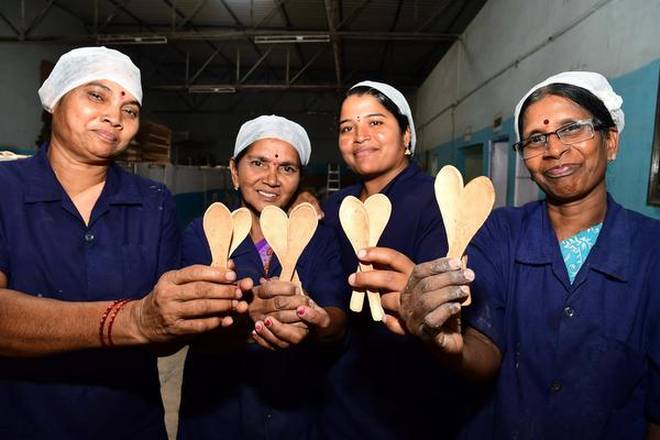
Bakey’s edible cutlery is Narayana Peesapaty’s solution to save the environment from plastic pollution.
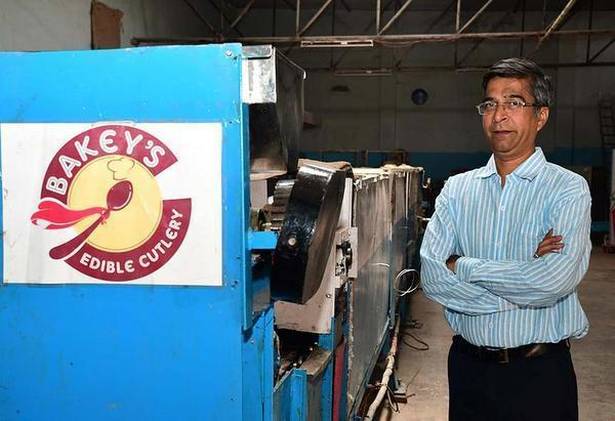
Narayana Peesapaty’s phone rings incessantly. Taking a break from the calls he says, “Enquiries about the product and machinery keep me busy all day. Even while I am at the factory, my staff and I get very little time to do any other work. ” Some of these phone calls are to congratulate Peesapaty for the Swachh Bharat Award, which he received on June 23 from Prime Minister Narendra Modi, on the occasion of World Environment Day.
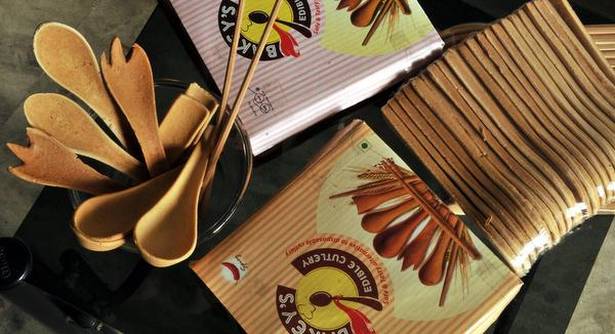
Apart from the congratulatory messages, some calls are enquiries for a product Peesapaty’s brand, Bakey’s, manufactures — edible cutlery. The unique cutlery is made mixing jowar (sorghum) with rice flour and wheat flour. He uses jowar only because unlike ragi and other millets, which have an overpowering taste, jowar is fairly neutral and allows different flavours to be mixed in.
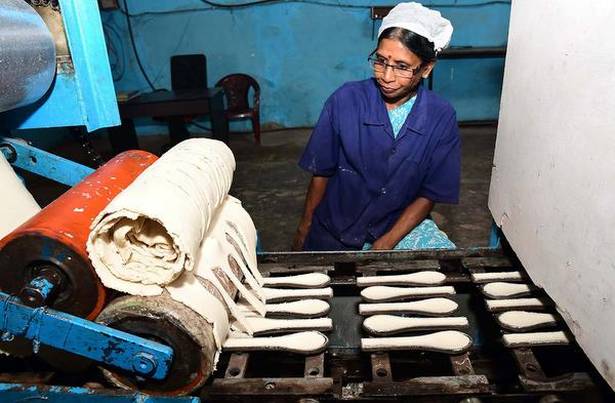
One year and many kilograms of millets later, Peesapaty, with the help of his wife, was able to successfully get the right recipe to make the spoons. Finally, in 2016, Bakey’s took shape. Baking the dough at 280° Celsius for 28 minutes makes them tough enough to even spoon up soup with. Peesapaty thought about this cutlery first by accident while he was 5000 metres above sea level. “I was on a business trip and had packed jowar rotis. I forgot all about it. Then, when hunger pangs began, I reached for my food. I don’t like in-flight meals. My jowar roti had hardened. It was brittle, but still edible. I slowly began scooping the curry with the pieces, thus making me aware of what can be done to avoid disposable spoons,” says Peesapaty.
He realised the solution was not simple. His obsession with finding an alternative to disposable cutlery had two angles. “Apart from harming the environment, do we really know how disposable spoons are disposed of in reality? If they are all really being disposed of, then spoon piles should be as big a concern as discarded sanitary napkins. But no one talks about single-use spoon piles. Why? Because, often, they are not disposed of,” asserts Peesapaty.
To double-check this theory, not only did he wade through garbage, but even started sneaking into catered events to get first-hand information. “I made my way to the ‘service’ section of the function hall. I saw that while food and other things were being discarded, the spoons were separated and put in a bowl of water. When I enquired about it, the staff said ‘the spoon will be washed and reused. It is the supervisor’s instruction’. Still not convinced? Wipe a disposable spoon with your finger or a tissue paper, or drop them in a bowl of water. You will observe a thin film of oil floating in the water,” he says.
Another concern is depleting ground water levels and the presence of chemicals in them. “Millets use less water than rice. The dry belt of Telangana was mainly cultivated for millets. Rice was aspirational because it was consumed by the rich. But once the farmers grew rice, they came into the trap of fertilizer companies, because dry lands do not yield good produce. Everyone wants to make a profit, so the use of fertilizers has become rampant,” says Peesapaty, explaining why he was determined to engineer his product specifically with millets.
The cutlery also serves the purpose of promoting millets for consumption. As a result, “Farmers get encouraged to cultivate millets, which require very less water,” explains Peesapaty. Bakey’s sources the jowar millet locally from Telangana.
The crisp spoons taste like thick baked rice crisps. They need a strong bite with the molar to break and chew them. The spoons, if not bitten, do not dilute the taste or flavour of the curry you are having. Bakey’s has sweet and savoury varieties as of now, and a team of 27 people are working on other flavours like chocolate as well, in the factory at Dilsukhnagar in Hyderabad. They are also looking at decreasing the current waiting period of two months.
“The demand and feedback the world over are overwhelming, and the company is taking care of delivery logistics on its own to keep costs down,” he says.
source: http://www.thehindu.com / The Hindu / Home> Life & Style> Food / by Prabalika M. Borah / Hyderabad – July 13th, 2018
A literary trove found in a grain market

Sarojini Naidu’s unseen private collection will soon be available for research
A treasure trove of hundred thousand private papers, books, paintings and scribblings of poetess and stateswoman Sarojini Naidu was discovered after a massive hunt ended in the Mahankali Grain Market attached to the famous Ujjaini Mahankali temple in Secunderabad.
Now, books and documents filling about eight almirahs have been moved to Marri Chenna Reddy Human Resource Development Institute (MCRHRDI) for safe-keeping and cataloguing. They will soon be available for researchers and historians. Though Sarojini Naidu hailed from Hyderabad, most of her personal papers and collections were donated to the Nehru Memorial Museum in New Delhi by her daughter Padmaja Naidu while some are with the National Archives of India.
The hint
The hint about these lost documents first came when former Foreign Minister Jaswant Singh was writing the biography of the founder of Pakistan Muhammad Ali Jinnah. Then again while former journalist and author Sheela Reddy was writing a book about the Jinnahs, she began searching for the documents and located them in the upper floor room of a busy grain market.
“It was 7.20 p.m. on August 2, 2017, and it had already become dark when the custodian of the market opened the door. Without any light, I could not see anything. The next day I reached there at 6 a.m. and the treasure in the almirahs blew my mind away,” said Raghavendra Singh, Director-General National Archives of India who was helped in tracing the papers by Ms. Sheela Reddy.
Among the collection were a few autographed portraits of Sarojini Naidu. “See this. This one has been drawn by the brother of W.B. Yeats (John Butler Yeats),” says Mr. Singh, showing an image clicked with his cellphone.
source: http://www.thehindu.com / The Hindu / Home> News> Cities> Hyderabad / by Serish Nanisetti / Hyderabad – July 11th, 2018
Master class on mitigating severe asthma
A Master class on Bronchial Thermoplasty, the ultra advanced procedure to treat severe asthma was organised by the Department of Interventional Pulmonology of Yashoda Hospitals here on Tuesday.
Said to be the first-ever such Master class in the country, the innovative and state-of-the-art procedure gaining rapid acceptance world over is available in few major modern medical centres. The Yahsoda had taken the initiative to organise the Master class for the benefit of practising pulmonologists, according to a release.
The two-day training programme included hands-on workshop and was inaugurated by Pavan Gorukanti, Director, Yashoda Hospitals Group, Hyderabad here on Monday. The Master class provided a comprehensive overview of advanced therapeutic bronchoscopic procedure- Bronchial Thermoplasty, he said.
About 200 leading pulmonologists from India and from overseas attended the programme. The Master class had both foreign and Indian faculties and few guest invitees including Adrian Chan from Singapore General Hospital, Singapore, Jamalul Azizi Abdul Rahman from Serdang Hospital, Malaysia and Elena from Romania and Deepak Talwar (Metro Hospitals) and Karan Madan (AIIMS) from India.
The programme also included live case demonstrations organised by the Yashoda Hospitals team of Interventional Pulmonologists led by Hari Kishan, V.G. Nagarjuna Maturu , M. Gangadhar Reddy and Y.Gopi Krishna. the release added.
source: http://www.thehindu.com / The Hindu / Home> News> Cities> Hyderabad / by Special Correspondent / Hyderabad – July 11th, 2018