How Telangana is building brand Hyderabad

Behind Hyderabad’s bounce-back as a technology destination is its IT, industries and municipal administration minister, K.T. Rama Rao
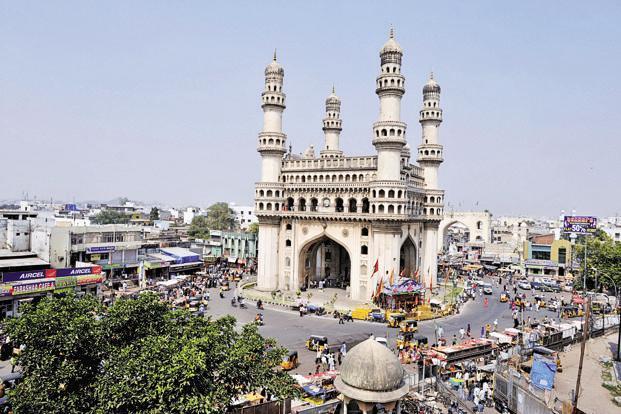
Hyderabad’s lower real estate costs coupled with the city’s excellent infrastructure work in its favour compared with other metros such as Bengaluru, Mumbai, Chennai and Delhi NCR. Photo: AFP

Hyderabad:

The Deccan city of Hyderabad was almost written off as an investment destination when K. Chandrashekar Rao swept to power in Telangana in June 2014.

The new state was just born after four years of tumultuous struggle. The agitation, spearheaded by Rao, witnessed prolonged demonstrations and shutdown calls, blocked train and road services through the region, largely disrupting public life.

Rao’s diatribe against the settled population hailing from Andhra and Rayalaseema regions of erstwhile Andhra Pradesh, it was pointed out, would drive away multinationals that seek talent based on merit, without regard for one’s ancestral background.

It was feared that Hyderabad, Telangana’s economic powerhouse, would die a slow death if KCR, as Rao is known, ignored the city that had already fallen behind other Indian metros, thanks to a prolonged agitation for statehood. Many thus dismissed KCR & Co.’s assurances of turning around Hyderabad, whose brand image had taken a bad hit during the years of agitation.

Precisely 23 months after the state’s formation, three of the world’s top technology companies decided to set up base in Hyderabad—choosing it over other cities such as Bengaluru, Delhi National Capital Region (NCR) and Mumbai. Taxi aggregator Uber Technologies Inc., the world’s most valued start-up, opened its first service centre in Asia in Hyderabad in February.

Apple Inc. was the latest jewel in Hyderabad’s crown when it established its first development centre in India in the city, joining other high-profile tech companies from America’s West Coast that made Hyderabad their home.

Salesforce.com Inc., one of the world’s top cloud computing companies, will open its first centre of excellence in Hyderabad on 7 June.

Before Apple and Salesforce.com, search giant Google Inc. and online retailer Amazon.com Inc. announced that they would have their biggest campuses outside home base US, in Hyderabad. Amazon has already commenced construction of a campus, as big as three million sq.ft, which is set to open by 2019.

Together with Microsoft Corp. and Facebook Inc., which had offices in the city before 2014, five of the world’s top technology companies have started or are in the process of setting up a significant presence in the city.

“The state formation happened after a period of turbulence. The very first task was to set the record straight,” said Jayesh Ranjan, information technology secretary of Telangana government, in an interview. The government met industry leaders promising physical safety of their employees, projected a pro-business attitude and showcased Hyderabad’s innovative environment.

The toning down of the rhetoric by Rao’s Telangana Rashtra Samithi (TRS) helped in assuaging the concerns of information technology (IT) sector.

In fact, investors were cautious and adopted a wait-and-watch mode during the initial months after the country’s youngest state took birth.

“People were not sure how the new government will function, how things will actually improve. The party had not been in power in the past. So people were waiting to see how they will perform,” said Vasudevan Iyer, director of Hyderabad market for real estate consultancy Knight Frank India Pvt. Ltd. “When the state split happened there was a lot of ambiguity among people and stakeholders, but then the way the government in Hyderabad actually performed is commendable.”

Behind Hyderabad’s bounce-back as a technology destination is its IT, industries and municipal administration minister, K.T. Rama Rao (known as KTR), a smooth-talking, charismatic former marketing professional who returned from the US to join his father’s party in 2004. KTR is the son of KCR.

After some initial follies, the father-son duo began nurturing Hyderabad, assuaging concerns, promoting the city as an attractive investment destination, and wooing global companies and start-ups alike. It helped that KTR has related portfolios of IT and industries (to draw investments) and municipal administration (to rebuild brand Hyderabad and address infrastructure issues).

Bengaluru, the IT and start-up capital of the country that had an early mover advantage, was Hyderabad’s biggest competitor.

KTR and his team quickly realized that they could not beat Bengaluru easily at its game of software exporting. They went to the drawing table and identified opportunities where they could “drive the bus”, Ranjan said.

Data analytics, cloud technology, internet of things (IoT), gaming and animation, start-ups, data centers—areas that no one city in India can yet lay a claim to—were identified in the process.

The team also watched carefully for Bengaluru’s follies.

So, when Karnataka taxmen went after e-commerce firms in 2014, threatening to halt their businesses, Telangana officials went knocking on Amazon’s door. Amazon had already signed the dotted line to set up its campus in Bengaluru. But in the backdrop of tax troubles in Karnataka, Telangana officials promised a conducive regulatory environment to Amazon, wooing the company to the state.

Of course, they also presented Hyderabad as an attractive (and cheaper) alternative destination to Bengaluru whose infrastructure was already bursting at its seams. Apart from the office space, Amazon also set up its then biggest Indian warehouse spread across 280,000 sq.ft in Telangana. Flipkart soon followed, opening its biggest warehouse, spanning 220,000 sq. ft, near Hyderabad.

That was also how they wooed back Google, which had decided to set up its campus near Bengaluru. Google had initially planned to set up its campus in Hyderabad—the company was even allotted land in Hyderabad way back in 2007—but reconsidered its plan after the land it was allocated ran into legal issues. With successive governments unable to solve the legal tangle, Google decided to move to Bengaluru, only to realize the city’s inadequacies. The Telangana government moved in quickly at this point by allocating site from its land bank and issuing quick clearances to Google.

At the same time, the government is attractively packaging the state as a destination for new-age technology companies. While governments across the world are grappling with disruption to their traditional industries by taxi aggregators and home lodging sites such as Airbnb, the Telangana government is assuring start-ups of rolling in conducive regulatory policies to ensure their business model can operate in the state.

Uber was in the eye of the storm over a rape incident in Delhi by one of its drivers when it announced its plan to establish its first centre of excellence in Asia in Hyderabad to provide round-the-clock specialized support for “critical incidents that require immediate attention”. Taxi aggregators such as Uber, Ola and TaxiForSure were under government scrutiny on whether they should be regulated when Uber said it will invest $50 million in the city.

The biggest factor that sealed the deal in Telangana’s favour was the government’s offer to “work closely” with Uber to develop a new regulatory framework. Telangana’s transportation department evolved a framework to allow new-age online services like Ola and Uber to operate without any ambiguity.

The state’s IT department, on its part, is continually making sure that issues related to new-age tech companies are addressed amicably.

When the Telangana government recently considered a ban on surge pricing, on the lines of the Delhi government, on Ola and Uber, the state’s IT department intervened on their behalf to point out the economic rationale behind surge pricing. The state’s transport department relented.

Of course, the city’s biggest advantage is a readily available talent pool of engineers graduating from the likes of IIT, IIIT and BITS-Pilani, among other engineering schools around the city.

“With a pool of quality talent, state-of-the art infrastructure and a progressive government, the state was a natural choice for us to set up our largest campus in India here,” David Zapolsky, senior vice-president and general counsel (legal) of Amazon, said in a statement in March, while breaking ground for the facility.

Hyderabad’s lower real estate costs coupled with, what is often lauded as, the city’s excellent infrastructure work in its favour compared with other metros such as Bengaluru, Mumbai, Chennai and Delhi NCR.

Last July, Ikea, the world’s largest furniture retailer, zeroed in on Hyderabad to purchase 13 acres of prime property at IT hub, Hitec City. Hyderabad was chosen over other cities such as Bengaluru, Mumbai and Delhi NCR for the company’s India debut.

“The difference between Bengaluru and Hyderabad is that Hyderabad offers twice the infrastructure of Bengaluru at half the cost,” said Ranjan.

KTR was quick to figure out the dynamics playing out in the global IT sphere. Even traditionally closeted companies such as Microsoft were embracing innovation and start-ups in a way never seen before, and the 39-year-old minister knew he needed to pitch the city as an innovation hub to make companies take Telangana seriously.

He sewed an arrangement between three of the biggest educational institutes in the city, Indian School of Business, Nalsar University of Law and International Institute of Information Technology (IIIT)-Hyderabad, to start a swanky incubator, T-Hub, close to the campuses of the big IT firms.

The incubator drew the likes of Microsoft chief executive officer (CEO) Satya Nadella and Infosys CEO Vishal Sikka to talk about innovation with the start-ups.

“For everybody (services companies and product development firms) the local innovation ecosystem is a key part of their consideration. Even if you want to attract a larger company, making sure there is an active thriving start-up ecosystem is a key part of that whole message,” Ramesh Loganathan, a recent president of local industry body, Hyderabad Software Enterprises Association, said. “It resonated well because some of the larger companies are looking at the city because we have projected a very strong R&D innovation start-up focus. They like to be operating in that environment.”

Sometimes it was just plain luck.

Telangana wasn’t even on the radar of plane maker Boeing Co. when a government delegation led by minister Rama Rao met the company’s executives in Washington DC during a tour last year.

Rama Rao and his team briefed Boeing about the state’s new industrial policy and how an aerospace ecosystem already exists in Hyderabad in the form of Indian government’s defence manufacturing installations and units of Tata Advanced Systems Ltd (TASL), which has tie-ups with Sikorsky Aircraft Corp, Lockheed Martin Corp., RUAG Aviation AG and Pilatus Aircraft Ltd.

After a series of meetings, Boeing finally zeroed in on Hyderabad to make fuselage for Apache helicopters in collaboration with TASL. The company is expected to break ground in June, Ranjan said.

Telangana is also among the states being considered by plane maker Airbus Group SE to set up a final assembly line for Panther helicopter it plans to make in India in collaboration with Mahindra Defence Systems Ltd. The company plans to make India a global hub for Panther helicopter production.

“Airbus Group is evaluating Telangana and Andhra Pradesh among several other Indian states to select a site for setting up a final assembly line for the Panther helicopter in case we were to be awarded the Naval Utility Helicopter programme,” an Airbus spokesperson said in an emailed statement.

source: http://www.livemint.com / Live Mint / Home> E-paper / Home> Politics / by Yogendra Kalavalapalli / Friday – June 03rd, 2016
Bobbing and weaving at Rasoolpura

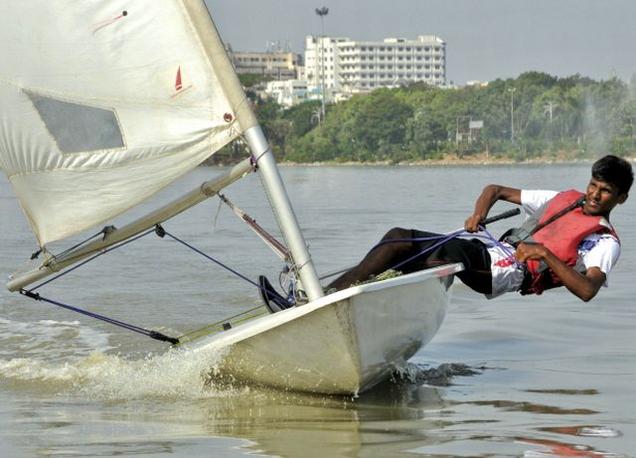
Yerrolla Prasad, a resident of Rasoolpura, sailing in the Hussan Sagar lake in Hyderabad. Photo: G. Ramakrishna / The Hindu
Yerrolla Prasad, a resident of Rasoolpura, sailing in the Hussan Sagar lake in Hyderabad. Photo: G. Ramakrishna
/ The Hindu

The slum is a nursery of sporting talent, and it’s in boxing that many of the youngsters show their punch.

This report is the third of a 12-part series on the changing face of the Indian slum, chronicling stories of new social and economic trends in our impoverished neighbourhoods

What makes them so athletic? Not a day passes without Rasoolpura’s young sportspersons making a dash for the track and field. Many vault into the boxing ring. A few go as far as the lake to tame the wind and sail. Girls hike to the ground for athletic training and handball practice.

A yen for sports, especially boxing, pervades the slum. Proximity to the Gymkhana Grounds, the famed cricket ground of Secunderabad, has stoked and preserved the passion.

Take Yerrolla Prasad, who has fallen completely in love with water but also occasionally spar. For this shy, soft-spoken 16-year-old, born and raised in a 7X7 tenement, sailing is a passion. If the wind keeps away, he leaps into the water for kayaking.

N. Shyam Prasad, who finished first-year B.Com., is saving up for a trip to Haryana to perfect his pugilistic skills, win the gold at the national level and join the Indian Air Force — his dream of years.

“All my friends abandoned sailing, overawed by the waters of Hussain Sagar Lake, despite their training in swimming. I never had any fear, and loved sailing. I hope it will help me get into the police service,” Yerrolla Prasad says.

The eldest of three children of a Dalit daily-wage earner, he snagged gold in the junior category of the Monsoon Regatta of the National Optimist Coastal Championship in 2014. Sponsored by the Yacht Club of Hyderabad, he participated in sailing events in Pune and Chennai. He was one of the 14 children from the slum trained in swimming by Bhumi, a youth-volunteer non-profit organisation, before being sent to the Yacht Club three years ago.

Shyam is now busy at a bakers’. “Four or five of us are working during summer holidays, so that we can save up for the trip and training in Haryana,” he says.

The Hyderabad District Sports Authority is coaching more than 10 youngsters from the slum at the Gymkhana Grounds. “We encourage youth to take up sports. The idea is to dissuade them from ‘gutkha’ and substance abuse. We ran a gym for three years, but had to shut it for lack of funds,” says Sheik Nayeem, convener of the Kriya Sangh Society, a community group trained by Bhumi before it left the slum.

N. Ramya, Shyam’s sister, wears her brother’s boxing shorts and shoes and trains with her friend K. Sandhya at the grounds for a summer camp.

“Initially, we could not cross our locality wearing shorts. There would be catcalls and jeers. Now, we wear trousers underneath and remove them after reaching the grounds,” says A. Bhavani, a Plus Two student.

Bhavani is into running, long jump, high jump and basketball, apart from handball. Introduced to sports during her schooldays, she was selected for training by the District Sports Authority and went on to participate in State-level handball and judo tournaments. Her brother A. Sai Kumar is into hockey.

“I studied in a private school, and though it didn’t have a ground of its own, the teachers took us to Gymkhana Grounds for games. It has become a habit,” Bhavani says.

Though parental aspirations are high about their wards’ education and career, that do not come in the way of sports.

Y. Bhaskar, Yerrolla Prasad’s father, has decided not to enrol his son in a private educational institution despite repeated calls from multiple colleges, as that would hinder his sailing aspirations.

“I want him to become an IPS officer. I hope his training as a sailor does help him get through,” he says, while his wife, Parvathi, nods in agreement.

“There are 130 to 140 self-help groups in this area, offering women loans at low interest rates. When it comes to school fees, loans of Rs. 10,000 to Rs. 20,000 come in handy,” Mr. Nayeem says.

“My daughter studied up to Class IX in a private school, after which they asked us to take her away as the school lacked recognition. I sent her to another English-medium school far off, though the fee is very high,” says Padma P., a domestic help. (With inputs from Rohit P.S.)

source: http://www.thehindu.com / The Hindu / Home> News> Cities> Hyderabad / by Swathi Vadlamudi / May 30th, 2016

T-Hub outpost in US

Hyderabad :

IT minister KT Rama Rao has said that an outpost of the T-Hub will be set up in Silicon Valley in the United States.

Addressing a convention of investors and IT professionals at Silicon Valley on Wednesday, Rama Rao dwelt at length on Telangana government’s plans on investments, industries and innovation. The meeting was attended by prominent industrialists from Silicon Valley.

Rama Rao said the Telangana government too started T-Hub to encourage new thoughts and innovations. The largest incubator T-Hub outpost centre would be opened in Silicon Valley, the minister said.

He said that efforts were on to make start-ups as scale-ups. ‘’We need support and cooperation from TiE (a global network of entrepreneurs) and investors from Silicon Valley,” the minister said.

“We are interested to partner with Silicon Valley and TiE to attract more investments to Telangana,” Rama Rao said.

The minister said the state government took up digital literacy in a massive scale and is moving towards m-Governance from e-Governance aiming to take the administration to the masses.

Rama Rao is currently touring the North American country along with some senior officials.

source: http://www.newindianexpress.com / The New Indian Express / Home> States> Telangana / by Express News Service / June 02nd, 2016

The story of India’s 29th State — Telangana

The Telangana Legislative Assembly. Photo: K.V.S. Giri / The HIndu
The Telangana Legislative Assembly. Photo: K.V.S. Giri
/ The HIndu

Telangana turns two on June 2 and the State government is pulling out all stops to make it memorable. The Telangana Formation Day also gives us an opportunity to revisit some of the key events that led to the creation of the 29th State of India.

The seeds of Telangana struggle were sown in 1955 when the recommendation of the States Reorganisation Commission to retain Hyderabad as a separate State went unheeded. Telangana leaders accused the people of Andhra of “colonising the region” by grabbing their jobs and land, and the government of not investing in the region’s infrastructure. On November 1, 1956, Telangana merged with the State of Andhra, carved out of erstwhile Madras, to form Andhra Pradesh, a united state for the Telugu-speaking populace.

Security personnel patrolling on Jawaharlal Nehru Road (Siddiamber Bazaar) during a 33-hour curfew in Hyderabad on June 05, 1969. Photo: The Hindu Archives/M.A. Rahim

The State witnessed a violent ‘separate Telangana’ agitation in 1969 and a ‘separate Andhra’ agitation in 1972. The 1969 stir was primarily started by social groups, students and government employees. Following the agitations, a six-point formula was evolved by Prime Minister Indira Gandhi for “accelerated development of backward regions and preferential treatment to local candidates in employment.”

Former Andhra Pradesh Chief Minister P.V. Narasimha Rao (left) and former Governor Kandubhai Desai (right) receiving the former Prime Minister Indira Gandhi, in Hyderabad on September 7, 1972. Photo: The Hindu Archives

Thereafter, the Telangana movement took a political turn. In 1997, the BJP supported demand for Telangana State and in the subsequent year, which saw an election, the party promised ‘one vote two States’. But the push intensified in 2001, when K. Chandrasekara Rao floated the Telangana Rashtra Samithi (TRS) to revive Telangana movement. Many believed it was the creation of Chhattisgarh, Jharkhand and Uttaranchal (now Uttarakhand) states that spurred the demand for Telangana. Three years later, the TRS fought elections in alliance with the Congress and won five Lok Sabha and 26 Assembly seats.

Karimnagar — the hotbed of the movement

During the first phase of the movement in 1969, Karimnagar district emerged as the centrestage for the intensification of agitations. While campaigning for the 2004 elections, Congress president Sonia Gandhi had also announced that she would respect the sentiments of the Telangana people in Karimnagar town by addressing a public meeting. Mr. Rao had contested as MP from the Karimnagar Parliament constituency in 2004.

In 2006 and 2008 by-elections too, he won from the same constituency. In all by-elections in the district, people voted in TRS candidates.

Karimnagar was the host for the intensification of Telangana statehood movement in 2009, when the TRS president had decided to launch a fast-unto-death, demanding the Telangana State. It was the same town where police had arrested KCR, who was on his way to launch his fast-unto-death in Siddipet town.

The movement had spread like a wildfire after his arrest in Karimnagar and several youth had committed suicide for the cause of Telangana.

Following the continuation of his fast-unto-death while in a hospital, the Union government had announced the formation of separate Telangana State on December 9, 2009. However, the government had again gone back on the issue on December 23, 2009.

About 17 pro-Telangana students had launched a fast-unto-death in front in the Osmania University campus after the Centre backtracked on the statehood issue.

Osmania University students staging a protest demonstration over the statehood issue. File Photo: G. Krishnaswamy

Sri Krishna Committee report

On February 3, 2010, a panel headed by Justice (Retd.) B.N. Srikrishna was formed to “bring about a permanent solution” to the statehood demand. The panel met 30 times, visited 23 districts and 35 villages and held interactions with about 100 organisations.

The report of the Committe for Consultation on the Situation in Andhra Pradesh was released by the then Union Home Minister P. Chidambaram, to representatives of political parties from the State on January 6, 2010. It said, “The united Andhra option is being suggested for continuing the development momentum of the three regions and keeping in mind the national perspective. With firm political and administrative management it should be possible to convey conviction to the people that this option would be in the best interest of all and would provide satisfaction to the maximum number of people in the state.”

Click here to download the full report (PDF- 7.1 MB)

Click here to download the summary. (PDF- 846.5 KB)

Click here to download the Appendices to the report (PDF- 10.4 MB)

___________________________________________________________________
The Hindu Editorial

The Editorial, dated February 15, 2010, said that “carving out smaller States is too important and complex an issue to be taken in the heat of inflamed passions and under the pressure of political agitations.” It called for peace and non-violent means to get to the bottom of the issue. “Those clamouring for a separate Telangana will surely help their own cause by extending full cooperation to the Srikrishna panel, instead of vitiating the atmosphere again by instigating violence or asking elected political representatives to resign. All stakeholders must ensure that the panel succeeds in its rather difficult task of balancing the interests and concerns of different sections and recommending a plan of action towards a solution, as set out in the terms of reference.” More…

______________________________________________________________________

Cabinet approves bifurcation

In December 2013, the Union Cabinet approved a Bill for the creation of Telangana State with 10 districts, paving the way for the bifurcation of Andhra Pradesh. The Cabinet had broadly approved most of the recommendations made by the Group of Ministers constituted to consider the contentious issues.

The Cabinet’s approval came after the Congress Core Group decided to adhere to the Congress Working Committee’s decision on a Telangana with 10 districts. Meanwhile, Osmania University in Hyderabad was slowly becoming the nerve-centre of the Telangana agitation. Student activists continued their agitation along with political leaders in the struggle.

Passage of the A.P. Reorganisation Bill

– The A.P. Reorganisation Bill was passed in 2014, listing out the specifics involved in the process of bifucation. Some of the salient features the Bill were:

– The Bill envisages Hyderabad as the common capital. The Andhra Pradesh Governor will be Governor for both successor States of Andhra Pradesh and Telangana.

– The common capital includes the existing area notified as Greater Hyderabad Municipal Corporation. Centre shall form expert committee to suggest a new capital of Andhra Pradesh within 45 days.

– The Centre will set up an apex council for the supervision of Krishna and Godavari rivers on water sharing.

– 25 Lok Sabha seats to be allocated to residuary Andhra Pradesh and 17 Lok Sabha seats to Telangana.

– Residuary Andhra Pradesh will get 175 Legislative Assembly seats and Telangana 119.

– Existing admission quotas in all government or private, aided or unaided institutions of higher, technical and medical education shall continue for 10 years during which common admission process shall continue.

– The Polavaram Irrigation Project will be declared as a national project and the Centre will take under its control the regulation and development and the Tungabhadra Board will continue to monitor the release of water to high level canal, low level canal and Rajolibanda diversion scheme.

– The High Court at Hyderabad will be common for both States till a separate High Court is set up for residuary Andhra Pradesh.

– Any dispute, regarding financial assets and liabilities, shall be settled through mutual agreement failing which by the Centre’s order on the advice of the Comptroller and Auditor General.

TelanE01jun2016

– All properties situated outside existing Andhra Pradesh will be apportioned between the successor States on the basis of population ratio.

– Greyhound and OCTOPUS forces of the existing Andhra Pradesh will be distributed after seeking opinions from the personnel and each of these forces.

– The award made by the 13th Finance Commission to the existing State of Andhra Pradesh will be apportioned between the successor States by the Centre on the basis of population and other parameters.

When years of struggle came to fruition

The last general elections to the Assembly and Lok Sabha seats in united Andhra Pradesh was held in two phases on April 30 and May 7. It was decided that the counting of votes for both phases would be taken up on May 16 and election process will come to an end by May 28. It was notified that the States of Telangana and residual Andhra Pradesh would come into effect from June 2.

The chief architect of the separate Telangana agitation, K. Chandrasekhar Rao, was sworn in Chief Minister of Telangana. Mr. Rao’s son K. Taraka Rama Rao and nephew T. Harish Rao, who took active part in the agitation, were among the 11 Cabinet Ministers sworn in at a simple ceremony, punctuated by slogans of ‘Jai Telangana’. Governor E.S.L. Narasimhan administered the oath of office.

And the celebrations began, India's 29th State was born. Photo: Mohammad Yusuf
And the celebrations began, India’s 29th State was born. Photo: Mohammad Yusuf

(Compiled by Sriram Sivaraman)

source: http://www.thehindu.com / The Hindu / Home> National> Telangana / by Internet Desk / June 01st, 2016

‘Amma Odi’ to transport new mothers home

Hyderabad :

We are aware of emergency 108 services that transport pregnant women to government hospitals. However, post-pregnancy, women are left to fend for themselves, and carry their newborns to their destinations with utmost care.

This would be a thing of the past now. Health minister Dr C Laxma Reddy announced on Tuesday that the government will soon launch vehicles that would assist a newly-delivered woman in reaching her house safe and secure.

“For this, we are going to launch a service – 102 – on the name of ‘Amma Odi’. Forty such vehicles will be launched soon,” he said. These vehicles will be kept available at remote areas, villages and agency areas and will arrive at government hospitals with just a phone call. The service would be free of cost.

Meanwhile, the government would also introduce a fleet of 50 vehicles that transport the bodies of poor people who die in government hospitals to their respective homes or to graveyards. The vehicles will be kept at Gandhi, Osmania and Niloufer hospitals in Hyderabad and two vehicles each will be kept at all the district headquarter hospitals.

source: http://www.newindianexpress.com / The New Indian Express / Home> Cities> Hyderabad / by Express News Service / June 01st, 2016

IIIT-Hyderabad to fund three innovative startups

Hyderabad :

At a time when most of the startups are focusing on solving fairly shallow problems, Avishkar, the start-up accelerator programme of International Institute of Information Technology, Hyderabad (IIIT-H) on Friday took three companies under its wings to encourage entrepreneurs who are into solving deep-tech problems.

Screened from about 140 applications across the world, the top three companies are all set to form the first batch of the six-month long programme. The selected startups will now work closely with the Avishkar team and the faculty members of IIIT-H labs and other partners over the next six months to get to a level of investment-readiness that will launch them to the next stage of their journey.

“We are a four-month-old company trying to build a virtual personal stylist for women. Through our app, we want to offer all the services that a stylist offers to women. In other words, we want to create artificial intelligence (AI) of a personal stylist. The best part about Avishkar is that unlike many accelerators, the programmes here are personalised for each and every startup and would be helpful for us to grow faster,” Komal Prajapati, founder, Fabulyst, said.

IIITtelangana31may2016

Aronin P, founder of Sastra Robotics, which made it to the first batch of Avishkar programme, said,“Our aim is to build next generation robotics arm that has special abilities and for that we need a fully equipped R&D lab and experienced people to guide us. Also, as this is an ambitious project, we need financial help at some point or the other. Through this programme, both these concerns are addressed.”

The programme facilitated by IIIT-Hyderabad Foundation, Co-Creation Consulting and 50K Ventures, aims to select 10 startups during the first year and each of the selected startups will receive `10 lakh seed funding.

Prof. Vasudeva Varma, Dean (R&D) said, “The Start-up ecosystem in India is currently very vibrant. However, most of these ventures cannot survive and be successful unless they have huge differentiation in terms of technology. With Avishkar, we will give these companies a massive edge by providing the required base of technology, mentorship, and talent on a need basis in addition to initial funding.”

Startups selected in 1st batch Fabulyst:

A start-up with a core team of data scientists, working on providing a superior and personalised search experience to women using advanced machine learning and AI technologies, thus creating a unique advantage in the online fashion market.

Sastra Robotics: Initially incubated at Startup Village, Kochi, the startup develops high-precision robots to automate and redefine hardware testing practices and has been successful in mimicking the human hand capabilities.

Endless Robotics: Founded by a team of students from BITS Pilani, this startup has already built intelligent wall painting robots to provide cheaper, faster and high-precision solutions to real estate owners. They are now working towards providing deeper image processing capabilities to their robots.

Deep Tech Accelerator

The programme focuses in the areas of Artificial Intelligence (AI), Augmented Intelligence (IA), and Augmented and Virtual Reality (AR/VR). The onus is on improving human comfort using cutting-edge technology.

source: http://www.newindianexpress.com / The New Indian Express / Home> Cities> Hyderabad / by V. Nirupa Sathya Sree / by Express News Service / May 28th, 2016

Heroes back home after Everest conquest

Adventurous spirit:Additional Superintendent of Adilabad district G.R. Radhika and D. Bhadraiah, a contract labourer, two of the five members who scaled Mount Everest, in Hyderabad on Saturday.— Photo: K.V.S. Giri

Three Telugus were part of a five-member team that scaled the world’s tallest peak.

One is a woman police officer working as Additional Superintendent in Adilabad district, G.R. Radhika, while the other is a contract labour on Andhra Pradesh Transco projects, D. Bhadraiah. Fatigued but beaming with pride, they flew back here at the end of a 50-day expedition after scaling the world’s tallest peak under the guidance of an ace mountaineer.

The three Telugu-speaking members of the expedition were part of an 8-member team, of which five actually breathed the shallow, but fresh air atop Mt. Everest a few days ago. They landed at Shamshabad airport to a warm welcome and loads of bouquets. When contacted, the expedition leader Shekhar Babu Bachinepally who runs the Bhongir Rock Climbing School in adjacent Nalgonda district seemed to have run out of words, describing his happiness at the success of the team he had trained.

The three others in the expedition who conquered Mt. Everest are an Indian Police officer of the Maharashtra cadre Suhail Sharma, an Indian Forest Service officer of Karnataka cadre, S. Prabakaran and Balan Shivaraman who works in a private company in Dubai. Apart from Mr. Shekhar, the two others who did not touch the peak included the team’s doctor Vimal Jaiswal and Ashok Munne who complained of pain and was advised by the Team Leader to give up this time.

Distinction

After Mr. Shekhar Babu himself scaled Mt. Everest first in the year 2007, he got the distinction of being the first civilian from South India to do so. Again, in 2014, he repeated his feat, with Poorna, a student of Class IX of Pakala village in Nizamabad district and Anand a student who is doing his graduation from the Nizam College here.

Poorna became the youngest girl in the world to climb the peak.

Speaking to The Hindu , Ms. Radhika, a police officer selected from Group I services in 2007, hailing from Anantapur district, said that if she could afford it, she wanted to do what is typically called ‘One Degree Skiing’ in Antarctica.

“I have been lucky and tough enough physically to conquer Mt. Everest but if it happens, I would like to realise my dream of ‘One Degree Skiing’ on the ice in Antarctica,” she said.

source: http://www.thehindu.com / The Hindu / Home> News> Cities> Hyderabad / by Suresh Krishnamoorthy / Hyderabad – May 29th, 2016

A first

Survey enters Limca Book of Records

The Intensive Household Survey by the State government held on August 19, 2014, has entered the Limca Book of Records as the most intensive household survey by a State.

In a certificate communicated to the State government, the Editor of Limca Book of Records, Vijaya Ghose, said the government created a national record with an elaborate exercise undertaken by nearly four lakh employees who covered 1.09 crore households in a single day. It was done to ascertain the social and economic status of citizens.

source: http://www.thehindu.com / The Hindu / Home> News> Cities> Hyderabad / Hyderabad – May 27th, 2016

Telangana chief secretary reviews plans for fish prasadam at Hyderabad

Hyderabad :

The state government is making all arrangements for the distribution of ‘fish prasadam’ for asthama patients in the city.

At a review meeting on the arrangements for the fish prasadam at the Secretariat here on Thursday, chief secretary Rajiv Sharma instructed the officials to install CCTVs, provide proper lighting, erect strong barricades and temporary sheds for patients, more counters and provision of adequate water tankers for storing fishlings.

The fish prasadam will be distributed at Exhibition Grounds on June 8 and 9 in the city. Security will be provided to Bathini Harinath Goud family. The chief secretary also stressed on maintenance of sanitation, garbage clearance, regular cleaning with bleaching powder.

As many as 110 special RTC buses would be operated from bus stands and railway stations to the exhibition grounds for the convenience of the patients. Usually over a lakh people from across the country attend the event.

source: http://www.newindianexpress.com / The New Indian Express / Home> States> Telangana / by Express News Service / May 27th, 2016

200 artistes to perform Perini dance

The heat is on:A policeman gulps down water during the rehearsal for Telangana Formation Day celebrations at Parade Grounds in Secunderabad.- Photo: K.V.S. Giri

One of the highlights of cultural programmes in connection with State Formation Day celebrations on June 2 will be Perini dance of Kakatiya period by 200 artistes at Lalita Kala Toranam.

The sequences in the dance reminisce preparation for war by the army based on a book ‘Nrutya Ratnavali’ written by Jayapa, the commander-in-chief of the Kakatiya army. It will be the first of its kind dance to be presented along with drumbeat, said Director of Culture Mamidi Harikrishna whose department will organise the event. A Telangana cultural carnival will be held at Tank Bund with 500 artistes performing folk arts, including Gussadi, Kommukoya, Lambadi dance, Puliveshalu, Bonalu, Kolatam, Pidathala Ramayanam and Batukamma. Noted gazal singer Talat Aziz will present Sham-e-Gazal at Lal Bahadur Indoor Stadium.

The other programmes during the day include performances by artistes of Telangana Sanskrutika Saradhi, the cultural wing of the Government, at People’s Plaza, Qawwali at Qilwat Grounds, Buddhist, Jain and Christian programmes at Harihara Kala Bhavan and all India Mushaira at Quli Qutb Shah Stadium. The Ravindra Bharati Auditorium will see classical dance and ballet on the theme “naa Telangana, koti ratanala veena”.

source: http://www.thehindu.com / The Hindu / Home> Cities> Hyderabad / by Special Correspondent / Hyderabad – May 28th, 2016