Zerodha launches trading portal in Telugu

Hyderabad :

Online brokerage firm, Zerodha, today launched its web based trading portal ‘Kite’ in Telugu.

It also announced Zero brokerage on all equity investments and the start of its mutual fund business.

Nithin Kamath, Founder & CEO Zerodha said, “The investment culture has to be nurtured, and we intend to do this not just by offering zero brokerage, but an extremely easy user experience with Kite in Telugu and providing more options for investment with our Mutual Fund platform.”

“Our plan is to reach out to the next 5 million participants who are currently not investing and show them how stock market can create wealth if invested for long termk,” he said.

Vice President Equity & Research Zerodha Karthik Rangappa said, “We are certain that Kite’s technology wrapped up and presented in a local language will not only ensure seamless access to markets, but also make the whole trading experience enjoyable”.

Kite is a minimalistic web based trading platform that adapts to mobiles and tablet. It is integrated with an advanced behavioural analytics and visualisation platform, called Quant, which helps traders understand their trading behaviour to make informed investment decisions, they said.

Apart from Telugu, Kite is now available in Tamil, Marathi, Kannada, Malayalam, Punjabi, Gujarati, Bengali, Odia and plan is to make it available in other major Indian languages in months to come.

Andhra Pradesh and Telangana forms one of the most important markets for Zerodha and currently, it has two branches and 11 partner support offices to meet the growing client requirements. VVK ARS

source: http://www.timesofindia.indiatimes.com / The Times of India / News Home> City> Hyderabad / PTI / April 20th, 2016

Megalithic site holds link to a hoary past

Historic find:Kendra Sirak, a researcher from United States, keenly watching a dolmen at the megalithic site near Kachanapalli.— Photo: By Arrangement

Kachanapalli continues to attract history enthusiasts and research scholars from far-off places

The vast megalithic site at Kachanapalli, known for its rich archaeological heritage and hoary past, nestled in bushy forests of Gundala mandal in Kothagudem division continues to attract history enthusiasts and research scholars from far off places.

The site has shot into limelight after its chance discovery by a team of undergraduate, PG and Ph. D students in history from University of Hyderabad and Khammam-based SR&BGNR Government Degree and PG College during a field trip to Kachanapalli in 2012.

Located about 75 km from Khammam, the sprawling site encompasses close to hundred megaliths comprising one female anthropomorphic statue in the vicinity of Batannanagar near Kachanapalli. One of the striking features of the site is the rock engraving of a person holding a baby right in front of a dolmen. A three-member team comprising experts in human skeletal biology and ancient DNA study had visited the megalithic site at Kachanapalli over a week ago.

The team included Assistant Professor Dr. Veena Mushrif Tripathy, Human Skeletal Biologist, Deccan College Postgraduate and Research Institute, Pune, Niraj Rai, Senior Research Fellow, Centre for Cellular and Molecular Biology, Hyderabad, and Kendra Sirak, Ph.D candidate in anthropology at Emory University, Atlanta, United States. Assistant Professor of History at SR&BGNR College Lt. K John Milton also accompanied them.

The team also visited the megalithic site on the campus of SR&BGNR College in Khammam. The college Principal Dr U Veerabhadraiah apprised them of the various types of pottery and iron implements unearthed from the megalithic site on the college campus a few years ago.

When contacted over phone, Dr Veena told The Hindu that the dolmens found at the site at Kachanapalli were very important from both archaeological and anthropological aspects. These megalithic monuments should be conserved for posterity. They will shed light on megalithic culture which was around 1000 BCE, their architecture, its development, mortuary practices and their beliefs about dead and their emotional behaviour, she noted.

The physical anthropological analysis will be helpful in understanding the adaptations, their morphology, pathology (ancient diseases) and their way of life, she said, adding that the megalithic monuments of Khammam will play a vital role in understanding local history.

source: http://www.thehindu.com / The Hindu / Home> National> Telangana / P. Sridhar / Khammam – April 20th, 2016

Photos on Hyderabad invited for a book

Hyderabad Metro Rail MD N.V.S. Reddy and investment banker Kali Kondury are working on a book ‘Hyderabad: Growing Global’, primarily addressed to Indian and global investors, CEOs of MNCs, captains of Indian industry and other decision makers towards furthering Hyderabad’s brand equity globally.

It will have three parts – Historic Hyderabad, Happening Hyderabad and Global Hyderabad – with high quality content, rich photography detailing the history, cosmopolitan culture, geographical and linguistic advantage, vibrancy and economic dynamism, fast growing infrastructure, world class educational facilities etc., of the city. The authors have appealed to those having high resolution photographs depicting the splendour and vibrancy of Hyderabad.

Those interested may contact Vijay Mandapaka at 7032703736/dgmcc.hmr@gmail.com. Selected photographs will be suitably acknowledged.

source: http://www.thehindu.com / The Hindu / Home> News> Cities> Hyderabad / by Special Correspondent / Hyderabad – April 19th, 2016

Dual delight intrigues botanists

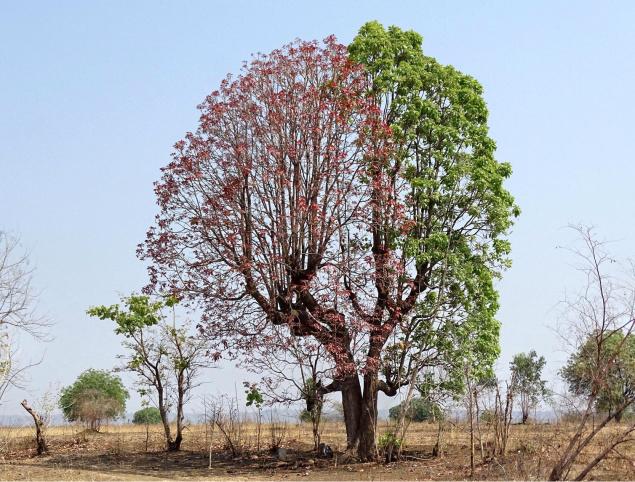
Bi-coloured wonder:A mahua tree with dual coloured foliage.–Photo: S. Harpal Singh

The mahua or ippa tree can be seen on the Utnoor-Asifabad road in Adilabad

Many miss this natural wonder while zooming past on the Utnoor-Asifabad road in Adilabad, but those who do spot the colourful tree, stop to marvel at its beauty. A majestic mahua or ippa tree, located about 500 metres from Heerapur village in Utnoor mandal, towards Jainoor, is a visual delight and scientific curiosity — half the tree has red-brown leaves while the other half has green leaves.

The tree retains this dual foliage from the end of March for about a month, soon after it sheds its flowers.

Adilabad has an estimated five lakh mahua trees, mostly in the tribal belt. The mahua flowers have medicinal value and form a major non-timber forest produce for the forest dwelling Gond and Kolam tribal communities.

The tree bears two differently coloured leaves at the same time apparently because it has a dual leaf development stage. “This could be because of two different seeds joining at the time of germination but retaining individual characteristics of growth on maturity,” said a forest department official of the rare phenomenon.

The tree is about 40 years old, according to villagers. “It was a young tree when I was a child,” recalled Atram Shankar, a 40-year-old Gond farmer from Hasnapur village, about 2 km from the bi-coloured beauty.

The Forest department has taken note of the tree with the rare foliage and Forest Range Officer of Utnoor, P. Ramesh Rao and others have visited the place to document the occurrence.

source: http://www.thehindu.com / The Hindu / Home> National> Telangana / by S. Harpal Singh / Adilabad – April 18th, 2016

Popularising the farm pond concept

In an effort to popularise farm pond concept, Komatireddy Pratheek Foundation dug up a farm pond at farmer Kola Bikshamaiah’s field at Kakulakondaram village of Nalgonda mandal here on Sunday.

Pratheek Foundation had started closely working with Deshpande Foundation, which has been actively working on rain water harvesting in Nizamabad and Maharastra.

CEO of Pratheek Foundation M.V. Gona Reddy said that they simply want to replicate the work of Deshpande Foundation in the district for the benefit of the farming community.

The chairman of the foundation and Nalgonda MLA Komatireddy Venkat Reddy said they were planning to initiate several skill enhancement programmes for the youth in the district to improve their employability. “They would also concentrate on maternal health, student leadership, micro-entrepreneurship and livelihood opportunities,” he said.

Several skill enhancement programmes planned to improve employability.

source: http://www.thehindu.com / The Hindu / Home> National> Telangana / by Staff Reporter / Nalgonda – April 18th, 2016

Collector urged to develop a cell at Quilla jail into national monument

Indur Bharathi general secretary Meka Ramaswami submitting a memorandum to Collector Yogitha Rana, in Nizamabad on Saturday.— Photo: K.V. RAMANA

Dasarathi Krishnamachary and Vattikota Alwar Swami, fighters of Telangana Liberation Movement, were kept in custody here

Meka Ramaswami, general secretary of Indur Bharathi, a literary and cultural organisation, appealed to District Collector Yogitha Rana to develop the cell in which the fighters of Telangana Liberation Movement – Dasarathi Krishnamachary and Vattikota Alwar Swami – were kept in custody during their incarceration at Quilla jail by the Nizam Nawab Mir Osman Ali Khan.

In a memorandum submitted to the Collector here on Saturday, he urged the administration to install life-size portraits of the two stalwarts who laid down their lives for people. The cell should be spruced up and developed into a national monument, he said.

Mr. Ramaswami also requested Ms. Rana to use her good offices to set up a permanent library on municipal or government land to enable people to read the duo’s literature and also to conduct research on them.

He thanked the Collector for her positive response to the twin demands.

source: http://www.thehindu.com / The Hindu / Home> National> Telangana / by Special Correspondent / Nizamambad – April 17th, 2016

UK Indian Transcribes Ancient Palm-leaf Folios

The ancient palm-leaf folios.

Hyderabad :

Writer, poet and multi-talented academic tutor at Sunderland University in the UK, Ragasudha Vinjamuri, has completed transcribing ancient palm-leaf folios in Telugu.

The palm-leaf folios have been in the British Library since 1942 and, after a three-year effort, Ragasudha completed the transcription providing a new insight into the life and work of the twelfth century theologian and philosopher Acharya Ramanuja.

The work, in the form of Satakam, will be released in the British parliament on May 10 on the occasion of the 999th birth anniversary of Ramanujacharya. British parliament member Bob Blackman will preside over the function.

Ragasudha is a writer, poet, journalist and founder of Sanskruthi Centre for Cultural Excellence. She has also popularised folk dances such as Koya and Lambadi to a wider audience in the UK.

Ragasudha came across the palm-leaf folios through the curator of South Indian languages at British Library, Nalini Persad, who asked the former to look through the folios.

Some folios were badly damaged and needed Ragasudha to extensively research and identify the missing content from those broken folios. She could ascertain the author of the work with the help of scholars in India. It took more than three years for completing the entire transcription. “I am glad to transcribe the palm-leaf folios that were in the possession of British Library, ascertained by scholars and historians to be about 300 years old,” she said. Vinjamuri now wants to bring into light some mythological characters that received little attention.

Ragasudha researched various texts and puranas and is now planning to bring out the story of characters like Lord Krishna’s daughter, Lord Shiva’s daughter and King Dasaratha’s daughter in dance form, titled ‘Unknown Daughters’.

source: http://www.newindianexpress.com / The New Indian Express / by Express News Service / April 11th, 2016

Seed is better preserved this way

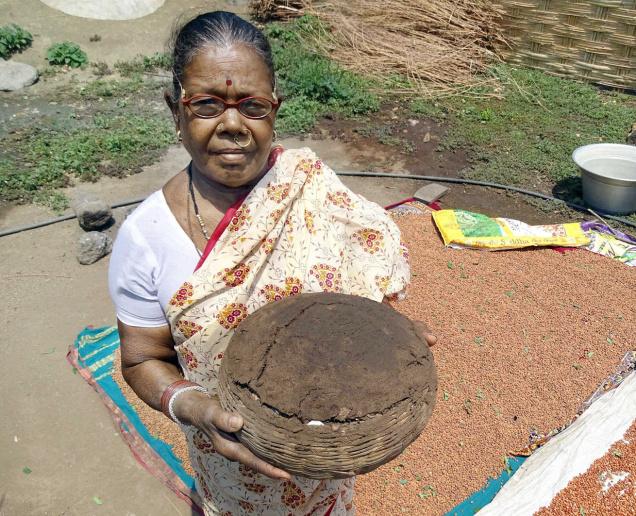
WAY FORWARD:tram Laxmibai displaying the airtight basket with seeds-Photo: S. Harpal Singh

Effective procedure of Adivasis to preserve seed for cultivating millets needs to be popularised

One of the important aspects of biodiversity conservation is seed preservation but, this area is perhaps the least bothered about in the gamut. While the non-tribal farming communities have jettisoned seed preservation technique completely after taking to foodgrain hybrids, the Adivasis in Adilabad district find no use for it despite the instance of cultivating desi or indigenous varieties.

As there is a sort of revival of the tradition of cultivating local varieties of millets by the aboriginal tribe farmers in the interior and far flung areas in the tribal belt, the need to revive the seed preservation technique has become imperative. Preserving seed could also help farmers in reducing their investment, according to agriculture experts.

“We are cultivating local variety millets in a limited extent which does not require us to preserve seeds beyond a few months. The little quantity of seeds which we get in one season is used up in the ensuing season,” explained Atram Madhav Rao, a Gond Adivasi farmer from Seetagondi village in Sirpur (U) mandal.

“I have some quantity of sama (little millet) and bhadi (barnyard millet) from 12 years back,” revealed Laxmibai, Madhav Rao’s mother. “Using this technique I can preserve seeds for longer even,” she added.

The technique which Laxmibai talked about is simple yet effective going by its potential to preserve seed. The seed which are needed to be preserved are stored in an airtight bamboo basket. The basket, its size varying with the quantum of seeds to be stored, is first lined with a thick layer of neem leaves from the inside. A thick layer of ordinary ash is covered over it and the seeds are placed over it.

After closing the lid of the basket, it is smeared with clay mixed cow dung to make it air tight.

“This mixture ensures that the seed remain without decaying or losing their potency to germinate over a long period,” Laxmibai stated.

The Integrated Tribal Development Agency (ITDA), Utnoor, will now take up awareness programmes aimed at reintroduction of the simple seed preservation technique among the Adivasis where it is promoting cultivation of desi varieties of millets.

“We need to do so, so that farmers who are cultivating the local varieties get self-sufficient in terms of seeds at the earliest,” observed ITDA Project Officer R.V. Karnan.

The ITDA is promoting cultivation of indigenous millets under the Vanabandhu Kalyan Yojana. It has procured seed from Adivasi farmers and distributed in areas where the tradition had been lost.

source: http://www.thehindu.com / The Hindu / Home> News> National> Telangana / by S. Harpal Singh / Adilabad – April 15th, 2016

Kadaknath breed of rooster to foray into Khammam

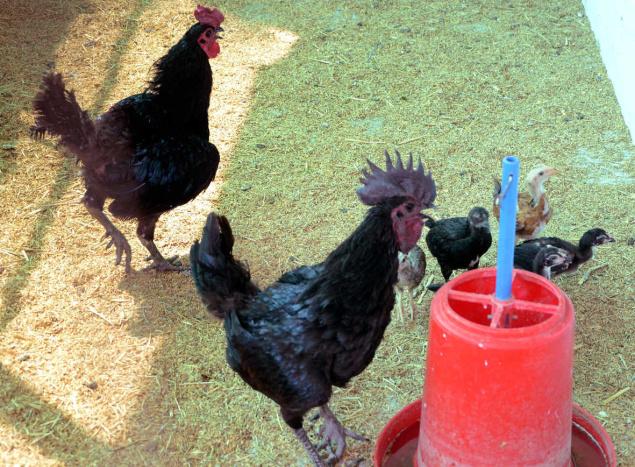
Seeking popularity:The Kadaknath breed of roosters at the demonstration unit of the Krishi Vigyan Kendra in Wyra of Khammam district.– PHOTO: G.N. RAO

Known for its unique black colour and black meat, the rooster suits the taste and preference of health-conscious people

The unique jet black coloured rooster christened ‘Kadaknath’ – the indigenous fowl breed of tribal heartland in Madhya Pradesh – is all set to foray into the predominantly tribal-populated Khammam district if the ambitious plans of the Wyra-based Krishi Vigyan Kendra (KVK) to popularise the low-fat and protein-rich native breed of chicken among local farmers are any indication.

The KVK has a small number of Kadaknath roosters known for their unique black colour and black meat that suits the taste and preference of health conscious people. Kadaknath breed of fowls stands out from other popular native variety of roosters at the demonstration farm of KVK by virtue of their unique jet black colour

The Kadaknath breed rooster acclaimed wide popularity in various parts of the country as a viable means of boosting income levels of rural households through backyard poultry farming.

Several farmers from various mandals in Khammam division evinced keen interest in the breed during a demonstration organised by the KVK scientists in Wyra recently.

Gauging farmers’ interest in the indigenous breed of rooster, KVK officials have drawn up plans to hold more demonstrations to highlight the benefits of rearing Kadaknath breed of fowls in terms of income and nutritional value among low-income families, particularly in tribal pockets of the district.

The breed is most suitable for backyard poultry rearing considering the low investment involved and good returns assured by it, says Hemanth Kumar, programme coordinator, KVK, Wyra.

Some farmers are rearing Kadaknath breed fowls in Sattupalli in Khammam district and a few other places elsewhere in the State, besides Tadepalligudem in West Godavari district of Andhra Pradesh.

Efforts are under way to popularise and promote backyard rearing of indigenous breed of roosters such as Kadaknath, Giriraja and Vanaraja to supplement the income of rural households and cater to the demand for eggs and meat

The protein-rich Kadaknath black meat contains low fat compared to other breeds of chicken, particularly the broiler variety.

This makes the Kadaknath breed most suitable for backward rearing to supplement income and serve nutritional needs of tribal people, he remarks, adding that farmers were being given tips on taking up backyard country chicken farming.

Inadequate availability

Inadequate availability of Kadaknath chicks and lack of proper financial support are posing major hurdles in undertaking backyard poultry farming using the most sought-after Kadaknath roosters, deplores Suresh, a tribal farmer of Venkatapuram.

The government agencies concerned should provide Kadaknath chicks free of cost and extend subsidies to exclusively promote the farm enterprise in remote tribal pockets of the district, he suggests, asserting that such a move would help check drought-induced migration in Agency areas.

source: http://www.thehindu.com / The Hindu / Home> National> Telangana / by P. Sridhar / Khammam – April 14th, 2016

SCR bags laurels for best performance

South Central Railway (SCR) has set a record of sorts by bagging All India Performance Efficiency Shields in six disciplines for the year 2015-16. General Manager-SCR Ravindra Gupta attributed the achievements to the commitment and duty-mindedness of the work force.

The six disciplines include those for comprehensive healthcare, stores, civil engineering, commercial, safety and environment management. With this, SCR made its mark at the national-level, on Indian Railways. The awards are to be presented by Minister of Railways Suresh Prabhu at the Central function of the Railway Week celebrations by Indian Railways on April 16 at Bhubaneswar.

General Manager-SCR, Ravindra Gupta attributed the success to the commitment of the work force. It was their zeal that led to the SCR attaining such results, by overcoming challenges, he said, addressing a large gathering of railway officers, staff and their family members at the 61st Railway Week Zonal-level celebrations held here on Monday.

Later, Mr. Gupta gave away 164 individual awards to officers and staff, 31 Efficiency Shields to departments and divisions, seven group awards and two special awards.

The function came to an end with the General Manager’s Efficiency Shield for over all best performance going to Secunderabad Division.

source: http://www.thehindu.com / The Hindu / Home> News> Cities> Hyderabad / by Special Correspondent / Hyderabad – April 12th, 2016