Rockwell Industries’ factory in Medchal gets Platinum rating

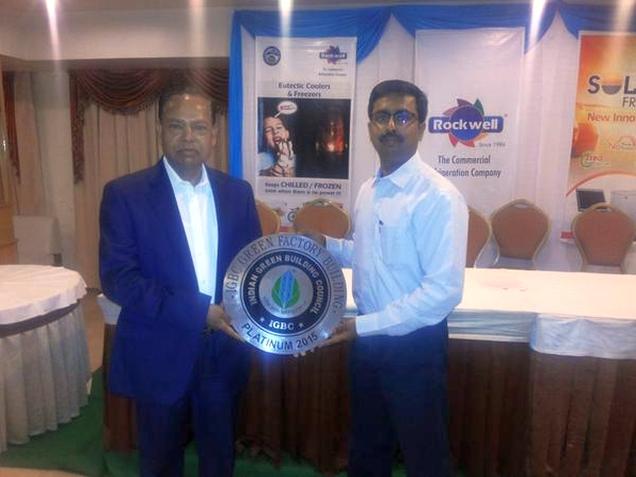
Rockwell Industries MD Ashok K.Gupta & M.Anand, Principal Counseller, IGBC Accredited Professional, displaying the Platinum rating shield in Hyderabad on Wednesday. Photo: N. Ravi Kumar / The Hindu

This is the first factory in all of Telangana and Andhra Pradesh to achieve the Platinum rating, declared M. Anand, Principal Counsellor and IGBC-accredited professional.

Cold chain equipment manufacturer Rockwell Industries’ new facility in Medchal, near Hyderabad, has achieved platinum rating standards of IGBC (Indian Green Building Council) for factory buildings.

The parameters for which it got the highest rating certification range from energy and water consumption, green energy generation, providing green landscape to using re-used materials.

This is the first factory in all of Telangana and Andhra Pradesh to achieve the Platinum rating, declared M. Anand, Principal Counsellor and IGBC-accredited professional at the CII-Sohrabji Godrej Green Business Centre, who was associated with the project.

Senior executives of Rockwell, led by Managing Director Ashok K. Gupta, at a press meet here on Wednesday, said that the facility was the first in its category across the country to receive the Platinum rating. “The new facility of Rockwell proves that factory buildings in Indian sub-continent can be made green by carefully working during design and construction stages,” explained Mr.Gupta.

Set up at a cost of Rs.28 crore, the company has incurred an incremental eight per cent cost towards the green parameters. In less than two years, it could recover the cost, said Mr.Anand. Manufacturing operations at the 45,000 sq ft facility began about a year ago.

Counting the green initiatives, he said that Rockwell had set up a 100-kilowatt roof-top (on-site) solar PV and a 1.5 mw windmill (off-site renewable energy generation) in Madhya Pradesh.

Towards reducing energy consumption and costs measures such as reflective roof coating, minimising lighting energy consumption by maximising use of daylight, provision of efficient LED and CFL fixtures have been made. Ultra low flow flush fixtures and 100 per cent rain water harvesting are some other features of the new facility.

A release from Rockwell said that the company received the green rating certificate on Monday from Telangana IT and Panchayati Raj Minister K.T.Rama Rao during the launch of Swachh Digital Telangana programme.

source: http://www.thehindu.com / The Hindu / Home> News> Cities> Hyderabad / by N. Ravi Kumar / Hyderabad – July 08th, 2015

Students showcase novel models in ‘eye care’

A group of students showcased how the buzzwords ‘technology’ and ‘innovation’ can help provide effective and affordable healthcare in the country.

At the ‘ReDx: Engineering the Eye’ workshop, which was inaugurated on Sunday, engineering students collaborated with their mentors from the medical fraternity to exhibit unique alternatives as well as newer ideas in eye care. In the workshop organised by L.V. Prasad Eye Institute, Camera Culture Group and MIT Media Lab, about five potential prototype models were on display.

One such model was JULIA (Just Use Logic in Imaging App), which was developed by a team of ten members selected from various institutes from across the country. “Autorefraction and Retinoscopy are the two methods used to detect refractive errors.

The equipment is expensive and the process is time consuming,” said Venu Madhav, IIIT student and member of the project.

“We have developed a device, which if manufactured on a large scale, costs only Rs.100 per piece. This can be operated even by an illiterate person and the test results can be known immediately. We tested this on 200 people and the difference of results of our device when compared with usual equipment was minor.”

Another tool called ‘visual field testing for babies’ is a first, according to those developing it. “Babies in the age group of three months to twelve months are checked for sight issues. There is no such testing for babies available now and this will help in early detection of Glaucoma and other eye ailments,” said Prem Nandini, mentor of the group.

Telangana IT Minister K.T. Rama Rao, who inaugurated the workshop, assured that the State government would provide favourable conditions for entrepreneurs and suggested that students ‘Indianise’ their products for the benefit of society.

Gullapalli N. Rao, Founder-Chair, L.V. Prasad Eye Institute, said that they aim to reach the most neglected citizens with the efforts.

In its third year, the programme saw about 100 participants.

The exhibits will be showcased for the next one week in Engineering Staff College of India in Gachibowli.

L.V. Prasad Eye Institute, Camera Culture Group and MIT Media Lab organise ‘ReDx: Engineering the Eye’ workshop

source: http://www.thehindu.com / The Hindu / Home> News> Cities> Hyderabad / by Staff Reporter / Hyderabad – July 07th, 2015

Filling Gaps in History

Hyderabad :

“Konjem konjem Telugu vastundi and thoda bahut Hindi bol leta hun,” says Benjamin E Cohen with a boyish grin. An associate professor in history at the University of Utah, Benjamin was on one of his yearly visits to the city. Also a research scholar, he was here to launch his second book, ‘In the Club’.

PIC: A RAdhakrishna
PIC: A RAdhakrishna

“People at the book launch said that my books and writings are ‘history, with a twist’. I like that. That is how my work is,” he says, with a wink.

Though it may seem quite natural for a history scholar to explore the history of clubs in a diverse country like India, the idea of dedicating a book that helps understand club culture is unconventional.
Benjamin explains, “I knew there were many old clubs across India and South Asia. I investigated whether or not any scholar had taken up their history – their whole history and not just one individual club. It turns out that there was a gap. I was interested in filling that gap.” He also shares his experience, “when you ask people if they know about the Secunderabad Club, they say yes. But if you ask them to elaborate, nobody will.”

The book takes a look at clubs in India, their role in building an associational life and a civil society in colonial India.

“It also talks about their role when India was transitioning from colonial rule to independence,” he elaborates.

His first book, ‘Kingship and Colonialism in India’s Deccan: 1850-1948’ was a fresh perspective on the relationship between the rulers and the ruled. Using archival material and not hearsay and rumour, Benjamin reconstructed the societal equations without any blinkers.

Benjamin is grateful to his friends and colleagues especially here in the city who have helped him draft the book. His biggest strength is his fluency to read, write and converse in Telugu, Hindi and Urdu. “I studied my languages first as a graduate student at the University of Wisconsin in Madison. Then I had the opportunity to live and work in Hyderabad during my graduation. I took private lessons with both Telugu and Urdu teachers. I tried to keep up with the languages back in the states,” he shares and adds that his interest in the area began when he was a child. As the son of a political scientist who also specialised in South Asian studies, he first came to India in 1977.

“I lived in Vizag, Delhi and Mussourie. We spent a year in Hyderabad. My whole life, I have either come to India or grew up in a home that was steeped in either Indian or South Asian culture,” he recalls. He worked in Chicago for three years after that.

“I was tired of that life,” he admits, “What I really wanted to do was find out more about India and South Asia,” he shares. Ask him what he likes about India and he counter questions, “How can I begin to answer that question?” and adds, “India is both a very old civilisation also a very young democracy. I find that combination fascinating. India has more excitement in one block than America has in 10.”

That is why he enjoys coming to India and is glad to contribute to its rich and diverse history. He also has two interesting projects lined up.

“I am finishing a book on Nawab Mehdi Hasan Fateh Nawaz Jung who was a minister in Hyderabad from 1883 to 93. He came here from Lucknow to work in the Nizam’s government. He had a British wife and they ran into some trouble. It was a scandal and was on the front pages of all the newspapers,” he tells us.

Another is a long history of water in Telangana from the Kakatiya rule. “I am very excited about these projects,” he exclaims.

source: http://www.newindianexpress.com / The New Indian Express / Home> Cities> Hyderabad / by Rajitha S / June 19th, 2015

More focus on Telangana in text books

Littérateur and member of text book review committee, Sunkireddy Narayana Reddy said that they gave greater importance to Telangana history, literature, prominent places and persons in the revised text books.

Addressing a discussion organised by Jayamitra Sahitya Samskrutika Vedika and Department of Education on the revised school text books here on Sunday, Mr. Narayana Reddy, said that they have discussed thoroughly on each and every lesson that were to be included in the curriculum. and quality of content was improved.

Noted poet, Venu Sankoju presided over the discussion. M.V. Gona Reddy, Belli Yadaiah, Achuyutha Ramaiah and others were present.

source: http://www.thehindu.com / The Hindu / Home> National> Telangana / by Staff Reporter / Nalgonda – July 06th, 2015

Women’s Hockey: Soundarya, Rajani script history

They are the first women hockey players from AP and TS to join the Indian team, which qualified for the 2016 Rio Olympics.

Yendala Soundarya
Yendala Soundarya

Yendala Soundarya and Etimarpu Rajani scripted history by becoming the first-ever women hockey players from Andhra Pradesh and Telangana to be members of the Indian team which qualified for the 2016 Rio Olympics.

 Etimarpu Rajani
Etimarpu Rajani

The last time India played in Olympics was in the 1980 edition when it was given a direct entry because of the boycott led by USA in the Moscow edition.

India made it to the next edition of Olympics (for the first time after 36 years) by virtue of defeating Japan 1-0 in the play-off match for the fifth place and both Ms. Soundarya and Ms. Rajani were part of the team in the World Cup semi-final league matches in Belgium.

Ms. Soundarya says she is delighted. “This is one of the finest moments in my career. We are all so happy that our biggest dream is coming true,” said both Ms.Soundarya and Ms. Rajani in a chat with The Hindu in Belgium.

For someone who took to hockey watching seniors and playing for India since 2006, the 25-year-old Ms. Soundarya was also a member of the Indian team, which won the silver in the Senior Asia Cup and the Champions Trophy.

Ms. Soundarya says that the team was confident in today’s crucial match. “Hats off to my teammate Rani Rampal; we emerged winner. And we are in celebratory mood right now,” she said in a voice choked with joy.

“I owe my success to my first coach Maqbool in Nizamabad and then to the SAI coaches, including Gloria, at the SAI Centre in Hyderabad, where I trained for five years,” the star player recalled. “Right now, no major event is scheduled and since we have qualified for the Olympics, some events may be lined up,” she said.

“I feel honoured to play for India, coming from a place like Nizamabad (she was a student of Modern Public School) which has no history of hockey players,” Ms. Soundarya exclaims.

Achievements not a surprise

SAI hockey coach P. Madhukaran, who was earlier the Indian women’s World Cup coach, recalls the abundance of talent these girls have shown in their formative years.

“Their achievements are not a surprise to me given their commitment and sincerity to keep improving,” he says.

source: http://www.thehindu.com / The Hindu / Home> National> Andhra Pradesh / by V. V. Subrahmanyam / Hyderabad – July 06th, 2015

On the threshold

Shop with fun: The Bethel Store. Photo: Special Arrangement

In a first of its kind in the country, St. Francis College sets up a retail store to be managed by students of Retail Management & IT course

For better learning experiences and prospects, students won’t settle for anything less than the best. The Department of B.Voc (Retail Management & IT) of St. Francis College for Women, Begumpet is attempting to provide just that, as it takes opportunity into a completely new, uncharted and exciting array.

Bethel Retail Store is a first of its kind in the country — a store for and by the students — aiming to to provide students with a hands-on experience of managing a retail store.

“The idea of the store stemmed from the need to provide students a way to implement classroom learning; industry assignments, projects, live research and internships are limited due to time and resource constraints. The course is a skill-based and focused on practical learning. So, it’s like a lab for the students to explore and be trained in,” shares Subi Verghese, Head of Department of B.Voc (RM & IT).

The store will showcase merchandise from various retailers for products ranging from textile, footwear, jewellery, books, cosmetics, handbags and designer wear. The present focus is on collaborating with small entrepreneurs, but could tie up with bigger brands in future. The format of the store will chang every month.

In running and managing the store, students will handle everything from promoting and marketing it to unpacking the products, setting up the display counters and shelves, selling to a customer, billing and handling cash operations of the store. Department faculty explains that they have set aside an hour in their timetable for skilling and students would handle the store in shifts.

“Industry retail experts will also train the students. The store isn’t expected to be a commercial establishment, but a platform to learn. A lot of initiative has been taken by the students themselves during the initial stages in terms of contacting people and implementing the idea. They’re thrilled about it,” adds Subi.

Mahati, a student shares her excitement: “At first we were sceptical of the idea and how we would go about it. But as it built up we realised it was an amazing opportunity. I’m expecting to learn more about aspects like how to visually market products.”

“This is something beyond what we’ve expected and we’re all eagerly waiting to start working at the store!” adds Usha, another student.

The store will be operational from mid-August, during the college hours. With the tagline “The Threshold of learning”, the store aspires to be that and more.

source: http://www.thehindu.com / The Hindu / Home> Features> MetroPlus / by Sadiyah Y. Lasania / July 02nd, 2015

Nikitha catches the ‘magic bus’ at the right time

Dantulturi Sri Nikitha practising football on the school premises on Friday.– PHOTO: Mohd Arif

Dantulturi Sri Nikitha of Nyamatabad in Nyalakal mandal, who dropped out from school, has a reason to celebrate now. She has made it to the football training programme at New Jersey, USA.

Three years after she left the school for financial reasons, Magic Bus, a voluntary organisation working with children, recognised her talent in football and helped her hone her skills as a goal keeper.

Her parents Subba Raju and Vijaya Lakshmi, who are farm labourers, had plans of marrying her off once they get a suitable groom. It was at this juncture that Magic Bus recognised her talent and prodded her to pursue it with enthusiasm. She came to the limelight during one of the community sports events organised by the Magic Bus. “Thanks to Magic Bus which made all efforts to get her readmitted to school. They convinced her parents to do so. Without the organisation, Nikhita’s talent might not have gotten proper exposure,” says Shakeela, Principal, Navabharat High School, where Nikhita is studying at present. Under Nikhita’s leadership, the school football team won more than eight matches and also represented the school at the State-level last year.

“She was distraught when we refused to readmit her in the school. Some of our relatives are still against she going to the US as they think that it will be of no use for her. Only her uncle, Subrahmanyam Raju, supported us throughout,” says Nikhita’s parents. But nothing has deterred Nikhita from chasing her dream. Ask her about it and phat comes the answer: “I want to become a football player. To achieve that, I will do whatever that is needed to be done. But my family needs support too ,” says Nikhita, who is flying to New Jersey today to be trained by Sports Leadership Academy there.

With the help of Magic Bus, a voluntary organisation, a dropout from school has managed to go to the US for training in football

source: http://www.thehindu.com / The Hindu / Home> National> Telangana / by R. Avadhani / Mirajpur (Medak District) / July 04th, 2015

Yet another first for Sania Mirza

Three-time Grand Slam winner, Sania Mirza.

First woman tennis player from India to be top-seeded in Wimbledon

Twenty-eight-year-old Sania Mirza has become the first woman tennis player from India to be top-seeded in the ongoing Wimbledon or for that matter, any Grand Slam championship.

“It’s a great honour to be the top-seed in what is considered to be the ‘home of tennis’,” said Sania from London, before leaving for practice on Friday, ahead of the next match.

“It’s a proud moment and is an official acknowledgement of Sania’s sustained, consistent performances at the highest level,” said her father, Imran Mirza.

Ms. Mirza, incidentally, is playing her 15th year at Wimbledon. She won her first major title there in 2003 at the first junior Grand Slam, in the girls’ doubles category. Sania’s best at Wimbledon in women’s doubles has been the semi-final appearance with partner, Vesnina. It also means she is now a member of the ‘Last-four Club’ in Wimbledon and enjoys certain privileges for a lifetime, including use of a special locker etc.

“No matter how many times you’ve been here, it is still really exciting. I have several beautiful memories associated with the ‘BIG W’,” said Mr. Mirza. His daughter’s performances at Wimbledon have been memorable, including the three-setter in singles, which she lost to the then reigning US Open champion, Svetlana Kuznetsova, playing for the first time on the famed Centre Court, besides beating Japan’s Akiko Morigami.

The only Indians top-seeded in a Grand Slam earlier were Leander Paes and Mahesh Bhupathi in the 1999 French Open edition men’s doubles. Ms. Sania Mirza, a three-time Grand Slam winner, is determined to complete a career Grand Slam, having won the mixed doubles titles in the Australian, French and the US Opens earlier.

Becomes the first woman tennis player from India to be top-seeded in the ongoing Wimbledon

source: http://www.thehindu.com / The Hindu / Home> News> Cities> Hyderabad / by V.V. Subrahmanyam / Hyderabad – July 03rd, 2015

NRI Kids Donate Rs 30,000 for Mission Kakatiya

Hyderabad :

Inspired by the state government’s effort to revive lakes in the state under Mission Kakatiya, a group of NRI children donated Rs 30,000 to irrigation minister T Harish Rao on Wednesday.

The children said the amount was raised by working during weekends by cleaning up gardens and cars in their locality.

Born in US and studying in prestigious schools in the city like Oakridge, Chirec, Delhi Public schools, the students run a social service organisation called Hill County Interactive Club.

Harish Rao congratulated them for their gesture.

source: http://www.newindianexpress.com / The New Indian Express / Home> States> Telangana / by Express News Service / June 25th, 2015

Gadwal weavers spin a divine gift for Tirumala

Mahbubnagar :

A family of weavers in Gadwal in Telangana receives a rare honour in the run up to the Brahmotsavams at the Sri Venkateswara temple in Tirumala every year. A month and a half before the festival, they get the honour of weaving the `Sesha Vastrams’ or the ‘Eruvada Jodi Panchalu’ made of cotton and silk for the Lord. And it is only after it is whispered into the ears of the deity by the head priest at Tirumala that the Sesha Vastrams have been received do the Brahmotsavams begin.

While the Brahmotsavams are held either in September or October every year coinciding with the Navaratri festival, family members of Mahankali Karunakar begin to look forward to an official communication from the Tirumala Tirupati Devasthanams that usually arrives in August seeking commencement of the weaving of the Sesha Vastrams.

“We procure the cotton fibre from Chirala and the silk is chosen from local sources. Three colours used for the fabric, yellow, maroon and red and prepared from natural products,” Chaka Satyam, one of the six weavers who devote themselves to making the Sesha Vastrams for 41 days at a stretch.

The weavers follow a strict personal regimen and protocol during this period. The weavers, led by Karunakar, seclude themselves in a section of a house where a special handloom is located. “For 41 days, we stay away from the rest of our families and have no interaction with them. We cook our own food during this period. The special loom is used only for weaving of the Sesha Vastrams and once the work is completed, it is locked and reopened only the next year,” Karunakar told TOI.

The only sounds that one hears outside the room for six hours a day for 41 days are that of the loom and the `Govinda Namalu’ chanted by the weavers for the entire duration.

Once the clothes are ready, a special puja is performed and then the Sesha Vastrams are carried to Tirumala and handed over to the temple’s main priest. “It is an honour for us and a divine opportunity to be allowed till the final threshold of the temple a day before the Brahmotsavams begin,” Karunakar said.

The weavers are also bestowed the rare privilege of being allowed to perform aarathi to the deity after handing over the clothes. “It is an experience that I cannot describe in words. The chief priest, after collecting the clothes, whispers into the ears of the deity `we have received Gadwala Sesha Vastram (Jodi Panchalu).’ The Brahmotsavams begin only after this ritual,” Karunakar said.

Three other weavers, Shanmuka Rao, K Murali and Ramesh, who take part in the manufacture of the Sesha Vastrams said that though many decorations adorn the deity, the constant feature is the presence of the Sesha Vastrams for the entire year till the next set of the clothes is presented to the temple.

source: http://www.timesofindia.indiatimes.com / The Times of India / Home> City> Hyderabad / by Pradeep Mandhumala, TNN / June 30th, 2015