Singareni Collieries: Telangana’s Ladder to Uninterrupted Development

Hyderabad :

The recent decision of the Telangana CM to buy the 49 % share of the Government of India in Singareni Collieries Company Limited (SCCL) is to be welcomed. In 2012-13, SCCL had revenues of `10, 129 crore, realised a net profit of Rs. 401 crore and paid Rs. 140 crore in income tax. It paid a dividend of `86 crore and royalties of Rs. 3,500 crore to the State and Centre. It also owns Andhra Pradesh Heavy Machinery Corporation (APHMCL) at Kondapalli, Krishna. SCCL operations are spread across four North Telangana districts — Khamman, Warangal, Karimnagar and Adilabad — where SCCL is the largest employer. SCCL, founded by the Nizam’s Government, has been in existence for over a hundred years and owns the only coal deposits in South India.

It also possesses large tracts of rural and urban land. SCCL’s non-mining activities such as schools, colleges, clinics and hospitals should be spun off to a taxexempt Singareni Foundation. Right now the top management of SCCL does not have expertise in education and health care. The Foundation will be run by experts who are wholly and solely dedicated to these specific tasks who will manage them more efficiently. An annual grant by SCCL will maintain existing services to SCCL workers and families. Moreover, the Foundation can generate additional resources from the State and Central Government and other sources to extend these services to the rest of the population of North Telangana.

The towns of Bellampally, Kothagudam, Munguru, Ramagundam, Mancherial and Yellandu are SCCL townships heavily dependent on expenditures of SCCL and its workers. Much of the land surrounding these towns is owned by SCCL. Singareni Foundation can take responsibility for developing these towns by providing sturdy roads and efficient drains, water and sewerage supplies and power. Funding can be sought from State and Central Government’s urban plan allocations In rural areas, the vast land owned by SCCL needs to be protected, as present and future mining operations will be conducted below these lands. However, these areas can be developed as fruit-bearing and fuelwood plantations.

These orchards and trees would stabilise the overburden and make underground mining less dangerous and improve the environment. These plantations could be developed on 3-5 acre plots leased from SCCL with the Foundation providing the initial costs of grafts, etc and the farmers providing the necessary labour and care. Preference should be given to SCCL workers either as post-retirement benefits or as a part of VRS package. Some land should be kept for future employees. Once the Foundation takes over all its social and development services, SCCL’s strategy should be to transform itself from a coal-mining operator to a power-generating one. SCCL should not sell any coal at all but convert all its mined coal to power and sell that power. This would increase its valueaddition and profitability.

This focused operation will enable SCCL to tap additional loan and equity funds from the market for expansion of mining and also for setting up pithead power plants. As for SCCL’s subsidiary APHMCL, this company holds vast extent of land in Kondapalli, Krishna district of residual Andhra Pradesh and it can perhaps dispose the same at a good price or develop the same. With all the suggested restructuring, purchase of 49% Central shares, hiving off the social services to the Foundation, disposal of APHML, raising of fresh equity and loans and setting up of pithead power plants , the future for the people of Telangana will take a new turn . Singareni Collieries Company already a gem, will then become the “Kohinoor” in the crown of the Telangana State.

source: http://www.newindianexpress.com / The New Indian Express / Home> States> Telangana / by Gautam Pingle / July 29th, 2014
Belarus Keen to Partner Telangana in Medical Education

Hyderabad :

Belarus has shown keen interest to coordinate efforts with Telangana in the realm of medical education including research, student exchange programmes and also conducting international conferences, the government said.

A delegation from the east European nation comprising Sergei Trotsyuk, First Secretary in the Embassy of Belarus, Alena Beliakova, Vice Dean of Vitebask State of Medical University along with V Rajaram, Authorised Representative of Medical University of Belarus today called on the Telangana Deputy Chief Minister T Rajaiah at the Secretariat here, an official release said.

During the discussions, the delegates expressed keen interest on student exchange programmes besides research and coordination in academic programmes in medicine with Telangana, it said.

Rajaiah expressed his happiness at the offer made by the delegates and directed State officials to follow up the proposals for the benefit of Telangana students keen to pursue higher studies abroad, the release added.

source: http://www.newindianexpress.com / The New Indian Express / Home> States> Telangana / by PTI / July 30th, 2014

Metro creates record; completes 27 km, 1,000 spans in 20 months

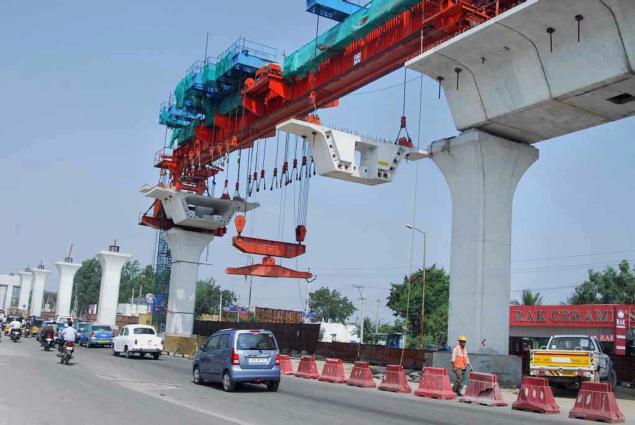
Hyderabad Metro Rail project created an all India construction record on Sunday with erection of the 1000th viaduct span and completion of 27 KM of Metro viaduct in just 20 months. The 1000th span near S.R. Nagar Bus stop was erected on Sunday. Photo: By Arrangement

The significance of record can be measured by the fact that Mumbai Metro Rail took about seven years to complete 11 km of metro viaduct; Bangalore and Chennai took over five years to complete about 25 km of viaduct each. Delhi took more than three years to achieve the same.

City’s ongoing elevated metro project has created a construction record by completing 27 kilometres of metro viaduct in just 20 months.

While the first between two pillars was erected near Genpact in Habsiguda in December 2012, the 1,000th was done on Sunday near S.R.Nagar bus stop, thus completing 38 per cent of viaduct works.

A total of 2,665 spans are required for 72 km of viaduct spread over three corridors: Miyapur to L.B.Nagar, JBS to Falaknuma and Nagole to Shilparamam/Raidurg.

The significance of record can be measured by the fact that Mumbai Metro Rail took about seven years to complete 11 km of metro viaduct; Bangalore and Chennai took over five years to complete about 25 km of viaduct each. Delhi took more than three years to achieve the same.

Engineering feat

HMR’s engineering feat of fast construction in congested roads of Hyderabad with a good safety record was possible due to a number of proactive measures taken by the State Government and the engineering capabilities of L&T, said Managing Director N.V.S. Reddy.

As on date 1,473 foundations (56 per cent), 1,370 pillars (52 per cent) are completed.

The Government too had facilitated setting up of the country’s two biggest precast yards, one at Uppal in 70 acres and another one at Qutbullahpur in 62 acres where L&T Metro Rail Hyderabad had established factory-like precast yards with sophisticated machinery such as automatic steel cutting and bending machines to produce precast segments each weighing about 40 tons, he said.

Precast segments are being transported in the night on low-bedded trolleys to various metro construction sites and erected between metro pillars with the help of “launching girders”. In all, 15 launching girders are being used to carry out these erection works simultaneously at several spots.

General length between two pillars is 100 feet, bridged by 11 precast segments. They are then glued and tied with a bunch of iron strands from inside, elongated and permanently grouted. The viaduct spans can withstand heavy loads plus heavy gales or earthquakes.

CM’s pat for HMR

Meanwhile, Chief Minister K. Chandrasekhar Rao congratulated HMR & L&TMRH engineers for the achievement on being informed by the MD.

source: http://www.thehindu.com / The Hindu / Home> News> Cities> Hyderabad / Special Correspondent / Hyderabad – July 28th, 2014

Race among Anglo-Indians hots up for nominated post

Decision of the Telangana government to put on hold nomination of Anglo-Indian community member to the Legislative Assembly it had selected has raised the hopes of other aspirants.

The 10,000 strong Anglo-Indian community in the new State expressed surprise when Telangana government backed Royden Roach for the nominated MLA’s post. It is said that the community associations have written to the government objecting to his nomination.

Maureen Hatch, a social activist, Warren Latouche, president of All-India Anglo-Indian Association, Secunderabad-Hyderabad branch and Gerard Charles Carr, Treasurer of Federation of Anglo-Indian Association of India are hopeful of nomination.

Initially, the TRS government had recommended the name of Maureen Hatch, a social activist and former employee of AP Industrial Development Corporation.

However, a ‘small technical error’ in the covering letter and not her bio-data had resulted in the file recommending Ms. Maureen Hatch as the nominated MLA being returned from Governor’s office for ‘relook’.

Ms. Maureen told The Hindu that when she was requested to give a copy of her bio-data to the Telangana Legislature Secretary. The covering letter addressed to Chief Minister K. Chandrasekhar Rao was given, but the body of the letter contained YSR Congress party’s name. The error was brought to her notice, correction was made and a fresh letter submitted and accepted. She appealed to the TRS government to consider her candidature.

Wing-commander Peter de Padua, Vice-president of All India Anglo Indian Association Hyderabad-Secunderabad branch said that country head of the association Neil O’Brien and the governing body has recommend the name of Warren Latouche, president of the City branch for the post. “Mr. Latouche has demonstrated in many ways, genuine concern for the members of Anglo Indian community,” he said.

Mr. Carr is also in the race hoping that his association with the TRS and the community service he had done would get him the nomination.

Anglo-Indian Association general secretary Hilary Platel clarified that Elvis Stephenson was not the vice-president of the Association.

source: http://www.thehindu.com / The Hindu / Home> News> Cities> Hyderabad / Special Correspondent / Hyderabad – July 26th, 2014

Bathukamma is made Telangana state festival

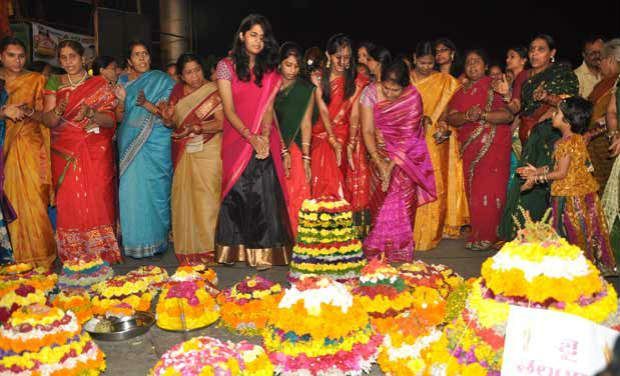
Bathukamma festival in Telangana. ( Photo:DC/File)

Hyderabad:

The famed Bathukamma will now be a Telangana State festival. The government has declared “Bathukamma Panduga” to be the state festival on the lines of recently declared Bonalu Jatra. This is the second festival in Telangana to be declared a state festival after Bonalu, which was celebrated with state-backing in Secunderabad and Hyderabad in a big way recently.

Youth advancement tourism and culture department issued orders on Thursday in this regard. Chief Minister K. Chandrasekhar Rao held a meeting with officials of the department of culture and others on June 16 and decided that Bonalu, Bathukamma be declared state festivals and celebrated in a big way across the state.

The Telangana Jagruti, headed by TRS MP Kavitha, had promoted Bathukamma in a big way during the Telangana movement along with Telangana cuisine. “Bathukamma Panduga is an important festival, which is celebrated across Telangana.

It is also an important cultural event of Telangana state, wherein large number of people, particularly women, participate with devotional fervour. Therefore, it is decided to declare the “Bathukamma Panduga”, as state festival duly providing assistance from different government departments and agencies for celebrating the festival,” said principal secretary to Telangana government B.P. Acharya.

Government asked the Department of Culture to take necessary action to celebrate the festival in a befitting manner. Bathukamma is one of the unique festival of Telangana region celebrated during Dasara Navarathri by women. Dressed in the best, the women sing songs in praise of Goddess Gouri during the nine day festivities.

Women seek the blessings of mother Goddes seeking prosperity and a good year. Colours, flowers and water are all intrinsic to the festival and the goddess herself is not one rooted in a shrine but turmeric and placed on top of conical flower arrangements that signify both life and eternity in their colours.

The flowers are immersed in tanks and rivers water on the 10th day. Local flowers like Gunuka, Tangedi, Lotus, Alli, Katla, Teku flowers which bloom in this season in various vibrant colours all across the uncultivated and barren lands are used to create flower arrangements.

Immersion of Bathukamma (Bathukamma visarjan) in water bodies is celebrated with utmost devotion and enthusiasm through out Telangana region.

source: http://wwww.deccanchronicle.com / Deccan Chronicle / Home> Nation> Current Affairs / DC Correspondent / July 25th, 2014

7-year Norm to Determine ‘Local’ Tag

Hyderabad :

Seven years of education immediately preceding the qualifying examination has been taken as the basis for determining the ‘local candidature’ in accordance with Andhra Pradesh Public Employment Order 1975 for the division of government employees between Telangana and the residuary state of Andhra Pradesh in the draft guidelines issued by CR Kamalanathan Committee.

The committee issued the guidelines on Friday for allocation of the state services employees, who are around 51,000, between Telangana and Andhra Pradesh and published the same on the public domain – www.reorganisation.ap.gov.in.

As per the 19 pages of guidelines, Article 371-D of the constitution will continue to remain in force in relation to the states of Telangana and Andhra Pradesh.

All the state-level posts (non-territorial) in departments would be equitably apportioned between the two states in the ratio of population (58.32 for AP and 41.68 for Telangana) or on the basis of geographic intensity of activity in the two states. State governments will determine the departments, state-level posts that are to be divided on the basis of geographic intensity of activities of the departments.

All sanctioned civil services and civil posts that existed immediately prior to the appointed day (June 1, 2014) shall be allotted to both the states. However, sanctioned posts do not include posts approved to be filled-in on contract or by outsourcing.

State services employees (allocable posts) will be given option to indicate their preference to service in either of the two states and allocations will be made after taking their option into consideration. However, it shall be open to the central government to allot the person to any successor state in the administrative interest or in the exigencies of public service. The allocation shall be done in order of seniority as available on June 1, 2014.

Those who have opted, who are ‘local candidates’ relatable to the state to which they have opted, shall, in order of their seniority, be considered for allocation first. If allocable posts in that category remain, others will be considered in reverse order of seniority by allotting the junior most.

Employees who are not local in relation to both states will be allocated on the basis of nativity or domicile based on due verification and certification of nativity or domicile by the head of the department concerned. Employees belonging to SC/ST communities shall be considered for allocation on the basis of their option, if they are local candidates or domicile. In the event an SC or ST employee has not exercised his option they will be allocated to the State of their domicile, as determined on their service register.

Class IV employees and drivers of light vehicles shall be allocated on the basis of option or local candidature, as far as possible. Spouse of All-India Services officers who is a state government employee shall be allocated, where so desired by the spouse, to the state to which AIS officer is allocated. Spouses in state government and related state government institutions shall as far as practicable be allocated to the same state, after considering their options.

Cases of alleviation of extreme personal hardship of state government employees will be exception to the principle. Widowed, legally separated and divorced women employees may be considered for allocation to the state to which option is exercised. Handicapped persons of more than 40 per cent disability may be allocated on the basis of option, subject to the procedure prescribed by the state government. Employees facing serious medical hardships (cancer, by-pass surgery, kidney transplantation of failure) be considered for allotment on special ground on priority on the basis of their option, subject to strict proof of verification.

Employees have to exercise their options in the prescribed proforma published along with the guidelines and submit the same to the Member-Secretary, Advisory Committee, GA State Reorganisation Department, AP Secretariat electronically and through the proper channel indicating their preference for either of the states within two weeks from the date of public notification calling for options.

Scrutiny of statements made in the option forms shall be done and factual accuracy of the statements made therein certified by the head of the department under whom the employee is working. If no option is received within the prescribed time, or where an employee is willing to be allotted to either of the two states such person shall be allotted based on the other criteria. Options once exercised cannot be changed.

After the distribution of posts is finalised, a tentative allocation list for all employees will be drawn up.Any objections by employees should be made within two weeks from the date of the publication of the tentative list.

The ambiguity over their temporary allocation among the employees has been finally put to rest with the issue of draft guidelines by Kamalanathan Committee. We are mostly satisfied by the guidelines though we have certain reservations pertaining to ‘local status’. We will submit our representations, if any, to the committee as advised.

— KV Krishanaiah, AP Gazetted Officers Assocation president

The draft guidelines issued by the CR Kamalnathan Committee lack clarity on several counts. In spite of our representation to the committee through our Chief Minister and Chief Secretary, none of the objections and suggestions were considered. We will decide our future course of action in the meeting with employees on Saturday and submit our objections to the committee as stated within 10 days. — G Deviprasad Rao, TNGO president

371-D in force

Seven years of education immediately preceding the qualifying examination basis for ‘local candidature’ in accordance with Andhra Pradesh Public Employment Order 1975

Committee draft guidelines posted on website www.reorganisation.ap.gov.in

Article 371-D of the Constitution will continue to remain in force in relation to the states of Telangana and Andhra Pradesh

State services employees (allocable posts) will be given option to indicate their preference to service in either of the two states

Employees belonging to SC/ST communities shall be considered for allocation on the basis of their option if they are local candidates or domicile

The allocation shall be done in order of seniority as available on June 1, 2014

Options once exercised cannot be changed under any circumstance

source: http://www.newindianexpress.com / The New Indian Express / Home> States> Telangana / by Express News Service / July 26th, 2014

Chekuri Rama Rao, a Versatile Literary Personality

Hyderabad :

In the death of Chekuri Rama Rao (1934-2014), popularly and affectionately called CheRaa, Telugu literature has lost one of its finest literary critics and a highly respected mentor of poetry in particular and literature in general. He was a versatile literary personality spread across poetry, linguistics, poetry appreciation, literary criticism, teaching, public speaking and editing.

Born in an agricultural family in Illindalapadu near Madhira in Khammam district, he had his education in Sattenapalli, Narsaraopet, Hyderabad and Visakhapatnam. While in high school in Narasaraopet, he began writing romantic poetry under the influence of Nayani Subba Rao, a harbinger of romantic poetry in Telugu. Studying BA in Nizam College in the early 1950s when love for Telugu language and literature were in the air, he got interested in Telugu and went to Andhra University to do his masters in Telugu. Acquaintance with Bhadriraju Krishnamurthy, forerunner Lingusitics discipline in this part of the world, inspired Rama Rao to take up his masters in Linguistics from University of Wisconsin and doctoral study at Cornell University, US. Returning from the US in mid 1960s, he joined Osmania University as a lecturer and worked there in various positions for about 30 years.

The hallmark of Chera was that he was a blend of a rigorous, trained analyst and sensitive, emotional dreamer. These two essential characteristics inform all his writings and speeches as well as his inter-personal relationships. All through he sailed with revolutionary trends in Telugu, so much that he was considered as a member of Revolutionary Writers’ Association without membership in technical sense. He might have attended and spoke at hundreds of meetings of revolutionary literary, students and cultural associations. Yet, that did not prevent him from sharing dais with traditionalists and speaking about and appreciating non-revolutionary trends. He was democratic to the core in all his personal and professional relations though being very strong in his views.

His name stands tall among the Marxist literary critics in Telugu, but his approach was a bit inclusive of taste and rasa, unlike traditional Marxist literary criticism. He published more than a dozen standard texts of literary criticism and linguistics including Telugu Vakyam (1975), Vachana Padyam – Lakshana Charcha (1978), Telugulo Velugulu (1982), CheRaathalu (1991), CheRaa Peethikalu (1994), Mutyala Saraala Muchchatlu (1997), Smriti Kinaankam (2000), Bhaashaanuvartanam (2000), Bhashaantarangam (2001), Sahitya Vyasa Rincholi (2001), Kavitvaanubhavam (2001), Vachana Rachana Tatvaanveshana (2002), Sahitya Kirmeeram (2002) and Bhasha Parivesham (2003).

He also published his poetry of youth after 20 years with the same title – Rendu Padula Paina (1982). Besides these published books and collections, there might be hundreds of uncollected research papers, essays, prefaces and introductions.

He will be remembered more for at least three significant works:

He created a sort of sensational interest among poets and poetry lovers in the mid-1980s with a weekly column of poetry appreciation in the Sunday supplement of Andhra Jyothi. The column, CheRaatalu was a rage in those days with almost all poets aspiring to be written about and all the poetry lovers seeking Rama Rao’s recommendations and analyses.

Any Telugu reader would thank Hyderabad Book Trust for creating and feeding the urge for good reading in Telugu society with its hundreds of titles since late 1970s. The credit for making HBT such an enduring brand goes to Rama Rao for helping HBT as its editor.

Andhra Pradesh Open University was able to attract thousands of neo literates to become graduates not only because of its ease of admission but also of the great style it used in all its text books. Rama Rao was one of the architects of the style.

The legacy Chekuri Rama Rao leaves behind is immense and in a way death cannot take him away from Telugu literary lovers.

source: http://www.newindianexpress.com / The New Indian Express / Home> States> Telangana / by N Venugopal / July 26th, 2014

Government Names Award in Honour of Telangana Literary Giant Dasarathi

Hyderabad :

Telangana chief minister K Chandrasekhar Rao wants to completely change the cultural image of Telangana. Stating that the culture was Telangana was always kept low under the rule of Seemandhra leaders, KCR said he now wants to establish a new cultural era for Telangana and show the world that Telangana culture is in no way inferior when compared to other cultures.

Post bifurcation, the KCR-led new government is leaving no stone unturned in extending its vision to rebuild the cultural image of the state. Keeping in view the vision, the chief minister announced a `1lakh award in the name of Telangana literary icon Dasarathi Karishnamachary on his 89th birth anniversary at Ravindra Bharathi on Tuesday. The award will encourage yound writers in the state, he said.

The award is the first one to be constituted by the new government in honour of a personality from the state. The award will annually recognise outstanding contributions in the field of Telugu literature. As a tribute to Dasarathi, who is known for his rebellious writings against the Nizams, the government will install his statue at Tankbund, KCR announced. “People create controversies when I speak about statutes but the reality is our children do not even know whose statutes exist at Tankbund,” the chief minister said.

After learning about the financial struggle of the icon’s family, the chief minister promised a government job for his son Dasarathi Laxman. “Dasarathi deserved greater honours and so does his family. From today, his family will not have to suffer. An appointment order will be ready in the next two-three days,” KCR said. Recalling his experience with Dasarathi’s writings, the chief minister said he was inspired by them as a students. “In fact, his writings inspired me during the Telangana movement,” he added.

“Today, to honour our legendary poet and writer is the victory of all the people of the state,” he said and added that the state government will organise the birth anniversary celebrations of eminent Telangana icons who have helped in the development of the state. “It is very disappointing that very few government institutions have been named after leaers from Telangana. Very soon a prestigious institution or university will be named after Dasarathi,” the chief minister said.

Listening to the discussion by guests like vice-chancellor of Telugu university Elluri Shiva Reddy and poet Rallabandi Kavita Prasad, KCR, who is a poet himself, rued the fact that he was not able to attend poetry meets due to his bust schedule. “Right now, I do not want to leave this place but I do not have a choice,” he said in a typically Telangana accent.

The chief minister felt that the state need more auditoriums like Ravindra Bharathi and promised to revamp the auditorium which has been hosting many cultural programmes for a long time.

Noticing the poor facilities at the auditorium, KCR promised to increase its annual grant from `30 lakh to `1 crore and assured that the state government would transform the auditorium into a world-class one. Taking a dig at previous regimes for the poor facilities in the auditorium, he said “Previous governments kept boasting that their Telugu was superior to our Telugu but left a place like Ravindra Bharathi in shambles,” and added the cultural revamp of the state included improving facilities at the Potti Sriramulu Telugu University.

KCR was the chief guest at a function to celebrate the 89th birth anniversary of Dasarathi Krishnamachary organised by the department of language and culture.

An Ode to Telangana

Dasarathi Krishnamacharya was a writer and poet from Telangana in the Nizam era. He is popularly known as Dasarathi. He was born on July 22, 1927, in Chinnaguduru village of Warangal district. Dasarathi is considered as one of the first to fight for Telangana. He became the icon of Telangana movement by his popular line ‘Na Telangana Koti Ratanala Veena’ in which he described Telangana with ‘veena’ decked with innumerable diamonds. He wrote these lines in the jail at Nizamabad when he was arrested for raising his voice against the Nizam rulers. These lines became very popular during the Telangana movement. He received Sahitya Akademi award for his literary work ‘Thimiramto Samaram’ (Fight against the Darkness) in 1974. He also wrote songs for Telugu movies like ‘Vandanam’ and ‘Iddaru Mitrulu’. He passed away in 1987.

Cultural Touch

Award to be given every year for best constribution in Telugu literature

Dasarathi’s statue to be installed at Tankbund

Birth anniv to be celebrated every year

source: http://www.newindianexpress.com / The New Indian Express / Home> States> Telangana / by Express News Service / July 23rd, 2014

Book plumbs new facets of Andhra Pradesh’s history

Hyderabad :

The objective of writing history of Andhra Pradesh, covering coastal Andhra, Rayalaseema and Telangana, without seeking government help is “to keep it scientific, secular and free from any bias,” said veteran historian V Ramakrishna on Friday.

He was speaking at a function organized to release the fifth volume of the comprehensive history of Andhra Pradesh. The volume was released by governor E L S Narasimhan who said that the Andhra Pradesh History Congress, which was formed in 1976 and whose members have compiled the voluminous data, should take some help to facilitate its work. “Do not oblige anybody, but do take help because it is a gigantic task and the need of the hour,” he said.

Ramakrishna, who is popularly known as VRK, said that it was in 1998 that the APHC decided to compile and publish the comprehensive History and Culture of Andhra Pradesh in eight volumes which, with time, have been expanded into nine volumes.

The need for the series was felt because no connected, authenticated, chronologically arranged narrative from an inter-disciplinary perspective, incorporating the latest data, is available today. “Writing micro history is difficult. The content of each chapter is verified at various levels for its authenticity. I want to pay tribute to the contributing historians because they have written, not for money, but their dedication towards the cause of history,” he informed the audience.

The members of the editorial board of the history series include K S Kameswara Rao, A Satyanarayan and G Venkata Ramayya while the general editor is V Ramakrishna. The fifth volume has been edited by R Soma Reddy.

According to speakers at the function, the present volume is on Late Medieval Andhra Pradesh covering the period between 1324 and 1724, a period that witnessed the rise of larger regional state powers such as the kingdom of Vijayanagara and the Bahmanis.

Consequent upon the constant flux of people of different languages, faiths, cultures and professions and the establishment of foreign settlements, a liberal spirit of tolerance developed, which was furthered by the prevalence of Sufi and Bhakti cults. One of the most significant features of the times was the evolution of composite Dakhni Deccani culture, along with the rise of the Deccani Urdu language.

source: http://www.timesofindia.indiatimes.com / The Times of India / Home> City> Hyderabad / TNN / July 19th, 2014

Once cricketer, Aarti is now her team’s video-analyst

Former Hyderabad cricketer Aarti Nalge / The Hindu

At 31, former Hyderabad cricketer Aarti Nalge is achieving what she could not as a player – be a part of the Mithali Raj-led Indian team for the next month’s England tour. This time, she’s in the team as its video analyst.

“Having played cricket at some level, I am aware of the expectations and especially what the coaches look for at the end of the day’s play. My job is to be ready to give them the video clips backed by complete statistics about a player’s performance any time,” explains this former national cricketer.

Illustrious lineage
Her father is the well-known curator for the Hyderabad Cricket Association (HCA) Datta Nalge. He was earlier at the Gymkhana Grounds and is now taking care of the pitch inside the Rajiv Gandhi Stadium, Uppal.

“My father is a huge source of inspiration and his support always matters to me,” says Aarti, who owes the role switch to BCCI president in-charge N. Shivlal Yadav and General Manager (Operations) M.V. Sridhar.

Sheer passion for the game made her quit well-paying jobs at Genpact and Bank of America. “I love cricket and can’t be away from it,” Aarti says. “I am also grateful to captain Mithali, the support staff and the BCCI for their faith in me,” she adds.

The team will play a Test match and three One-dayers. Aarti’s previous engagements include the recent Sri Lanka One-Day series in Visakhapatnam and the T-20 World Cup in Bangladesh.

source: http://www.thehindu.com / The Hindu / Home> News> National> Telangana / by V.V. Subrahmanyam / Hyderabad – July 23rd, 2014