Kushagra Mohan of Hyderabad who won the silver medal in the under-10 category of the Asian Youth chess championship in Tashkent. / by Arrangement / The Hindu
Kushagra Mohan clinches silver medal in the Asian Youth Chess Championship in Tashkent.
Kushagra Mohan, a fifth standard student of Hyderabad Public School, Begumpet, provided a silver lining when he clinched the silver medal in the just-concluded Asian Youth Chess Championship in Tashkent (Uzbekistan).
The city boy won the medal in the under-10 category representing India, which incidentally is his second after his bronze in the same event last year. Coached by Rama Raju, Kushagra, who is a Candidates Master now, is already dreaming big and his next big event is the World Youth Chess Championship in Durban (South Africa) this September.
“My confidence level is high after the Tashkent silver. I hope to keep improving,” he said. Ever since his bronze in the 2011 national under-seven championship in Pune, Kushagra has been making a slow and steady progress which was evident when he won the Asian Schools Championship silver the same year.
With father Rajesh Mohan, a businessman, and mother Meena encouraging him to the hilt, Kushagra, who idolises the reigning world champion Magnus Carlsen, is in the mood to script a few more success stories in the world of chess.
source: http://www.thehindu.com / The Hindu / Home> News> Cities> Hyderabad / by Special Correspondent / Hyderabad – July 02nd, 2014
Picture for representational purpose (Photo: DC/File)
Vijayawada:
After dividing the police force, the trained sniffer dogs were divided between the two states. Apart from making the sniffer and tracker dogs stationed in each region to stay put, the intelligence security wing dogs were also distributed. According to ISW officials, AP got 10 sniffer dogs while Telangana got eight based on the population.
DSP of dog training academy at Moinabad K. Subrahmanyam said, “The dog squads are divided, but the training academy is the same. We have 40 dogs being trained in our academy and they will be inducted to the police force as per the earlier requests. We already have five attacker dogs of Belgian Malinois with Octopus the anti-terror force.
In the present batch that is undergoing training, we have five more Belgian Malinois being trained.” However, the requirement for sniffer and tracker dogs from the districts has been increasing. In Machilipatnam on Thursday a sniffer dog died and police cremated it with the official salute. “Several dogs have become old and sick. There are deaths reported from the district units regularly,” said an official.
source: http://www.deccanchronicle.com / Deccan Chronicle / Home> Nation> Current Affairs / by DC Correspondent / June 29th, 2014
We know robots are the future. But humanoids take a lot of time learning to do their tasks. Hyderabad-raised researcher Dr Rajesh P.N. Rao and his team has found a novel way of teaching robots using crowd sourcing technology. They say robots can just go online and find hints from hundreds of people to do their tasks by themselves without having to teach them with painstaking long commands.
In a first, University of Washington associate professor Dr Rajesh P.N. Rao and his team had demonstrated the first brain to brain interaction through the Internet in which one person would imagine an action and another ‘online’ would replicate the imagined action. Working on robots, Dr Rao, who studied in Hyderabad till the age of 18, says humanoids could one day proliferate in our environment.
But robots are now designed to do a particular task or a set of them. They have to be programmed to teach them how to go about a job. Robots learn by imitating humans, but it could take many lessons for it to hold a dish perfectly or place the book at the right place.
But Dr Rajesh Rao’s team has proposed using crowd sourcing techniques where robots can, all by themselves, go online, and ask for advice “Robots in the not-so-distant future will be in our homes, offices, and other human environments. We will want them to learn new skills on-the-job so that they can get better at helping us” Dr Rajesh Rao said.
“Our research demonstrates that robots can go online, and hire human helpers whenever they are stuck and get hundreds of hints and suggestions from humans all around the world,” he further said.
Crowd sourcing is the process of soliciting information from a large online community. “This is a way to go beyond just one-on-one interaction between a human and a robot by also learning from other humans around the world,” Dr Rajesh said.
However, there could be problems if some spammers in the online community feed wrong information to the robot. “There were some spammers who produced repeated data from multiple accounts, and even others who produced data without following instructions. We are planning to adopt more complex quality control techniques to improve the quality of crowd sourced data in future,” researchers said.
source: http://www.deccanchronicle.com / Deccan Chronicle / Home> Technology> Latest / by DC Correspondent / June 30th, 2014
Art gallery puts up a collection of visuals on the journey of the medium of radio. As the title revealed, it took the viewer on a journey, of how radio evolved with some local attention on how ‘All India Radio’ (AIR) or ‘Akashvani’ came about, since the 1930s.
At first glance, it looked as if it was a typical film function. But the resemblance ended there. Visitors could then see the distinction at ‘Journey of Radio’ a collection of visuals put together by Muse Art Gallery.
It took a while for guests to go up and down the long corridor at the Marriott Hotel here, looking at paintings and other visuals that seemed to tell a story on their own.
As the title revealed, it took the viewer on a journey, of how radio evolved with some local attention on how ‘All India Radio’ (AIR) or ‘Akashvani’ came about, since the 1930s. The collection of 50 visuals was initiated by the curator of the gallery, Kaali Sudheer.
Veteran announcers Jyothsna and Ilyas, whose tryst with AIR is over 3 decades old, spoke of how serious their programmes were in those days when there was no television. “While officially, our duty hours were 7 hours only, we would normally spend 10 hours and sometimes, during important occasions, it would go up to 15 hours too,” said Ilyas.
source: http://www.thehindu.com / The Hindu / Home> News> Cities> Hyderabad / by Special Correspondent / Hyderabad – July 01st, 2014
Nearly 3,000 IIT alumni from across the globe are expected for the event, which will be held in December
All roads will lead to Hyderabad in December when the cream of India’s intellectual exports will converge in the city for the 12th edition of the IIT Global Conference, an annual meet of alumni from the prestigious engineering institution.
Nearly 3,000 IIT alumni from across the globe are expected for the event, which is being organised with the agenda to contribute to the country’s development.
It will be held from December 19 to 21, and is being hosted by the PanIIT Hyderabad Alumni Association and IIT Hyderabad.
A curtain raiser of the event was held on Sunday at the Indian School of Business (ISB), in which some prominent IIT alumni participated.
Chief executive officer (CEO) of tablet-maker Datawind, Suneet Singh Tuli gave a detailed presentation on the low-cost Aakash, as part of his keynote address.
Unlike companies like Apple and Samsung that target the well-heeled 5 per cent, Mr. Tuli said he was interested in going after the remaining 95 per cent, which constituted a vast untapped market of people ignorant about internet and tablets.
Tech-induced change
He spoke of how technology could result in a decrease in illiteracy, and of its advantages in improving education and commerce.
ISB Dean Ajit Rangnekar called upon the IIT alumni to try and contribute more to the country’s development.
www.thehindu.com / The Hindu / Home> News> Cities> Hyderabad / by Staff Reporter / Hyderabad – June 30th, 2014
Princess Faizunnisa Begum, the eldest daughter-in-law of the seventh Nizam, Mir Osman Ali Khan, died here on Friday. She was 92. She is survived by five sons and a daughter.
The princess was married to Nawab Hasham Jah Bahadur. The Nizam, who nicknamed her ‘Faizu’, presented two gold bangles to her at the time of her marriage in 1935. After the wedding, the Nizam dropped the couple personally at their residence, according to Nawab Najaf Ali Khan, grandson of the Nizam.
The princess was laid to rest at Masjide Judi in King Kothi where the last Nizam also rests. A large number of Nizam family members were present on the occasion.
source: http://www.thehindu.com / The Hindu / Home> News> Cities> Hyderabad / by Special Correspondent / Hyderabad – June 28th, 2014
The sixth-seeded Indian, who had won the India Open Super Series earlier this year, prevailed 21-18 21-11 in a 43-minute contest against Spain’s Carolina Marin.
Ace Indian shuttler Saina Nehwal produced a dominating performance to lift her second title of the season, winning the $750,000 Star Australian Super Series after beating Spain’s Carolina Marin in the summit clash in Sydney on Sunday.
The sixth-seeded Indian, who had won the India Open Super Series earlier this year, prevailed 21-18 21-11 in a 43-minute contest which made her richer by $56,000.
The 24-year-old Saina, who enjoyed a 1-0 head-to-head record against Marin going into Sunday’s match, logged the first point and displayed some deft net play against her rival, stroking in some delectably timed volleys to take a 5-2 lead in the opening game.
But the 21-year-old Marin was not the one to give up easily and showed just why she is considered one of the most feisty players on the circuit. She narrowed the gap to 6-8 but seemed distinctly out of her comfort zone every time Saina dragged her towards the net.
Also, Marin didn’t help her cause by committing a service error to gift an easy point to Saina, who went into the interval leading 11-7 after an intriguing rally which ended with the Spaniard smashing the shuttle wide.
Marin raised her game and the decibel levels after the break but Saina was quick to counter-attack and returned her rival’s attempted smashes with quiet intensity.
In between, Marin played some fine strokes but they never came consistently enough as Saina made it 17-12. Marin’s dogged determination was there to be seen in every point she played for but that alone was never going to be enough to upstage a composed Saina.
The Indian, who didn’t seem affected at all by Marin’s aggressive outpouring of emotions after every claimed point, sealed the opening game 21-18 after her world number 11 rival smashed one into the net 23 minutes into the match.
In the second game, Marin’s determination helped her take a 3-1 lead to start with but it was not too long before Saina came back into the fray, this time on the back of some well-placed strokes from the baseline.
Perhaps taking a cue from Marin, Saina too let some emotion show as she clenched her fist and shouted ‘come on’ after every clinched point. But one of her screams came about in the middle of a rally, prompting Marin to complain to the chair umpire, who merely asked her to continue.
The distraction didn’t do any good to Marin as Saina raced to a 11-4 lead against the Spaniard, who looked to be in disarray.
After the interval, Saina kept up the pressure, regularly inducing errors from Marin, who struggled to maintain the intensity she displayed in the opening game.
Dominating the proceedings, Saina produced some of her trademark smashes to further demoralise her rival, whose shoulders had dropped by that stage.
But there was to be some moments of drama before the win came about.
Leading 19-9, Saina challenged a line call that went against her but replays showed that the shuttle had in fact landed wide. The Indian made another mistake while playing the very next point as she buried an attempted smash into the net.
But Saina made amends quite quickly and clinched the title after Marin lobbed a shuttle wide.
source: http://www.thehindu.com / The Hindu / Home> Sport> Other Sports / PTI / Sydney – June 29th, 2014
Swimmers from different age groups from Hyderabad who won medals in the recently-held National life-saving pool championship in Pune. PHOTO: By Arrangement / The Hindu
Swimmers from Hyderabad put up a creditable performance winning four gold, 11 silver and seven bronze at the National Life-saving Pool Championship-cum-training in Pune. The camp’s focus was on life-saving techniques, a media release said.
The young talent, in the age group of 12-17 years, were initially given training in the different forms of saving lives in water. The swimmers were also taught how to respond to crisis calls, with focus on the recent Beas tragedy in which some college students from the city were washed away due to the sudden release of water from a dam.
For the 14 swimmers from the city, who had trained at the SAAP swimming pool here, it was an experience to remember.
“It is a creditable performance given that this was the first-ever exposure for the children, who had initially joined the pool at the Police Control Room solely for recreation. We hope to keep improving in the days to come, given the abundance of talent,” says coach Hajira Abbasi.
“It is a unique event wherein the skills of young talent are not only put to test, but in the process, they are made aware of their social obligation: that of helping the needy in the waters,” says the coach.
Dr Surya Prakash Singh, a scientist at the Inorganic and Physical Chemistry Division of the CSIR-Indian Institute of Chemical Technology (IICT), Hyderabad, has been given the prestigiouYoung Scientist Award by the government of Uttar-Pradesh. The Council of Science and Technology UP Government selects bright and young scientists below 35 years age for this award every year for the recognition of their significant contributions in their respective area of research. The award has been bestowed to Dr. SP Singh on his contributions in the area of chemical sciences particularly on solar energy research.
Dr. Singh is working as a Scientist at CSIR-Indian Institute of Chemical Technology, Hyderabad. He studied chemistry at the University of Allahabad, India, and obtained his Ph. D in 2005. After working at Nagoya Institute of Technology, Japan, as a postdoctoral fellow (2006-2008), he joined, as an Assistant Professor at Osaka University, in 2008. He worked as a researcher at Photovoltaic Materials Unit, National Institute for Materials Science (NIMS), Tsukuba, Japan (2010-2011).
He has been involved on novel C-C bond forming reactions and synthesis of New and Highly Efficient Sensitizers for Dye-Sensitized Solar Cells, Organic-Thin Film Solar Cells and published over 85 papers in peer-reviewed journals and 5 patents, editor of two books and author of two book chapters. He is guest editor in chief for several international journals like Advances in Optoelectronics, Journal of Nano Energy, Current Organic Chemistry, and Power Research etc.
source: http://www.timesofindia.indiatimes.com / The Times of India / Home> City> Hyderabad / by Ch. Sushil Rao, TNN / June 28th, 2014
What gives late 19th century photographer Raja Deen Dayal’s work the acclaim it has received? An exhibition showcasing arguably India’s first professional photographer’s works tries to dissect
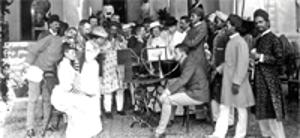
LISTENING TO THE PHONOGRAPH: DEEN DAYAL, GHALIB JUNG AND FRIENDS AT HYDERABAD 22ND MAY 1891The palpable excitement of Nawab Ghalib Jung and his friends whilelistening to the first phonograph in Hyderabad is visible. Such naturalexuberance is seldom seen in 19th century photography
Lala Deen Dayal was to Indian photography what his peer Raja Ravi Varma was to painting. As a 20-something civil engineer, Deen Dayal was working at the draughtsman office at the Indore Public Works Department when he heard an ominous rumour — all draughtsmen were to be replaced by photographers. It was 1866. Dayal decided to brush up his photography skills; a subject that he had learnt during his final year in college. A decision that paved the way for Deen Dayal to eke out a successful career in professional photography.
Vikram Sampath, Executive Director of the Indira Gandhi National Centre for Arts (IGNCA), says: “The heavy Bellow cameras of the 19th century would have been cumbersome. But his photographs are so extensive that they can be the starting point for fleshing out the socio-cultural aspect of that period.” IGNCA is presenting the exhibition Raja Deen Dayal Photographs, a collection of 150 rare period photographs which will be shown in the city for the first time.
Sampath says he can imagine how hard it must have been for Deen Dayal to get people to be photographed, considering the superstitions around the act. “People believed that if photographed, their life span would be reduced.” It was not uncommon for him to break the glass-plate negative in front of the subject after giving them their photographs, probably to assure them that it wouldn’t be used again. But he would have stealthily kept another copy in the archive.
Grand old man
Here was an Indian photographer appreciated by Indian maharajas (the sixth Nizam of Hyderabad, in fact, wrote a verse in praise of him) and British Viceroys. His photographs were exhibited to great reviews in international exhibitions. He was appointed the court photographer for Hyderabad (1885); Mir Mahboob Ali Khan, the Nizam of Hyderabad, conferred on him the title Musawwir Jung Bahadur (the Bold Warrior Photographer) and referred to him as Raja Deen Dayal. In 1897, Queen Victoria granted him the Royal Warrant, which meant he could cover the Delhi Dubar (1903). He had flourishing studios in Secunderabad, Indore and Bombay that were operated by his firm Deen Dayal & Sons. And even after his death (1905), his fifth generation has photo studios in the twin cities of Hyderabad and Secunderabad. Not bad for a man who was born (1844) in a small town near Meerut.
Luck and talent
In 1870, when Deen Dayal was hired by the Archeological Survey of India, his brief was to capture 78 monuments of Central India. The technique used was refreshingly different. The monuments stood out against the sky as he captured them from a low angle, making them imposing and grand. Some, like the Gwalior Fort, had an extraordinary view of the sharp precipice below the steep path leading up to the main entrance. The portraits of the monuments form an extensive collection of places across India.
Deen Dayal quit his government job to pursue photography when he realised that the albums prepared by him on Indian monuments were a hit with the British officers returning to Britain. Sir Henry Daly appointed him the official photographer for the Prince of Wales’s tour of India in 1875. He started accompanying the Viceroys, Lord Dufferin and Lord Elgin, on their tours. His interactions with Indian royalty gave him unmatched access to their world. By being the court photographer of the Nizam, Deen Dayal secured a generous patron and an easy access to British officers in the cantonment. He was probably the first Indian photographer to have a Zanana (ladies only) studio at Hyderabad which was run by a specially-appointed employee, Kenny Levick.
From glass plates to digital
Deen Dayal’s family had preserved the glass-plate negatives with history recorded on them. Those negatives required long exposures and hours of work. Each comes with documentation of the place and year, apart from the name of the royals or nobles. The commoners were categorised broadly with captions such as ‘Maratha’ and ‘Brahmin’. IGNCA has reproduced the originals after the entire collection of about 3,000 negatives were handed to them by the family in 1989. These were then digitised and the first exhibition took place in New Delhi in 2010. For all aficionados of photography, this show remains the best place to know how it all began for one photographer, arguably the first Indian professional photographer.
Raja Deen Dayal Photographs, 10 am to 5 pm till July 20, NGMA
source: http://www.bangaloremirror.com / Bangalore Mirror / Home> Entertainment> Lounge / by Jayanthi Madhukar, Bangalore Mirror Bureau / June 23rd, 2014