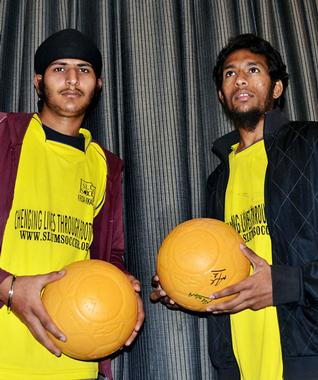
Simarpreet Singh and Tariq Ahmed from Hyderabad who have been selected to represent India in the World Cup football for Homeless to be played in Chile this October. PHOTO: V. V. Subrahmanyam / The Hindu
Soccer fever is reaching a climax in Brazil. But for two young footballers, Tariq and Simarpreet Singh from the city, it might just be the beginning of a journey to recognition. The two boys have been selected to represent India in the Homeless World Cup (for those who come from slums) in Chile in October.
“A World Cup is a World Cup. We are on cloud nine,” the delighted duo exclaimed. They are products of ‘Sports Coaching Foundation’ football camp where Hyderabad Sporting Club chief coach Mohd Saleh trains.
“This is a dream come true and we will try our best to make an impact in this event,” say the soccer duo. Nineteen-year-old Tariq is an engineering graduate from Hussaini Alam and Simarpreet is a commerce graduate from Zaranagar locality of Mehdipatnam. “This is nowhere near the real World Cup soccer but this is a sport that is played with great passion,” the duo says.
“These boys would not have made it to Chile but for the initiative of Kaarmic Education Services’ Dantu Kartik and Adithya Sanjay of Awakening Foundation who spotted talent and started grooming them. I am glad that Tariq and Simarpreet are from the SCF where they have been training under lights,” says a proud K. Sai Baba, general secretary of SCF.
SCF felicitated the duo.
source: http://www.thehindu.com / The Hindu / Home> News> Cities> Hyderabad / by V. V. Subrahmanyam / Hyderabad – July 12th, 2014
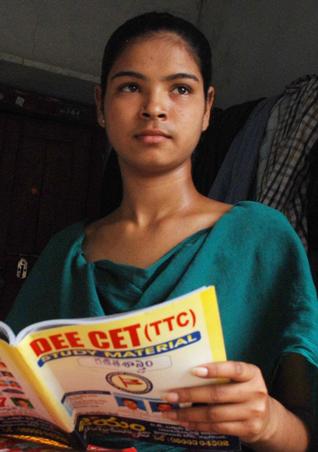
Anitha is the first Chenchu girl to clear Intermediate from her village now aims to become a teacher at Chench colony, Chandampet mandal in Nalgonda district. Photo: Singam Venkataramana / The Hindu
By clearing the Intermediate exam, Dasari Anitha has not only become the first girl from Chenchugudem to do so, but also an inspiration to other tribal girls
Dasari Anitha may be no Malala Yousufzai, but her achievement has left the whole Chenchu tribal habitation in Chenchugudem ecstatic. The 18-year-old has cleared her Intermediate examination, a feat no girl from the Chenchu tribal village has ever accomplished.
Anitha scored 671 marks out of a total of 1,000, something the villagers say would encourage girl education among Chenchu families.
Located in Timmapur Panchayat under the Chandampet mandal, the 42-house exclusive Chenchu habitation had never sent a girl to college until Anitha was admitted to the Tribal Welfare Residential Education Societies’ College in Damarcherla mandal two years ago (the Biology-Physics-Chemistry group).
The previous highest qualification was that of a girl who had studied up to the class 7, says Anjaiah, Anitha’s father. “But she was married off at a very tender age,” he said.
However, things have changed after Anitha went to college, he said. Twelve girls have since been admitted to the Mini Gurukulam in Chandampet to classes 5, 6 and 8.
Anitha told The Hindu that she aimed to become a teacher after completing her two-year Teacher Training Course (TTC).
Her mother Eedamma said the family was elated at her achievement and was looking forward to seeing Anitha become a teacher. She hoped Anitha’s achievement would inspire her three younger siblings.
The Chenchu couple cultivates various crops in their two-acre land, but that still leaves them little for two square meals a day for their six-member family.
The Chenchu habitation has appealed to the government to provide Anitha a TTC admission and guide her to become a teacher as her achievement could provide a boost to girl education not only in the nine tribal habitations of Chandampet mandal, but also in Chenchu families living in adjoining Nallamala forest.
source: http://www.thehindu.com / The Hindu / Home> News> National> Telangana / by Staff Reporter / Chandampet (Nalgonda Dt.) – July 09th, 2014
Aakar Asha Centre for Enablement of Physically Disabled, Kukatpally, has launched a ‘One Rupee Reconstructive Surgery Campaign’ for differently-abled persons. The centre will hold camps at 12 locations in the city to identify persons who might benefit from reconstructive surgeries.
Such surgeries are usually beneficial to patients who have suffered burns, accidents where they have suffered disfigurement and those who are recovering after the removal of benign tumours. “The entire cost of consultation, blood tests and reconstructive surgery will be borne by us. I also request individuals and groups to support us in this noble cause by donating generously,” said director and managing trustee, ‘Aakar Asha’, Bharatendu Swain.
The campaign also aims at seeking partners to mobilise physically disabled persons to camps, reaching out to donors, matching donors and beneficiaries and follow-up care of beneficiaries. “We have noticed that with proper intervention, transformation happens in many cases. The campaign will reach out to credible groups to partner in this cause for raising donations,” he said. Interested donors can call: 23050960/8978468242.
source: http://www.thehindu.com / The Hindu / Home> News> Cities> Hyderabad / by Staff Reporter / Hyderabad – July 10th, 2014
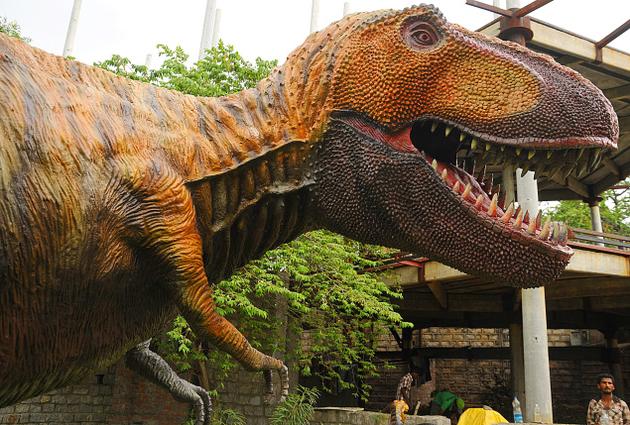
The posh locality of Jubilee Hills in the city is all set to get a park with representations of species dating back to millions of years. As part of its chain of theme parks across the city, the Greater Hyderabad Municipal Corporation (GHMC) is completing work on a ‘Jurassic Park’ close to the Lotus Pond and the facility will be thrown open to the public in a couple of months.
Jurassic Park project at the Lotus Pond in Jubilee Hills is nearing completion after delay in execution of works by GHMC resulting in escalation of cost. / Photo: Mohammed Yousuf / The Hindu
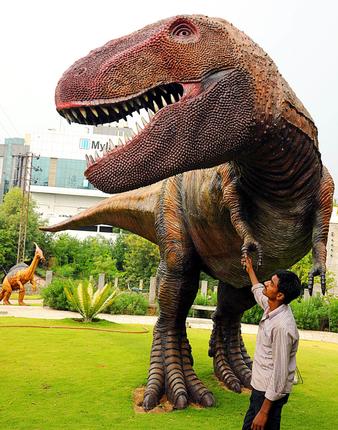
The innovative aspect of the park is life size models of creatures that roamed the earth some 150 million years ago and went extinct. The urban biodiversity wing of the GHMC is setting up nearly 21 models of dinosaurs of varying sizes and designs, which help recreate the aura of a lost era.
“But for three models, the rest have been received and installed,” said the GHMC Biodiversity Director, Y. Ramesh. Plans are also afoot to have a giant-sized dinosaur model that will be spread across 60 feet and tower to a height of 20 feet, he said.
Jurassic Park project at the Lotus Pond in Jubilee Hills is nearing completion after delay in execution of works by GHMC resulting in escalation of cost. / Photo: Mohammed Yousuf / The Hindu
The ‘Jurassic Park’, which so far cost around Rs.19 lakh, apart from models of the fauna that flourished millions of years back, will also put together a rich collection of flora from the period. According to officials, these are the plant species that are usually referred to as living fossils having survived the ages and threats of extinction.
The plant species will be selected based on Palaeobotany studies and will include cycads, tree ferns and certain palms and gymnosperms. “We already have some varieties of cycads and more varieties will be acquired soon,” Mr. Ramesh said.
The officials plan to complete the works at the earliest after equipping the rest of the dinosaur models and adding the flora. The city is scheduled to host the Metropolis World Congress and around 2,000 delegates from across the globe are expected to visit the city for the international meet. “We plan to have the ‘Jurassic Park’ ready before the Metropolis meet gets going,” an official added.
source: http://www.thehindu.com / The Hindu / Home> News> Cities> Hyderabad / by T. Lalith Singh / Hyderabad – July 06th, 2014
Guess why people didn’t want Mirza to play tennis growing up? Ans: Tan
Sania Mirza. Photo: Chris Hyde/ Getty Images
Babyjaan’s dear friend got into the car and they began their typical chatter.
I’m wearing pink tights, even I’m wearing pink tights; my T-shirt is nice it has Dora. My T-shirt is also nice it has a picture of a rainbow. You like my shoes? Do you like my shoes? They’re shiny. You washed your shoes? Even I washed my shoes.
And then, bam, without warning, her beautiful friend, always a calming, extremely sensible influence on my rowdy livewire of a daughter, held up her arm to Babyjaan’s and said: My skin is lighter than yours.
I always knew I would have to give Babyjaan the Dark is Beautiful pep talk. Our obsession with skin colour is so pervasive and so predictable it almost makes me yawn. Babyjaan’s faced it on the playground forever, except she doesn’t know it yet. Example: Your daughter’s so pretty (compliment to fair girl). Your daughter has beautiful hair (compliment to Babyjaan).
I’m not worried. I’ll just add it to the list of monsters she needs to know she will encounter in The Indian Girl’s Battle to Grow Up Sane. Note to self: Figure out a way to link it to Maleficent, her current favourite bad girl.
Thankfully, Babyjaan gets comebacks. At 3 I had coached her to respond to idiotic children who say “Your mama’s got funny hair”, referring to my uncoloured, more salt less pepper, more frizz less curls, with traces of gold. My well-trained bot simply replies: “Her hair is interesting. It’s cool, not boring (like your mama’s).” Ok, strike the brackets.
In fact, I had already planned a couple of rejoinders for this dark skin thing. She could say: “That’s because I have more melanin than you, go look it up.” And “Colourism is racism, surely you know that? Or hasn’t your vocabulary gone past four-letter words like dark and fair?”
But I must confess that every Girl Boss who talks about this issue gives me some measure of relief, and revives the belief that we are all in this battle together and that we will eventually wrest back our Right to Colour from the uppity fair and lovelies.
This week’s hero was Sania Mirza for me and Babyjaan (though she doesn’t yet know it). Mirza told reporters that one of the earliest obstacles she faced on her journey to become an international tennis champ was colour prejudice. So many people advised Mirza’s parents not to enrol her in tennis classes because she would __ (that three-letter word most feared and dreaded among parents of girls in India. Ans: Tan). This in turn would affect Mirza’s marriage prospects, never mind that she was then only a couple of years older than Babyjaan.
The international media obliged by retelling stories about India’s disgusting skin colour hang-ups; the national media buried the news on the sports page (even sports fans don’t read the sports pages these days, they are too busy watching Wimbledon and the World Cup). A woman talking about prejudice is hardly newsworthy here, right?
But don’t mind that you didn’t make it to page 1 Sania Mirza. Keep sharing and thank you so much. I think it’s time to introduce Babyjaan and her friend to your growing-up battles.
source: http://www.livemint.com / Live Mint & The Wall Street Journal / Home> Leisure> First Cut / by Priya Ramani / Saturday – July 05th, 2014
Filmmakers from Telangana on Friday demanded the bifurcation of the AP Film Chamber of Commerce (APFCC) and strongly opposed the move to change its name to Telugu Film Chamber of Commerce.
At a meeting held some time ago, the executive committee had decided to change the name of the body, which would deal with the industry in both the states. Friday’s general body meeting was called to ratify the decision, but saw major opposition from the Telangana members, who attended in huge numbers. They contended that the APFCC should represent only the 13 AP districts while the new Telangana Film Chamber of Commerce (TFCC) should represent the interest of the industry in the new state.
“The demand is very clear. Telangana filmmakers should have a separate body since a new state has been formed. There is no compromise on that,” M Vijayendar Reddy, an exhibitor and president of TFCC, told TOI.
After the initial volley of arguments, APFCC president NV Prasad brought the meeting to order and said a committee comprising five representatives each from the two states would be formed to discuss the issue. The decision made by this committee would be discussed at the next general body meeting.
Meanwhile, Friday’s meeting also saw a few students, reportedly from Osmania University raising ?Jai Telangana’ slogans pressing for the bifurcation of the film chamber outside the meeting venue at Filmnagar.
source: http://www.timesofindia.indiatimes.com / The Times of India / Home> City> Hyderabad / TNN / July 05th, 2014
Restaurants are roping in mural and graffiti artists to amp up Hyderabad connect and showcase popular sights, right on their walls
What do some of the new eateries in town have in common? No, it’s not the cuisine. It is their decision to showcase snapshots of the city in murals that are framed and mounted on their walls or make up most of one wall. In a new trend, several new eateries in town are opting to highlight popular city landmarks. From the Golconda Fort, Charminar, Falaknuma Palace, Hussain Sagar to the bustling food culture in these parts of town, it is all translated onto the canvas, or in this case on the wall.
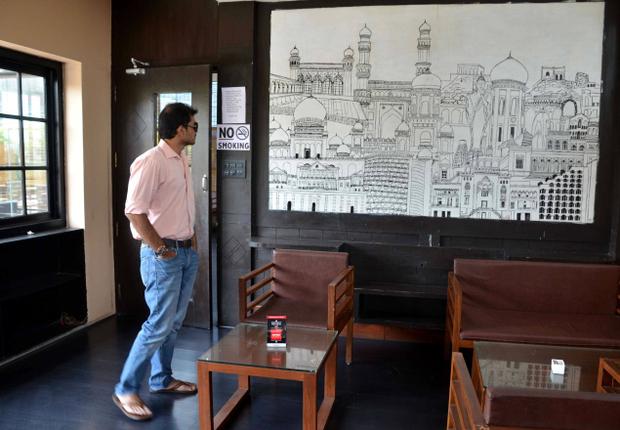
PAINT WARS: City murals are fast becoming popular. The work at Plaza Fiesta. Photos: Nagara Gopal
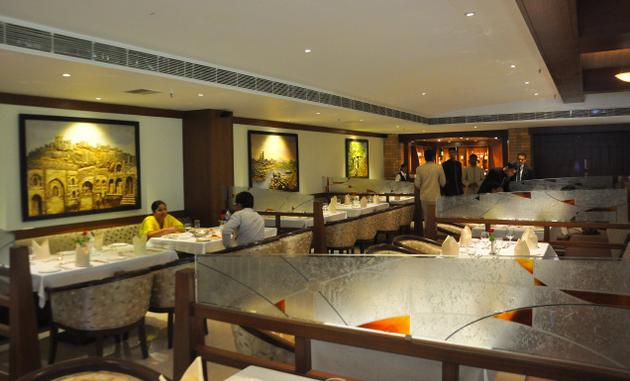
Take for instance the Plaza Fiesta restaurant at Paryatak Bhavan. The restaurant boasts of quite a few works synonymous with the Deccan region. In fact, some of the 3D relief works have been created by popular Hyderabadi artist Aziz. “We wanted to create a unique ambience that would be distinctly different from what other restaurants offer. Also, we wanted to showcase some of our popular landmarks to visitors; so what better way to do so than art,” says Surya Prakash, officer on duty at Plaza Fiesta.
The works in this restaurant include images of the Golconda, the city’s unique rockscape and a banyan tree. “We have works by six artists on display — Aziz, Chinna Shripathi, Supretha Ghosh, Palash Paul, Agacharya and Madhu Kuruva,” adds Surya Prakash. While some of the works are displayed within the restaurant, others are mounted near the entrance to welcome guests.
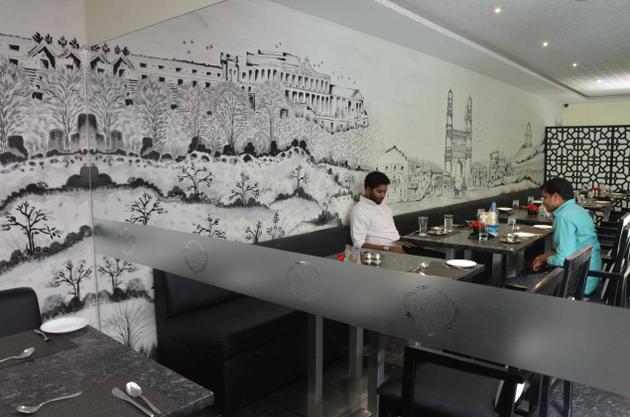
PAINT WARS: City murals are fast becoming popular. The work at TenHill. Photos: Nagara Gopal
Hyderabadi fine dining restaurant TenHill also proudly displays city landmarks as part of its décor. It has gone beyond mounting paintings in the restaurant, to have an entire wall that displays the mural. “We had city-based artist Rekha create the mural for us; it is quite impressive. My aim was to portray the culture of the city, and I asked her to create something that showcases not just landmarks synonymous with Hyderabad but also the bustling life around these areas. So we have a Charminar, Golconda, Qutb Shahi Tombs etc forming the mural along with images of skilled chefs whipping up the famous Hyderabadi Biryani, haleem and sheermal,” explains Amar Chowdhary, proprietor of TenHill. The black and white mural, which took a week to complete, is the perfect foil for the restaurant’s otherwise bright décor.
PAINT WARS: City murals are fast becoming popular. The work at Hyderabad Times Café Photos: Nagara Gopal
The newly-opened Hyderabad Times Café (HTC) in Jubilee Hills has a wall mural in black acrylic against a white background in one of its dining areas. “Keeping with the name of our café, we wanted to do something with the décor that would have a city connect. Hence, we had artist Aamira Hussaini create a sketch of all the popular landmarks in the city including Taj Krishna and the Hussain Sagar to cover one wall in our café,” says Rizwan M., manager operations at HTC.
Aamira, who has created murals for several office spaces and hospitals in the past, says that this was her first stint with a commercial establishment. “Zeeshan, the owner, is a friend and he wanted something done on one particular wall. He gave me a free hand and I thought why not do a city-specific mural. So what I created is an abstract that highlights various monuments and sights in the city. It took me around two days to complete it,” she says.
source: http://www.thehindu.com / The Hindu / Home> Features> Friday Review> Art / by Ranjani Rajendra / Hyderabad – July 02nd, 2014
Art gallery puts up a collection of visuals on the journey of the medium of radio. As the title revealed, it took the viewer on a journey, of how radio evolved with some local attention on how ‘All India Radio’ (AIR) or ‘Akashvani’ came about, since the 1930s.
At first glance, it looked as if it was a typical film function. But the resemblance ended there. Visitors could then see the distinction at ‘Journey of Radio’ a collection of visuals put together by Muse Art Gallery.
It took a while for guests to go up and down the long corridor at the Marriott Hotel here, looking at paintings and other visuals that seemed to tell a story on their own.
As the title revealed, it took the viewer on a journey, of how radio evolved with some local attention on how ‘All India Radio’ (AIR) or ‘Akashvani’ came about, since the 1930s. The collection of 50 visuals was initiated by the curator of the gallery, Kaali Sudheer.
Veteran announcers Jyothsna and Ilyas, whose tryst with AIR is over 3 decades old, spoke of how serious their programmes were in those days when there was no television. “While officially, our duty hours were 7 hours only, we would normally spend 10 hours and sometimes, during important occasions, it would go up to 15 hours too,” said Ilyas.
source: http://www.thehindu.com / The Hindu / Home> News> Cities> Hyderabad / by Special Correspondent / Hyderabad – July 01st, 2014
Nearly 3,000 IIT alumni from across the globe are expected for the event, which will be held in December
All roads will lead to Hyderabad in December when the cream of India’s intellectual exports will converge in the city for the 12th edition of the IIT Global Conference, an annual meet of alumni from the prestigious engineering institution.
Nearly 3,000 IIT alumni from across the globe are expected for the event, which is being organised with the agenda to contribute to the country’s development.
It will be held from December 19 to 21, and is being hosted by the PanIIT Hyderabad Alumni Association and IIT Hyderabad.
A curtain raiser of the event was held on Sunday at the Indian School of Business (ISB), in which some prominent IIT alumni participated.
Chief executive officer (CEO) of tablet-maker Datawind, Suneet Singh Tuli gave a detailed presentation on the low-cost Aakash, as part of his keynote address.
Unlike companies like Apple and Samsung that target the well-heeled 5 per cent, Mr. Tuli said he was interested in going after the remaining 95 per cent, which constituted a vast untapped market of people ignorant about internet and tablets.
Tech-induced change
He spoke of how technology could result in a decrease in illiteracy, and of its advantages in improving education and commerce.
ISB Dean Ajit Rangnekar called upon the IIT alumni to try and contribute more to the country’s development.
www.thehindu.com / The Hindu / Home> News> Cities> Hyderabad / by Staff Reporter / Hyderabad – June 30th, 2014
What gives late 19th century photographer Raja Deen Dayal’s work the acclaim it has received? An exhibition showcasing arguably India’s first professional photographer’s works tries to dissect
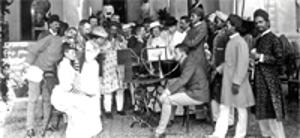
LISTENING TO THE PHONOGRAPH: DEEN DAYAL, GHALIB JUNG AND FRIENDS AT HYDERABAD 22ND MAY 1891The palpable excitement of Nawab Ghalib Jung and his friends whilelistening to the first phonograph in Hyderabad is visible. Such naturalexuberance is seldom seen in 19th century photography
Lala Deen Dayal was to Indian photography what his peer Raja Ravi Varma was to painting. As a 20-something civil engineer, Deen Dayal was working at the draughtsman office at the Indore Public Works Department when he heard an ominous rumour — all draughtsmen were to be replaced by photographers. It was 1866. Dayal decided to brush up his photography skills; a subject that he had learnt during his final year in college. A decision that paved the way for Deen Dayal to eke out a successful career in professional photography.
Vikram Sampath, Executive Director of the Indira Gandhi National Centre for Arts (IGNCA), says: “The heavy Bellow cameras of the 19th century would have been cumbersome. But his photographs are so extensive that they can be the starting point for fleshing out the socio-cultural aspect of that period.” IGNCA is presenting the exhibition Raja Deen Dayal Photographs, a collection of 150 rare period photographs which will be shown in the city for the first time.
Sampath says he can imagine how hard it must have been for Deen Dayal to get people to be photographed, considering the superstitions around the act. “People believed that if photographed, their life span would be reduced.” It was not uncommon for him to break the glass-plate negative in front of the subject after giving them their photographs, probably to assure them that it wouldn’t be used again. But he would have stealthily kept another copy in the archive.
Grand old man
Here was an Indian photographer appreciated by Indian maharajas (the sixth Nizam of Hyderabad, in fact, wrote a verse in praise of him) and British Viceroys. His photographs were exhibited to great reviews in international exhibitions. He was appointed the court photographer for Hyderabad (1885); Mir Mahboob Ali Khan, the Nizam of Hyderabad, conferred on him the title Musawwir Jung Bahadur (the Bold Warrior Photographer) and referred to him as Raja Deen Dayal. In 1897, Queen Victoria granted him the Royal Warrant, which meant he could cover the Delhi Dubar (1903). He had flourishing studios in Secunderabad, Indore and Bombay that were operated by his firm Deen Dayal & Sons. And even after his death (1905), his fifth generation has photo studios in the twin cities of Hyderabad and Secunderabad. Not bad for a man who was born (1844) in a small town near Meerut.
Luck and talent
In 1870, when Deen Dayal was hired by the Archeological Survey of India, his brief was to capture 78 monuments of Central India. The technique used was refreshingly different. The monuments stood out against the sky as he captured them from a low angle, making them imposing and grand. Some, like the Gwalior Fort, had an extraordinary view of the sharp precipice below the steep path leading up to the main entrance. The portraits of the monuments form an extensive collection of places across India.
Deen Dayal quit his government job to pursue photography when he realised that the albums prepared by him on Indian monuments were a hit with the British officers returning to Britain. Sir Henry Daly appointed him the official photographer for the Prince of Wales’s tour of India in 1875. He started accompanying the Viceroys, Lord Dufferin and Lord Elgin, on their tours. His interactions with Indian royalty gave him unmatched access to their world. By being the court photographer of the Nizam, Deen Dayal secured a generous patron and an easy access to British officers in the cantonment. He was probably the first Indian photographer to have a Zanana (ladies only) studio at Hyderabad which was run by a specially-appointed employee, Kenny Levick.
From glass plates to digital
Deen Dayal’s family had preserved the glass-plate negatives with history recorded on them. Those negatives required long exposures and hours of work. Each comes with documentation of the place and year, apart from the name of the royals or nobles. The commoners were categorised broadly with captions such as ‘Maratha’ and ‘Brahmin’. IGNCA has reproduced the originals after the entire collection of about 3,000 negatives were handed to them by the family in 1989. These were then digitised and the first exhibition took place in New Delhi in 2010. For all aficionados of photography, this show remains the best place to know how it all began for one photographer, arguably the first Indian professional photographer.
Raja Deen Dayal Photographs, 10 am to 5 pm till July 20, NGMA
source: http://www.bangaloremirror.com / Bangalore Mirror / Home> Entertainment> Lounge / by Jayanthi Madhukar, Bangalore Mirror Bureau / June 23rd, 2014