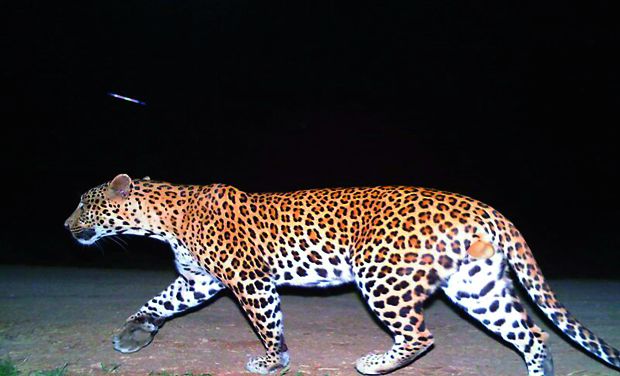
Nehru Zoological Park veterinary officials and tiger specialist Nawab Shafath Ali Khan were called in to tranquilise the panther on prowl at Icrisat (International Crops Research Institute for the Semi-Arid Tropics) in Patancheru.
Though the panther was caught on the camera-trap set up by wildlife officials, it has managed to avoid capture.
Additional principal chief conservator of forests (wildlife) Mallikarjuna Rao said, “We have stepped up our efforts to catch it. We are also taking the help of Shafath Ali Khan to track the animal.”
Mr Khan has been involved in tranqualising man-eaters in various parts of the country. Mr Rao added, “The animal rescue van from Nehru Zoological park has been kept at Icrisat. A veterinary team, led by Dr Srinivas, which has expertise in tranquilisation has also been deployed.”
source: http://www.deccanchronicle.com / Deccan Chronicle / Home> Nation> Current Affairs / DC Correspondent / June 11th, 2014
A special cover on late Qadir Ali Baig and a brilliant monologue by Rashmi Seth marked the 10th anniversary of the Foundation
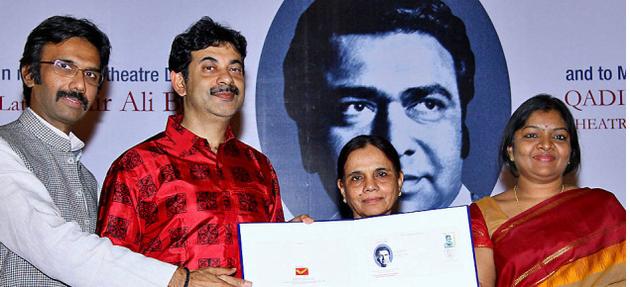
It was indeed an honour for theatre fraternity when a special postal cover was released on June 3, at Salarjung Museum, in memory of Qader Ali Baig on the occasion of his 30th death anniversary.
launch of postal cover
The occasion of the launch of the Special Cover was also to mark ten years of the Qadir Ali Baig Theatre Foundation.
Director of Postal Services, Radhika Chakravarthy said, “India Post honours famous personalities whose contribution is exemplary and it is a befitting tribute to late Mirza Qadir Ali Baig sahab.”
Acknowledging the unique honour, Mohammad Ali Baig said, “This tribute would provide further inspiration and motivation to us as well as rest of the country’s theatre fraternity.”
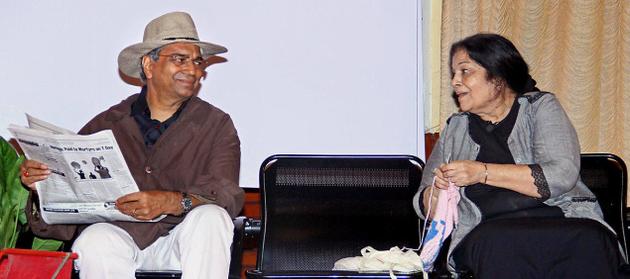
Special occasionA scene from the play ‘Dhoop Ka Tukda’
Play by Rashmi Seth
The event was followed by a moving performance by veteran actress Rashmi Seth in the play Dhoop ka Tukda , which had the packed audience follow her in total silence. Seth acted in late Qadir Ali Baig’s several socially-meaningful plays in the 1970s and 80s like Aadhey Adhurey , Burf ki Minaar and has also featured in Mohammad Ali Baig’s epic spectacles Resham ki Dor , Taramati , Quli: Dilon ka Shahzaada and Savaan-e-Hayat . Her performance was an apt tribute to the doyen.
Dhoop ka Tukda , written by Nirmal Verma, is about a woman, separated from her husband, dwelling on her pathos, memories, the trials and tribulations in her life and her search for hope. Rashmi Seth excelled in the 40-minute monologue, maintaining the walk and body language of an aged, arthritis-afflicted woman who has gone through a lot in life, her tremulous voice modulation bringing out her misery evocatively. Subhash Gupta as the silent man in the park spoke with his expressions, though immersed all the time reading a newspaper. The play was produced by Qadir Ali Baig Theatre Foundation and directed by Rashmi Seth.
source: http://www.thehindu.com / The Hindu / Home> Features> MetroPlus / June 06th, 2014
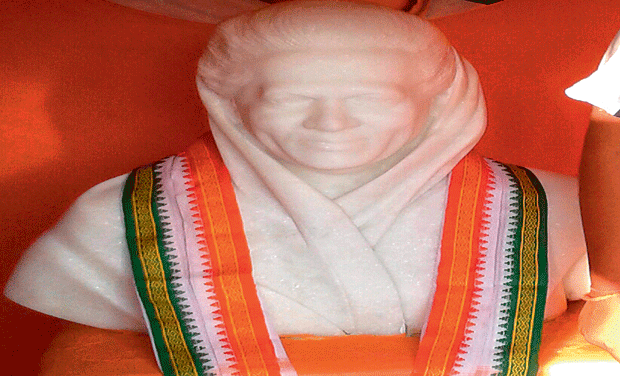
Former Karimnagar MP Ponnam Prabhakar and Jagtial MLA-elect T. Jeevan Reddy inaugurated a temple for Congress president Sonia Gandhi constructed in Mallial mandal headquarters on Monday. The temple was built by Daram Adi Reddy, a former Mandal Parishad president, and the Congress leaders of Mallial at the mandal crossroads.
A sum of Rs 2.50 lakh was spent in construction of the temple. The statue was brought from Jaipur in Rajasthan.
Mr Prabhakar said the temple was built because Mrs Gandhi is considered a goddess for the people of the region for her efforts in creating a separate state braving all odds. He appreciated Mr Adi Reddy and others for building the temple.
Mr Adi Reddy said Mrs Gandhi is a living goddess for the people of Telangana. He claimed that the temple was built as a token of gratitude to Mrs Gandhi for her determination and her commitment towards the Telagnana issue.
source: http://www.deccanchronicle.com / Deccan Chronicle / Home> Nation> Current Affairs / by DC Correspondent / June 04th, 2014
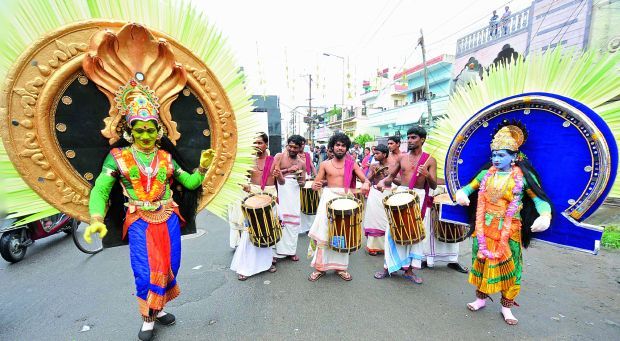
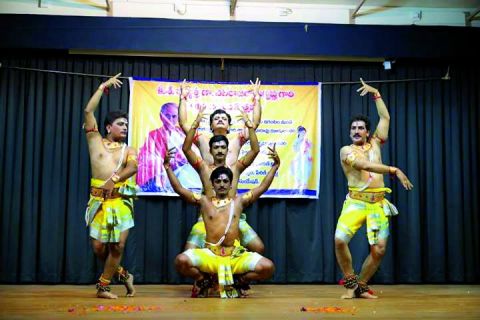
it’s a celebration: Festivals such as Bonalu and Bathukamma are a big part of the Telangana identity. Puli Vesham, Dappu Nrityam and Veera Natyam are appreciated for their “aesthetic significance”
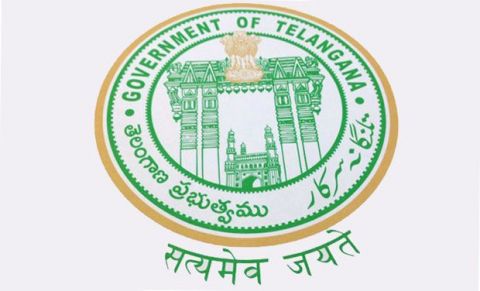
The logo of Telangana by Laxman Aelay has become a “must like” for the artists from the region. And this is perhaps the dawn of the new identity for Telangana. Now, with the formation of the new state, it is only natural that a lot of effort will be put into restoring and re-asserting lost identities.
The Telangana Logo Designed by Laxman Aelay
A NEW START
Senior artist Fawad Tamkanat and a group of artists are raring to revamp the museums and public spaces. “There are a lot of paintings of Abdur Rahman Chughtai, which are now worth so much, as the artist has become coveted by global auction houses, and we don’t even display these paintings properly,” he says, citing an example. These artists also hope to bring in more art into the public sphere starting from government offices.
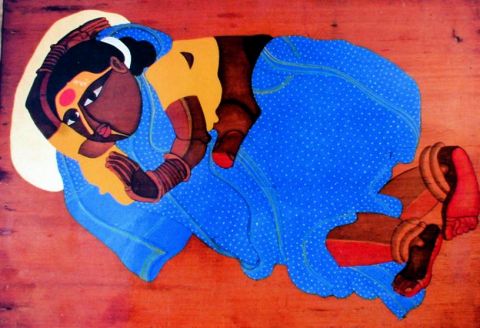
A work by senior ‘Telangana’ artist Vaikuntam, who rose to prominence as early as the 1980s
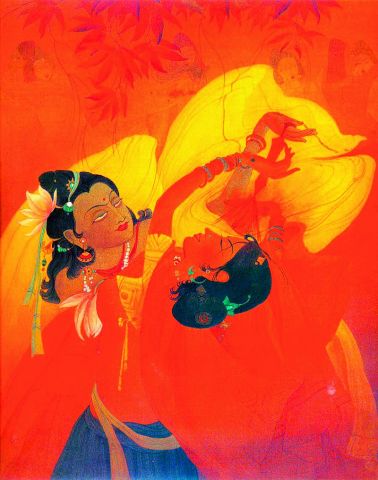
A work of Abdur Rahman Chughtai
And their need will find backing even in the government as K. Kavitha, the founder of Telangana Jagruthi, an initiative to uphold the culture of the region, vows to fight for the cause of culture. “After all, the whole movement has been about the reassertion of the cultural identity of the people of this region. I hope the government will realise this, and I will do whatever it takes to ensure that the culture of Telangana is not only restored, but also researched,” she asserts.
FOLK, A WAY OF LIFE
Theatre or performance art has always been a part of Telangana life. But the staging was what was peculiar to the culture. An academic, Linga Srinivas, now pursuing his PhD in folk arts in Telugu University explains, “Every caste had a sub-caste that would be involved in these shows. The performances, included song and dance and are often performed for a community or the village after the day’s work is done. And some were reserved for special occassions”
THE CRADLE The Kakatiya Dynasty and its activities between the 11th and 14th century formed the roots to the Telangana art, culture and architecture. Pandu Ranga Rao of Kakatiya Heritage Trust explains, a “bible for art and culture” came from a head of the elephant army, Janasenapathi, whose book Nrtta Rathnavali, which has been now translated into English. “Even Bathukamma, Sammakka festivals find root here,” he says, adding “People like Janasenapathi also rebelled against the Kakatiyas. The martyrs thus became god-like to the tribes.” While Ramappa temple murals speak volumes, a dance form that came down from the warriors — called Perini Sivatandavam — is still being carried forth by Narataja Ramakrishna and his disciples.
National Award-winning filmmaker and a noted Telangana cultural figure, B. Narsing Rao explains, how theatre also changed over time to involve the movement. “As a child, I watched people from the shepherd community stage witty theatre. It involved characters bringing up issues, discussing them, while an artiste resolved them. The forms were called Gollu Sudhi, Oggu Kathalu and Gotralu.”
In 1970s, Gollu Sudhi and Oggu Katha mingled and new forms emerged. The ‘Dhoom Dham’ shows were about the struggle and exploitation. “It was around that time that Gaddar came into the picture and a large number of people joined in the movement. People adopted the old sensibilities of theatre and art, but only the content changed,” he says.
Now, it’s all about the future for Rao, “otherwise the struggle won’t make sense”. “A new crop of artists need to be trained for films as well,” he says.
IMMERSIVE ART AND A RICH INFUSION
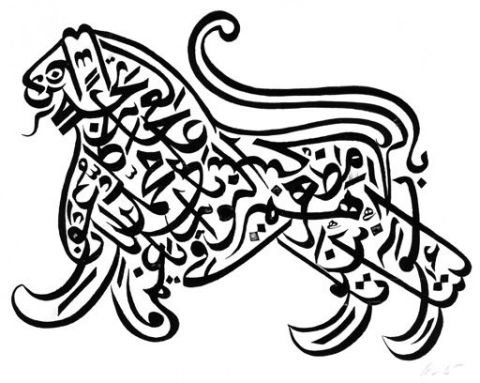
Telangana has Urdu and Arabic calligraphy
Curator and artist Avani Rao goes on to elucidate how the art was born out of everyday life. “If you notice, most of the big artists that we are proud of today are from Telangana. Art is a huge part of their daily life. The attitude towards art is very immersive.”
“The content was very simplistic. Women are such a big part of the ‘Telangana’ society, they carry forth the responsibilities and even make decisions. So we see a lot of artists painting women,” she adds.
Meanwhile, talking about the Qutub Shahi and Nizami influences, an octogenarian who has taught three decades at JNTU, Professor Shareef starts, “The city was set up by Quli Qutub Shahi, a great lover and patron of not only art, but also music.” The region has been fortunate to have patrons of art. In fact, even Aurangzeb was an artist who weaved topis and also made copies of the Quran in calligraphy. He also nurtured the spirit of learning as he invited Persian artists to train the artists here. The region, therefore, has a lot of good miniatures. “The Dakhani miniatures are rich figuratives and sometimes even incorporate literature (poetry). But they can’t be called illustrations, they are inspired by the words,” explains Fawad.
source: http://www.deccanchronicle.com / Deccan Chronicle / Home> Lifestlye> Offbeat / by Samyuktha K / June 02nd, 2014